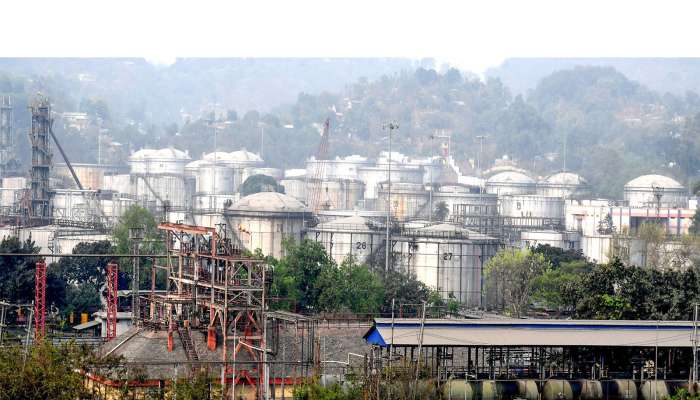
India may still be importing more than 80 per cent of crude requirements but diversification of energy and import sources and a large domestic refining capacity reduce the impact of oil shocks
| Photo Credit:
The phrase ‘India has done better than expected’ became common in the 2020s, the era of poly-shocks. Recent reports again often have these words. But continually having to revise forecasts indicates understanding of the economy needs to be improved.After a series of crisis-time articles, it is time to do a post crisis assessment, as external shocks wane (temporarily?).Three reasons resilience exceeded expectations are: changes that lower the impact of traditional shocks; diversity that is protective in a volatile global environment; and better policy capability and design. Let us illustrate the arguments with respect to the Middle-East tensions and to the possibility of below normal rainfall.Crude oil shocksPast trauma colours the present — the impact of the seventies and subsequent oil shocks tends to be projected onto current shocks. But the economy has changed in many ways. It may still be importing more than 80 per cent of crude requirements but diversification of energy and import sources and a large domestic refining capacity reduce the impact of oil shocks.The confidence to protect the economy from short-term shocks with counter-cyclical policy reduces growth volatility and its adverse impact on investment plans. But calls to fully pass on oil price shocks grew louder as time passed, although short-term support was already designed to be limited, targeted and transient. It was in the process of being drawn down, while long-term measures to moderate shock vulnerability gathered pace.In an escape from normal political resistance or inertia there were major decisions in the past four months that will escalate green substitution. These include ethanol blending, clean gasification of coal reserves, enabling regulation for city gas pipelines and for greening of commercial vehicles. The share of renewable sources in electricity generation increased sharply. Simmering global tensions should sustain the push — once bitten twice shy. Inefficiencies in fertilizer pricing are yet to be tackled.Moreover, global oil market changes, with many more sources of supply, reduce the hold-up power of any nation or event. The world also has many substitution possibilities. The Hormuz closure created shortages in many commodities and disrupted export markets, but alternatives mitigated the impact and, as tensions relaxed, reversal was faster than expected.Space built through macroeconomic stabilisation and buffers enables counter-cyclical policy. Compared to the 2010s, a better beginning point helped allow policy to moderate shocks rather than tighten in anticipation as is the norm in emerging markets (EMs), even though this aggravates growth volatility and reduces benefits from higher potential EM growth.Market over-reactionBut for FPIs multiple sustained negative India shocks after the US election dominated advantages of macro-stability. FPI outflows continued in line with the tendency to assume the worst for EMs and a lack of granular knowledge. Market nervousness always escalates during outflows although in every past post-liberalisation shock inflows had resumed after the shock passed. The usual commentaries started about underlying structural problems. Forex markets over-reacted. Positions on expected depreciation drove the rupee much below its equilibrium range. The real exchange rate reached a 13-year low in April.Despite much larger forex reserves and stable macros there was a concerted push to get special concessions for inflows such as were given during the taper tantrum when macros were fragile.But the expected turnaround happened soon after and the BOP is heading for a large surplus.Repeated market pressures, however, give valuable lessons for policy. First, when markets are nervous, it is important for the RBI to be there to prevent self-fulfilling panic expectations setting in. A stitch in time saves nine. Second, volatility has fallen in equity markets since they are less dependent on FPI. Diversity has to be increased in types of CAD financing so it also is not dependent on volatile flows. The trade deficit itself has to reduce.Smart regulation and intervention is necessary to protect markets from themselves. We are seeing the consequences of that over-reaction in South Korea as leveraged AI bets unravel bringing down their stock price index, KOSPI. Indian diversity is deeply protective. The excess risk premium markets charge EMs should reduce for India as this is realised.India’s moves to reduce transaction costs to attract better quality debt flows are smart. While it has the right to advance or retreat along the path towards capital account convertibility in order to manage externally imposed volatility, reversing market deepening or imposing retrospective penalties are best avoided. But to preserve policy degrees of freedom and stabilising diversity, foreign equity or debt must be kept below a 10 per cent share of the domestic market. Below that they usefully add to diversity, above they create excess volatility.Monsoon factorA poor monsoon is another frequent past shock that affects perceptions of Indian prospects even today. The El Nino predictions have been raising market inflation forecasts. But these reactions are again largely based on past experience and the same three factors apply.First, agriculture has changed in many ways that reduce rainfall dependence. Top down irrigation has often wasted water in India but now there are bottom up efforts at water conservation and optimum use.Our research shows that market depth reduces the pass through from rainfall shocks to tomato, onion and potato prices that have dominated recent inflation spikes. Dense mandi networks and State reform scores have significant effects, underlying the importance of State policy. Research also shows that firms’ pass through of commodity price shocks has reduced in the inflation targeting period. But inflation forecasting models largely do not include these changes.Rains have revived in July, which is the main planting season, so the overall deficit may not be large. In addition, the beginning point is again a helpful counter to poor rains — excess foodgrain stocks and higher reservoir levels after two years of plentiful rain.Again, the policy response across States matters. Farmers must be guided against planting water-intensive crops and towards hardy native crops. Greater crop diversity reduces rainfall dependence. Ranking States by policies to increase climate resilience will help make them more responsive. Rating agencies are doing this. CareEdge has such a ranking.Analysts should also worry about their own credibility. It will gain if they resist the temptation to rediscover ‘internal structural flaws’ and push for more liberalisation whenever there is an external shock. Instead, measures to increase diversity, reduce vulnerabilities and protect growth could be highlighted. In a shock prone world, diversity is essential for de-risking and resilience.The writer is Professor Emeritus, IGIDRThe confidence to protect the economy from short-term shocks with counter-cyclical policy reduces growth volatility and its adverse impact on investment plansPublished on July 7, 2026