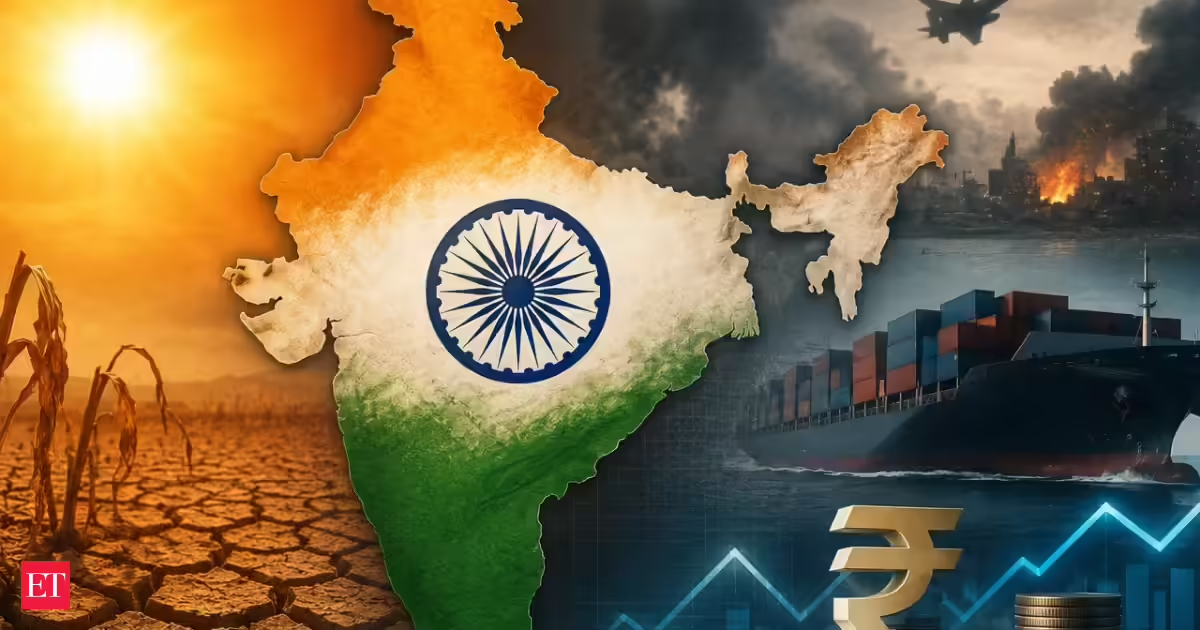
A widening conflict in West Asia, volatile oil prices, the threat of El Nino and an increasingly fragmented global economy are casting a long shadow over the world’s growth outlook.Yet, amid the turbulence, India believes it can still outrun the storm.In its annual report released on Friday, the Reserve Bank of India painted a picture of a world entering a more dangerous economic phase in 2026-27 — one where geopolitics, not interest rates, has become the defining force shaping inflation, trade and capital flows.“Geopolitical risk has re-emerged as the dominant drag on global growth in 2026,” the RBI said, warning that a prolonged or widening West Asia conflict could further darken the outlook for the global economy.The central bank said the adverse impact of the conflict that broke out in late-February is already visible in forecasts for growth, inflation and trade. The International Monetary Fund now expects the global economy to grow by 3.1% in 2026, lower than the 3.3% forecast in January, while global trade volumes are expected to slow sharply.The worry is not just war itself, but what travels with it: expensive oil, disrupted shipping lanes, financial market volatility and a renewed risk-off mood among investors.“Surging energy prices and disruptions in key shipping routes could intensify supply-side pressures,” the RBI said.India’s balancing actAgainst that backdrop, India is preparing for what may become one of its most delicate balancing acts in recent years — protecting growth while containing inflationary shocks imported from abroad.The RBI projected India’s economy to grow 6.9% in 2026-27, though it cautioned that risks remain “tilted to the downside”.The optimism rests on pillars New Delhi has spent years building: healthier bank and corporate balance sheets, government-led infrastructure spending, manufacturing incentives and a renewed push to reduce dependence on imports in strategic sectors.This is no longer merely an economic strategy. It is increasingly becoming a geopolitical one.The Union Budget’s focus on semiconductors, electronics, biopharma, rare earths and green technology manufacturing reflects a broader attempt to insulate India from a world where supply chains are becoming weapons and economic alliances are rapidly shifting.Measures such as the production-linked incentive schemes, India Semiconductor Mission 2.0 and investments in freight corridors and logistics networks are expected to deepen manufacturing capacity while reducing critical import dependence.At the same time, India is trying to position itself as a destination for global capital fleeing geopolitical uncertainty elsewhere.The RBI said tax incentives for foreign companies building data centres, liberalised foreign investment rules in the space sector and the government’s AI ambitions could help attract fresh investment flows despite a fragile global environment.The monsoon gambleBut for all the talk of semiconductors and artificial intelligence, India’s fortunes in the coming year may still hinge on the skies.The RBI warned that the outlook for agriculture remains dependent on the progress of the southwest monsoon, with the possibility of El Nino conditions posing a downside risk to farm output.An erratic monsoon threatens more than crops. It can ripple through food prices, rural demand and overall inflation at a time when global commodity prices are already under pressure from geopolitical tensions.Still, policymakers appear more confident than in previous decades that India can withstand weather shocks better than before.The RBI noted that rising irrigation coverage, improved crop management and technological advances have reduced agriculture’s vulnerability to rainfall variability over time.The government is also betting heavily on diversification into fisheries, aquaculture and high-value crops while using buffer stocks and diversified import sources to manage fertiliser supplies that could face disruption due to global conflict.Inflation, oil and the uneasy calmThe central bank expects retail inflation to average 4.6% in 2026-27, above its formal 4% target but still within the tolerance band.Yet much of that forecast rests on one uncertain assumption: that the West Asia conflict remains contained.A sharp escalation could quickly upend calculations.Higher crude oil prices would feed directly into fuel, transport and manufacturing costs. A stronger dollar and worsening global risk sentiment could pressure the rupee and trigger capital outflows from emerging markets.Bond yields could also rise if central banks globally delay interest rate cuts in response to persistent energy-driven inflation.For now, the RBI’s Monetary Policy Committee has chosen caution, keeping the repo rate unchanged at 5.25% while retaining a neutral stance.“The growth-inflation outlook remains delicately poised amid heightened geopolitical risks,” the report said.A world turning inwardThreaded through the RBI’s report is another concern: the steady fragmentation of the global economic order.The central bank warned of rising protectionism, debt sustainability concerns and financial market volatility as countries increasingly turn inward amid geopolitical uncertainty.For India, this shift creates both danger and opportunity.While slowing global trade threatens exports, the country also sees an opening to emerge as an alternative manufacturing and technology hub as companies diversify supply chains away from concentrated geographies.The report highlighted India’s expanding trade agreements and efforts to promote local currency settlements in cross-border trade as part of a broader strategy to navigate a less globalised world.Even in artificial intelligence — a sector increasingly becoming central to geopolitical competition — India is positioning itself aggressively.The RBI noted that India ranked third globally in AI competitiveness and ecosystem vibrancy, with cumulative private investment in AI touching nearly $11 billion between 2013 and 2024.The resilience testFor the RBI, the message is ultimately one of cautious confidence.India enters 2026-27 not untouched by global turmoil, but arguably better prepared for it than many large economies.The banking system remains well-capitalised, infrastructure spending continues, inflation expectations are relatively anchored and domestic demand remains resilient.But the margin for error is narrowing. A wider war in West Asia, a prolonged oil shock or severe climate disruptions could quickly test the assumptions underpinning India’s growth story.“The Indian economy exhibited resilience in 2025-26, amidst several external headwinds,” the RBI said in its concluding assessment.The year ahead may determine how resilient that confidence truly is.
India steers boat through a risky channel between war clouds and El Nino
India faces a challenging global economic outlook for 2026-27. Geopolitical tensions and volatile oil prices are key concerns. However, India is building resilience through infrastructure, manufacturing incentives, and reduced import dependence. The nation is positioning itself as an investment destination amidst global uncertainty. Domestic demand and strategic initiatives offer a path forward.
963 words~4 min read