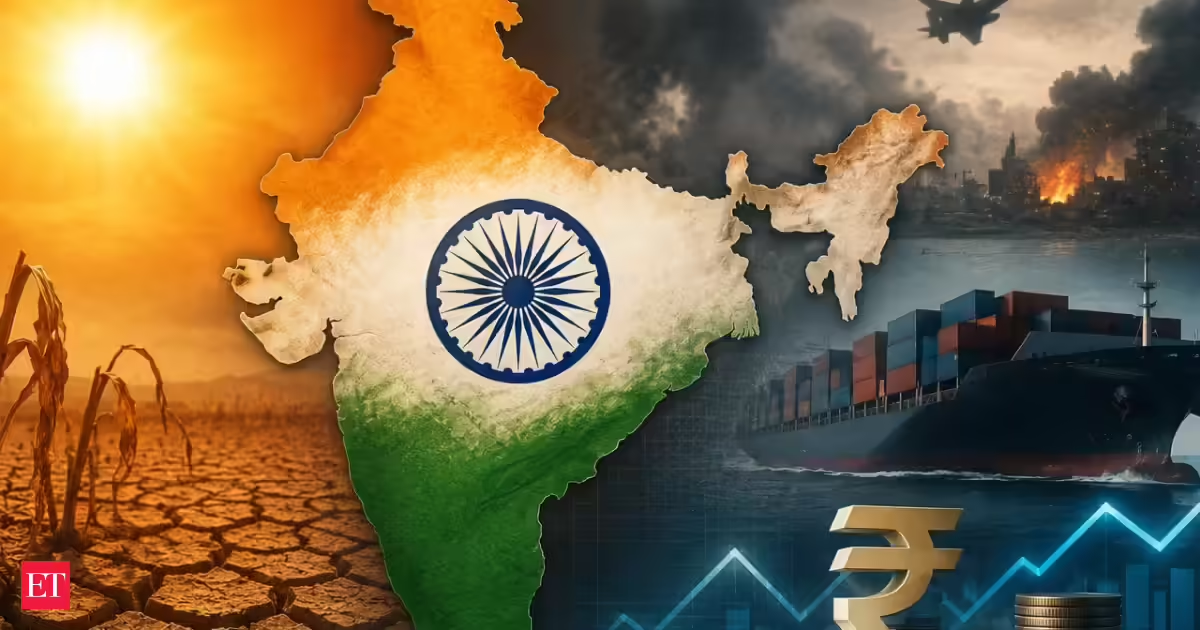
India’s growth outlook for FY27 remains positive, supported by strong macroeconomic fundamentals, though the West Asia conflict and the attendant risks could pose headwinds to growth and inflation in the short run, according to RBI’s Annual Report for FY26.The report noted that domestic economy is expected to remain resilient despite challenging external environment, with the growth prospects backed by strong macroeconomic fundamentals, including robust domestic demand, relatively lower dependence on exports as a growth driver, and a stable policy environment,The risks that the report flagged include elevated energy prices, supply chain disruptions, financial market volatility, uncertainty surrounding global trade policies and weather-related disruptions.The report noted that healthy corporate and bank balance sheets, government’s continued thrust on capital expenditure and the implementation of trade agreements with the key partners are expected to sustain investment and growth momentum.Nevertheless, in a highly uncertain global environment, continuous assessment of the evolving developments is warranted to frame the appropriate policy response on an ongoing basis.Referring to implementation of various trade agreements; rising irrigation intensity and improved crop management practices; efforts in ensuring adequate availability of fertiliser and other key inputs, and focused policy push on seven strategic and frontier sectors, among others, the report said considering these factors, and on the assumption that the adverse impact of the West Asia conflict would remain contained in the near-term, real GDP growth for 2026-27 is projected at 6.9 per cent with risks tilted to the downside.The report said inflation in FY27 is likely to remain aligned with the (4 per cent) target on the back of adequate foodgrain stocks, sufficient reservoir levels and stable agricultural prospects despite possible El Niño conditions and above-normal summer temperature.However, the evolving upside risks to inflation may emanate from multiple other factors such as spike in global fuel and commodity prices amid geopolitical tensions, potential spillovers to input and wage costs, and volatility in exchange rate. Considering all these factors, CPI inflation for FY27 is projected at 4.6 per cent with risks tilted to the upside.Upward pressure on bond yieldsThe report cautioned that domestic bond yields could face upward pressure if the global monetary easing cycle stalls or reverses in response to persistent oil price shocks amid fragile conditions in the Middle East.However, the government’s commitment to fiscal consolidation, along with the liquidity injection measures by the Reserve Bank, is expected to contain the upward pressure on yields.Equity market dynamicsThe report observed that equity market dynamics would be conditioned by evolving geopolitical developments, global financial market volatility and foreign portfolio investment flows.It warned that a deterioration in risk sentiment alongside strengthening of the US dollar could trigger capital outflows. At the same time, ongoing efforts to expand local currency settlement framework are expected to further advance INR (Indian Rupee)-based cross-border transactions.Banking system: Sufficient buffers to withstand adverse shocksThe report expects the Indian banking system to remain resilient, supported by prudent regulatory reforms, stable credit growth and adequate capital buffers.However, lingering geopolitical tensions and supply chain disruptions may pose near-term risks to corporate earnings and the performance of loan portfolios.“Elevated sovereign yields may also exert pressure on financial institutions’ investment portfolios. Nonetheless, on balance, supported by sound fundamentals and healthy balance sheets, the domestic financial system has sufficient buffers to withstand adverse shocks.Published on May 29, 2026
India’s growth outlook for FY27 remains positive: RBI Annual Report
West Asia conflict and the attendant risks could pose headwinds to growth and inflation in the short run
544 words~2 min read