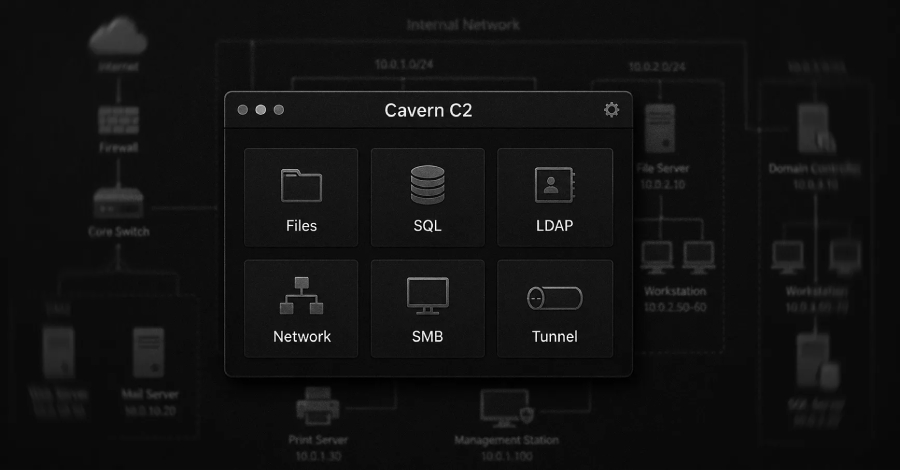
An Iranian hacking group affiliated with Iran's Ministry of Intelligence and Security (MOIS) has been wielding a previously undocumented modular command-and-control (C2) framework dubbed Cavern (aka Cav3rn) targeting Israeli organizations.
The activity, which has primarily singled out IT providers and government sectors, has been attributed to a threat cluster tracked by Check Point Research under the moniker Cavern Manticore, which it said shares some level of tactical overlaps with MuddyWater and Lyceum, the latter of which is assessed to be a subgroup within OilRig.
"The framework reflects a mature and adaptable toolset built around a shared .NET foundation, while using multiple compilation formats across different components, including .NET Framework, .NET Mixed-Mode C++/CLI, and .NET Native AOT," the cybersecurity company said.
"The compilation format itself becomes the anti-analysis layer that forces reverse engineers into multiple toolsets and metadata-reconstruction workflows."
The components of the C2 framework are used as Cavern Agent and Cavern modules, demonstrating a clear division of responsibilities between core communication capabilities and mission-specific post-exploitation functionality. This architecture has inherent advantages as it allows the operators to tailor deployments based on the victim profile, reduce forensic visibility, and ensure persistent access through bespoke modules for reconnaissance, data theft, tunneling, and lateral movement.