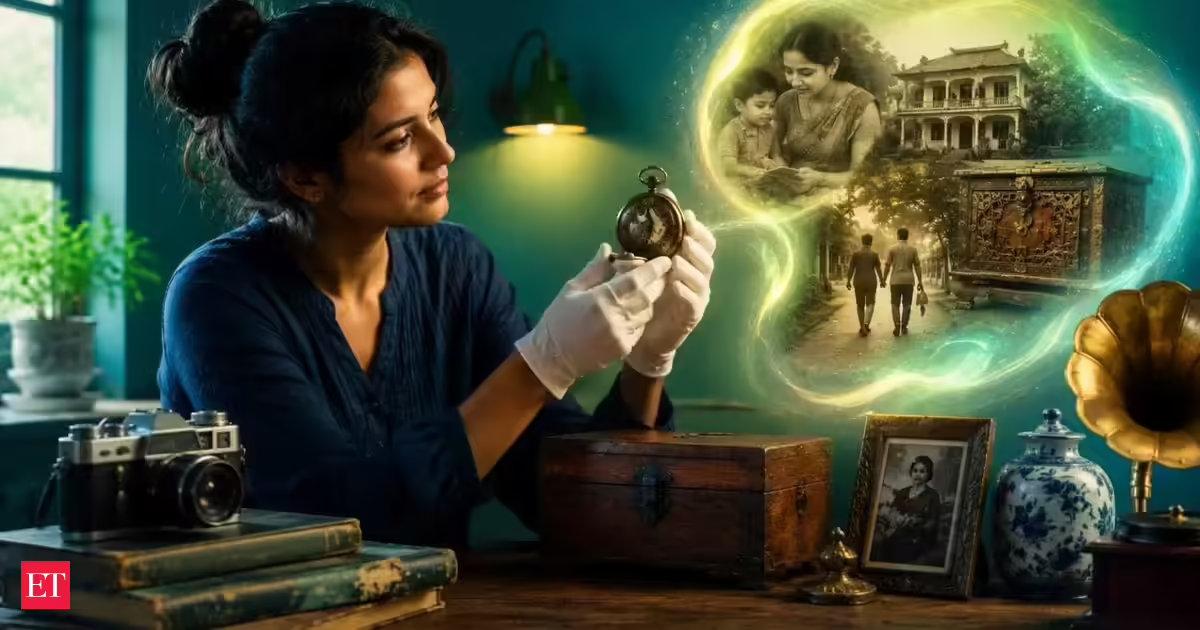
If you’ve ever refused to take off a necklace belonging to your late grandmother, or felt a small ache after losing a ring from someone you once loved, you’re not being dramatic. A 1988 study by consumer researcher Russell Belk, ‘Possessions and the Extended Self,’ published in the Journal of Consumer Research, found that the things we own, including jewelry, often become part of who we are, not just accessories we wear.In the abovementioned paper, Belk argues that the self extends beyond the body and mind. It reaches out into the things, the people, the places that we call ours. He refers to this as the "extended self." Jewelry is one of the few everyday objects that literally embody that idea, resting on the body itself, being frequently given as a gift, and rarely thrown away.Why a ring can feel like a piece of youThis same research also shows that people don’t just use their possessions; they psychologically incorporate them into their identity. Belk cites previous psychological studies in which people were asked to categorize items on a scale from “not self” to “self.” Personal belongings were generally rated very close to body parts and personal traits and well above things like furniture or scenery.Jewelry fits squarely into the ways Belk describes objects being folded into our sense of self. It is something we wear, touch, never take off, and build meaning around through everyday habit. It is also often a gift, and this paper finds that gifts from loved ones are particularly likely to be seen as an extension of both the giver and the receiver, because they come with a part of the giver's identity.Old jewelry boxes often double as memory boxes. Image Credits: ChatGPTIt's not the theory of one researcher. In a related study, ‘“My Favorite Things”: A Cross-Cultural Inquiry into Object Attachment, Possessiveness, and Social Linkage,’ in the Journal of Consumer Research in 1988 by Melanie Wallendorf and Eric Arnould, American households were asked to identify the objects they valued most. The researchers found that people valued their favourite possessions more for the personal memories they evoked than for their price or appearance. A simple item linked to a certain person or time was often more important than something more ostentatious that had no story behind it.The jewelry box as a memory boxThis lines up with something many of us sense already: a ring, bracelet or pendant rarely stays ‘just jewelry’ once it is connected with a person or moment. It becomes a surrogate for a relationship, a trip, a chapter of life.Belk’s paper also draws on an earlier book by Mihaly Csikszentmihalyi and Eugene Rochberg-Halton, published in 1981, ‘The Meaning of Things: Domestic Symbols and the Self.’ The researchers found in interviews with families in the Chicago area that as people age, the things they consider “special” are increasingly likely to be things that remind them of other people, such as gifts and photographs, rather than purely functional items. Jewelry is a good example of this. Small enough to keep for decades, portable enough to travel with, and personal enough to pass down.It could help explain the unique emotional weight that heirloom jewelry carries in American families. A grandmother’s wedding band or a father’s watch is not significant because of the gold or the stones. Belk’s research suggests it can function almost like a physical thread that connects generations, allowing people to feel continuity with family members even after they’re gone.Heirloom jewelry can act as a thread connecting generations. Image Credits: ChatGPTWhy losing jewelry can feel like losing a part of yourselfBelk's paper also examines what happens when we lose possessions unintentionally, such as through theft or accidents. Drawing on interviews with burglary victims, he found that many described the experience in strikingly emotional terms, not only as a financial loss but as a kind of personal violation, because the objects taken had become connected to their sense of identity.This is consistent with common experience. Losing a phone is annoying. Losing a grandmother's ring can feel closer to grief because it isn't just the object that's gone; it’s the tangible link to a memory or a person.The takeaway for a generation obsessed with meaningful accessoriesThat’s not to say every accessory carries a profound psychological weight, nor does Belk’s research suggest that. A lot of jewelry is bought and worn simply because it looks good, and that’s fine too. But the younger generation’s interest in custom name necklaces, birthstone rings and “mom jewelry” reflects a broader appetite for meaningful accessories. It’s a body of research that fits a pattern psychologists have described for decades: people often use small, wearable objects to hold on to the memories and relationships that matter most to them.So next time someone asks why you still wear that slightly tarnished bracelet from your best friend, you can say it's not just sentimental; it's backed by science. That piece of jewelry can be more than just a decoration. It could be a small, wearable piece of your own extended self.
Psychologists say wearing sentimental jewelry is not simply about fashion, but often helps people stay emotionally connected to loved ones and important memories, according to research on the 'Extended Self' published in the Journal of Consumer Research
Psychologists reveal how sentimental jewelry strengthens emotional connections to loved ones, drawing from research on the 'Extended Self' in the Journal of Consumer Research.
837 words~4 min read