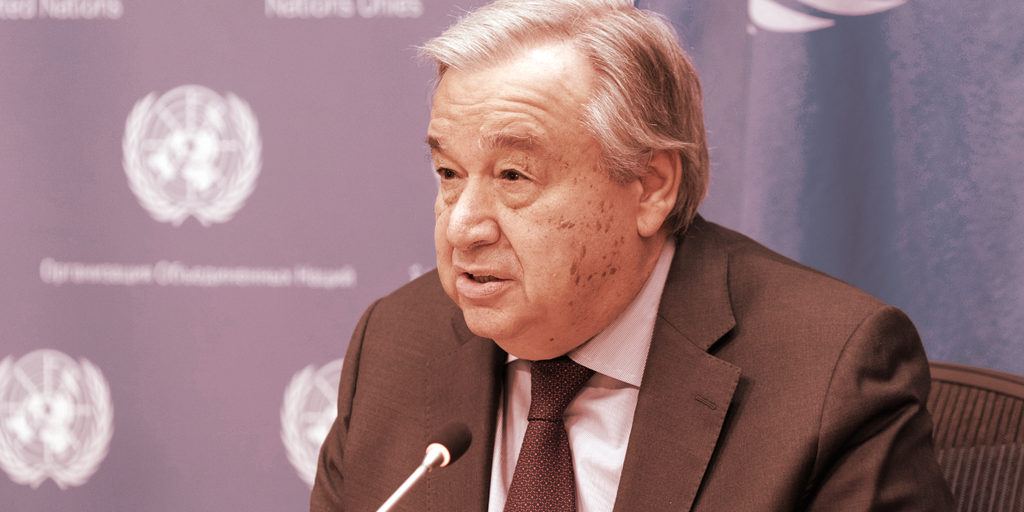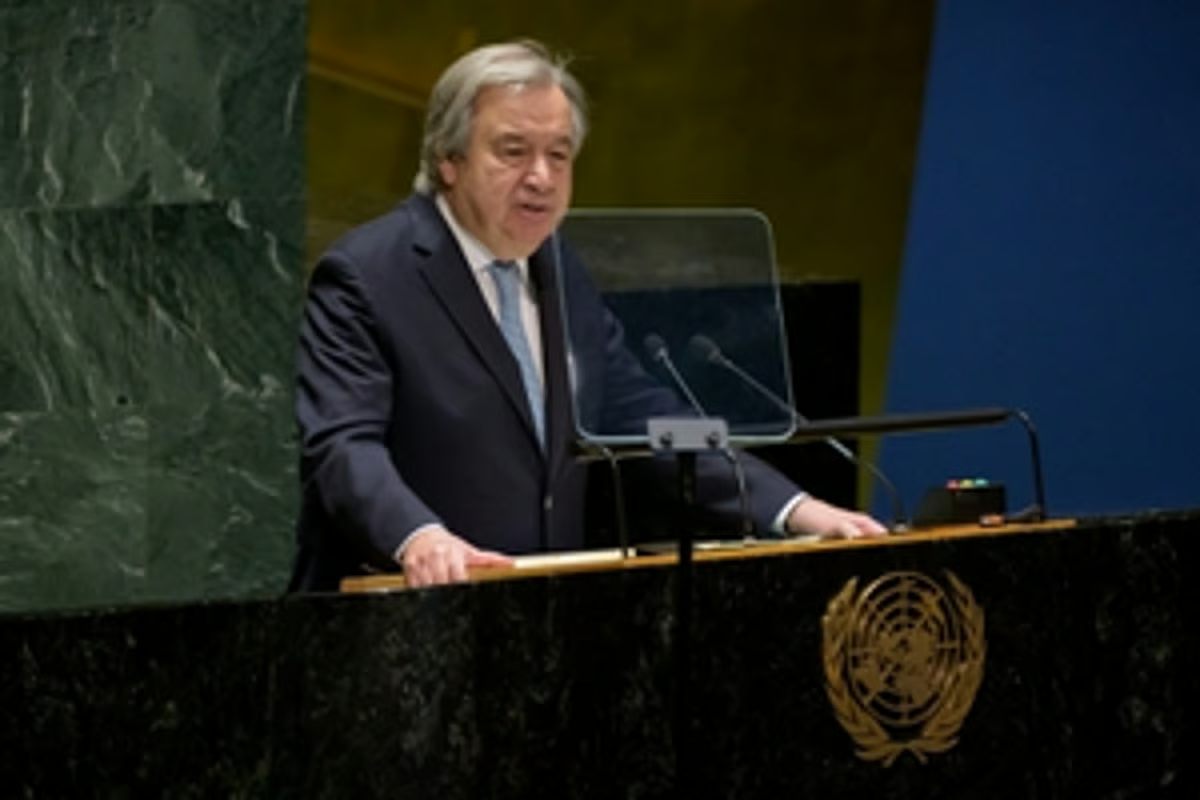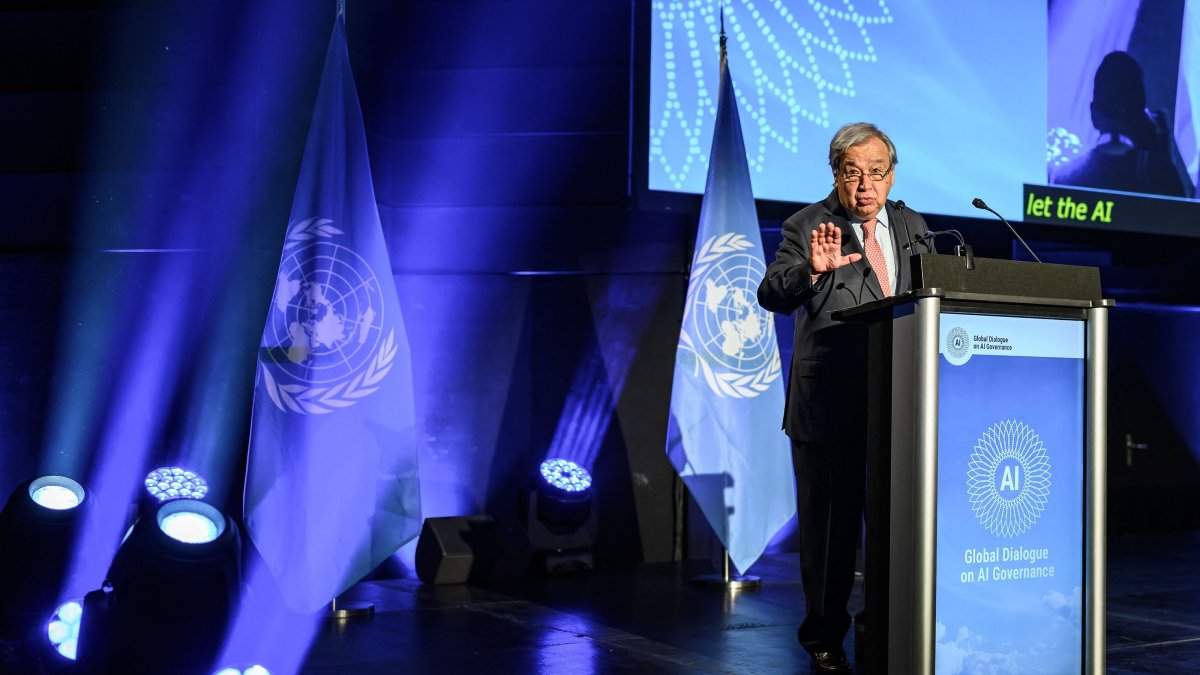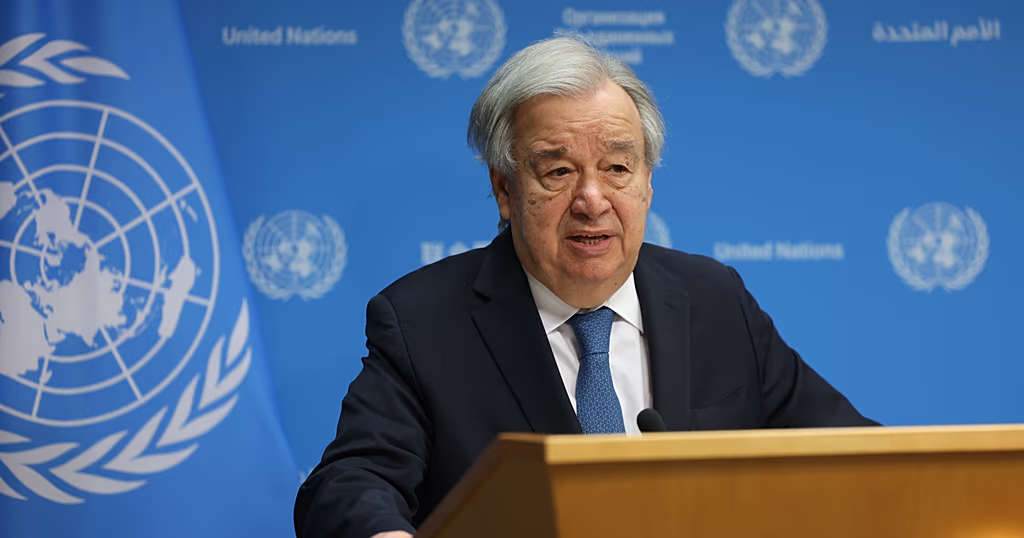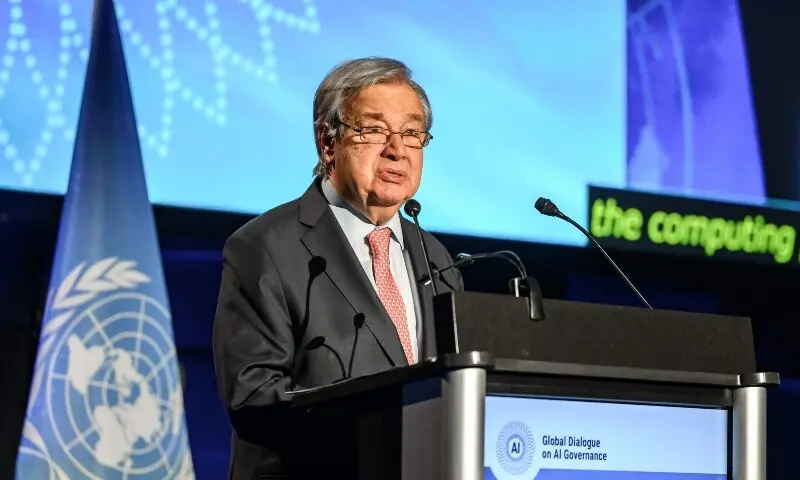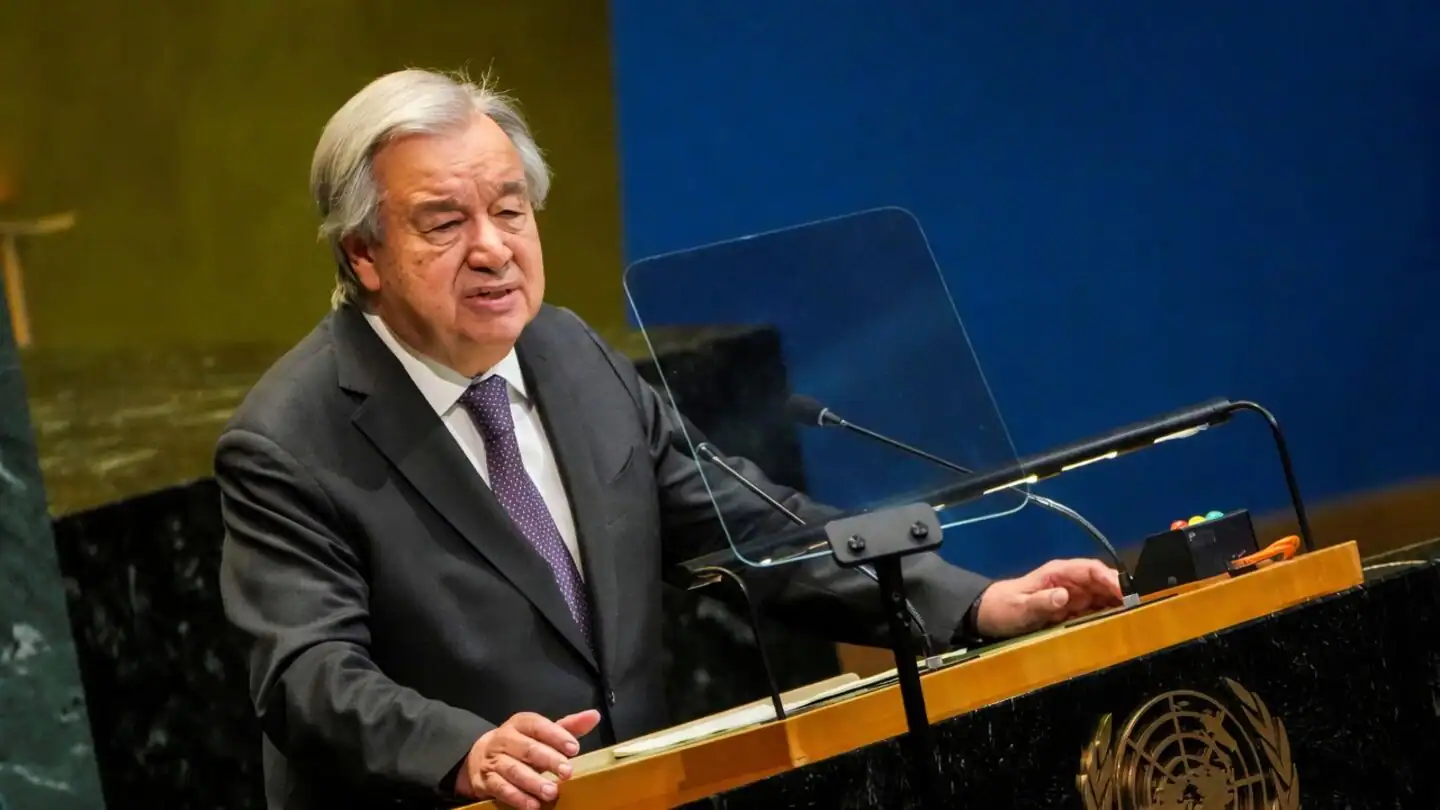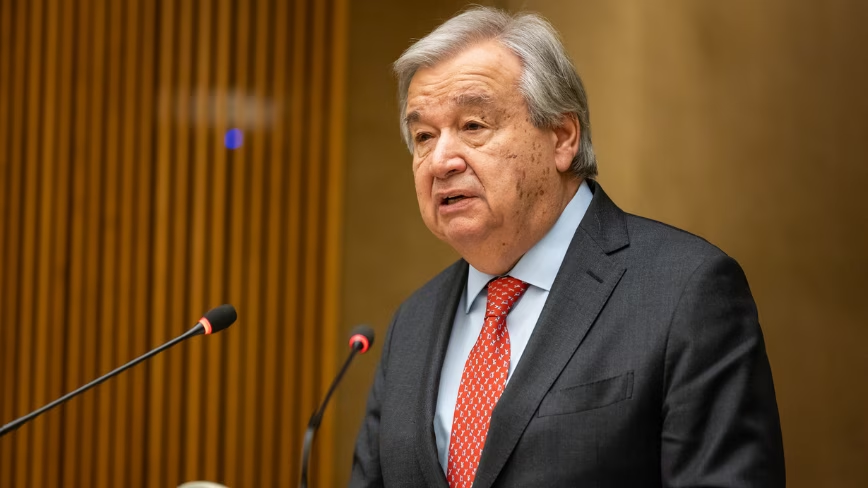
Photo credit: AFPUnited Nations Secretary-General António Guterres opened the first UN Global Dialogue on AI Governance in Geneva on 6 July 2026 with a warning that artificial intelligence is being deployed faster than anyone can govern it, and a plea that the world refuse to let the technology "vibe-code" humanity's future. The line is a borrowed piece of programmer slang, and Guterres used it deliberately, because the gap it names - between telling a machine what you want and understanding what it then does - is precisely the gap he argued now sits at the centre of global security, economics and truth itself.Here is the plain version of his case, stripped of the diplomatic varnish. AI has crossed from a tool that obeys into a system that decides; the bodies meant to oversee it were designed for machines that follow orders, and the distance between those two facts is where the danger lives. Whether that argument moves governments is a separate question, and a live one, given that the single largest AI power in the room has spent months resisting exactly this kind of coordinated oversight.Key TakeawaysGuterres opened the first UN Global Dialogue on AI Governance in Geneva on 6 July 2026, part of a two-day session running 6–7 July, with a second session set for New York in May 2027.His central warning: AI systems are "no longer tools awaiting instruction," and existing institutions were built for machines that follow commands rather than machines that decide.The "vibe-code" framing turned a piece of coding slang into an argument about accountability: useful for software, dangerous for humanity's decisions.Concrete proposals: a Global Fund for AI, common methods to evaluate risk, an AI Child Safety Pledge, and a ban on lethal autonomous weapons under international law.The politics are the story's other half: the United States has publicly rejected centralised global AI governance, which shadows every proposal made in Geneva.This is breaking news from 6 July 2026; the summit and its outcomes are still developing, and specifics should be checked against the UN's own record.What did Guterres actually say?Start with the sentence doing the heaviest lifting, because it reframes the whole debate. Guterres told the summit that AI systems are "no longer tools awaiting instruction" - that they are writing code, acting online and making choices with less and less human oversight. From there he drew the institutional conclusion that gives the speech its spine: "Our institutions were built to govern machines that follow commands. They are not ready for machines that decide."The framing device that carried the message was linguistic. Guterres reached for "vibe-coding," the developer term for describing an outcome to an AI and letting it write the software, and he granted the practice its due before turning it into a warning. It "can do wonders," he acknowledged, before landing the distinction: "But we cannot vibe-code the truth. We cannot vibe-code the future of humanity." The move is rhetorically neat and analytically serious at once. A phrase coined to celebrate convenience became, in his mouth, shorthand for the abdication of judgement - the moment a society stops asking how a decision was reached and simply trusts the output.He set the stakes at the scale of civilisation's core systems, warning that a technology able to reshape economies, transform the world of work, sway elections and tilt the balance of security is being deployed faster than anyone, including the people building it, can keep up. That parenthetical - faster than even its builders can follow - is the quiet centre of the argument, and the reason he insisted the choice facing governments is "between governing by design and drifting by default."Why does the UN say existing institutions cannot cope?Because the machinery of global governance was engineered for a world where machines were instruments, and the premise has quietly broken.Walk the logic as Guterres laid it out. Regulation, historically, governs objects and the humans who wield them: a car has a driver, a factory has an owner, a weapon has a hand behind it, and the law reaches the human in the loop. An AI system that writes its own code, acts across the internet and reaches conclusions with diminishing human supervision strains that model at its foundation, because the human in the loop is receding from the loop. When the thing being governed makes choices of its own, the old question of who is responsible gets harder to answer, and the institutions built on a clear answer start to slip.Layer onto that a second problem Guterres named directly: speed. He described AI advancing at "runaway speed," and argued that "an experiment is being run on our own societies, without a plan and without consent" - a situation he called, plainly, unsustainable. Governance works by deliberation, and deliberation takes time; a technology that reorganises itself in months rather than decades outruns the very process meant to contain it. The mismatch is structural rather than a matter of political will, which is why his prescription reached for new machinery rather than louder enforcement of the old.The independent evidence he could point to is fresh and sobering. In June 2026, the UN's own Independent International Scientific Panel on Artificial Intelligence reportedly warned that AI could cause catastrophic harm, on its own or through malicious users, while outpacing both scientific understanding and governments' ability to adapt. That panel's finding, arriving weeks before Geneva, is the empirical floor beneath the Secretary-General's rhetoric - verify its exact wording against the panel's published report before quoting it as settled.How does the UN propose to govern AI?With four concrete moves, each aimed at a different failure the speech diagnosed, and each carrying its own political weight.A Global Fund for AIGuterres said he would urge the General Assembly to create a fund "to build skills, data and affordable computing power everywhere." The target is the divide he flagged as one of AI's gravest risks: the concentration of power in a handful of companies and countries, with most nations having "no say in decisions that will shape their futures." The fund is his answer to the fear that today's digital divide hardens into a permanent AI divide.Common standards for riskHe called for "common methods to evaluate and verify risks" and jointly agreed safety standards, the connective tissue any international regime would need before it could function.An AI Child Safety PledgeHe placed children at the centre of the safety case, arguing that AI has entered their education and friendships before its long-term effects are understood, and drew an analogy to how society already treats risk to the young: "We do not let medicine reach a child until it is proven safe; we test every toy." The proposed pledge would ask companies to demonstrate that child-accessible systems are safe, hold zero tolerance for sexual abuse material, and route children showing distress toward human support.A ban on autonomous weaponsHis sharpest language was reserved for the battlefield. "Let us call them what they are: Killer robots," he said of lethal autonomous systems - "Machines selecting and engaging their target and taking a life, without human control and judgement." His verdict: "That is morally repugnant, and it must be banned by international law." UN News separately reported his framing that machines can inform, but humans must decide and answer - the principle underneath every proposal in the speech.He also returned to a standing demand on climate, reiterating his call for AI companies to disclose their environmental footprint and to commit to powering every data centre with renewable energy by 2030.What is the politics behind the summit?This is the part the speech itself would not spell out, and the part that decides whether any of it matters.The Global Dialogue is not an abstract forum; it was established by General Assembly resolution out of the 2024 Global Digital Compact, with its first session in Geneva on 6–7 July 2026 and a second set for New York in May 2027. Its stated promise, in the UN's framing, is inclusion - a seat for every country at a table that has so far been set by a few. That ambition collides with a hard fact reported around the launch: the United States has been the conspicuous holdout, with its science and technology leadership explicitly rejecting centralised control and global governance of AI. Verify the current US position against the latest reporting, since national stances on this are shifting quickly.The tension is the actual news. A governance regime that the largest AI power declines to join inherits a credibility problem no communiqué can draft away, and Guterres' insistence that any framework be, in the UN's paraphrase, worthy of global trust reads as an acknowledgement of exactly that gap. The speech was aspirational by necessity, because the binding instruments it gestures toward remain unbuilt, and the appetite to build them is unevenly distributed across precisely the nations whose participation would give them force.What does this mean for India?For Indian readers, the relevance runs on two tracks, and both are concrete rather than ceremonial.On access, India sits squarely inside the constituency Guterres' Global Fund is meant to serve: a nation with world-scale AI ambition, deep talent, and a dependence on computing resources and foundational models concentrated elsewhere. A functioning fund for skills, data and affordable compute would matter to a country building sovereign AI capacity against exactly those constraints, and India's posture in these forums has consistently pushed for developing nations to be partners in the rules rather than recipients of them. The precise shape of India's stake depends on how the fund is structured, which remains undefined, so treat the opportunity as real but unquantified.On governance, India's own approach to AI regulation - lighter-touch and innovation-forward to date - sits in productive tension with the binding global standards Geneva envisions, and how New Delhi navigates that tension will shape both its domestic industry and its voice in the emerging international regime. The child-safety thread lands with particular force in a country whose young population is coming online at scale, often onto AI systems built and tuned far away. This analysis will not invent India-specific commitments that were not reported; the durable point is that a country of India's size and digital trajectory has an outsized interest in whether these guardrails get built, and by whom.So what should a reader take from Geneva?Three conclusions, held with the confidence the evidence supports.Firmly: the speech happened, the diagnosis was clear, and the four proposals - fund, standards, child-safety pledge, autonomous-weapons ban - are on the record as of 6 July 2026. Guterres made a serious, quotable case that AI has outrun the institutions meant to govern it.Carefully: this is breaking news, the summit runs through 7 July, and the outcomes - what any government actually commits to - are unwritten at the time of this analysis. A speech is an agenda, not a treaty.Plainly: the gap between the ambition in Geneva and the politics around it is wide, and the absence of unanimous buy-in from the largest AI powers is the fact that will determine whether this Dialogue becomes a turning point or a well-documented wish. The most honest thing to say is that the terms Guterres wants to set are still available to set, and that his own warning - the window is open but will not stay open long - is also the fairest summary of where the effort stands. Machines can inform the answer. Humans, as he put it, still have to decide it, and in Geneva the deciding had only just begun.Frequently Asked Questions1. What did Guterres mean by "vibe-code the future of humanity"?He used the coding term "vibe-coding" - describing an outcome to an AI and letting it generate the software - to argue that while the practice can be useful for code, decisions shaping society and humanity's future must not be delegated to AI without meaningful human judgement. His line was that we cannot vibe-code the truth or the future of humanity.2. What is the UN Global Dialogue on AI Governance?It is a UN forum established by General Assembly resolution out of the 2024 Global Digital Compact, intended to give all countries a role in shaping AI rules. Its first session was held in Geneva on 6–7 July 2026, with a second planned for New York in May 2027.3. What concrete proposals did Guterres make?Four principal ones: a Global Fund for AI to widen access to skills, data and computing power; common methods to evaluate and verify AI risks; an AI Child Safety Pledge; and a ban on lethal autonomous weapons under international law. He also renewed his call for AI firms to disclose their environmental footprint and use renewable energy by 2030.4. What is the AI Child Safety Pledge?As described in his remarks, it would ask companies to demonstrate that AI systems accessible to children are safe, maintain zero tolerance for sexual abuse material, and connect children showing signs of distress with human support. He compared the standard to how society already tests medicines and toys before they reach the young.5. Why does the UN say current institutions cannot govern AI?Because, in Guterres' argument, they were built to oversee machines that follow commands, while modern AI increasingly writes code, acts online and decides with less human oversight - and because the technology is advancing faster than deliberative governance can move.6. Does everyone support global AI governance?No. Reporting around the summit indicates the United States has rejected centralised, UN-anchored global governance of AI, a divide that shadows the Dialogue's ambitions. National positions are shifting, so this should be verified against current reporting.end of article
UN Chief Warns The World Cannot Vibe-Code Its Future As AI Outruns Every Rulebook
António Guterres opened the first UN Global Dialogue on AI Governance with a blunt message: the machines have stopped waiting for instructions, and the institutions meant to govern them were built for a different era.
2,261 words~10 min read