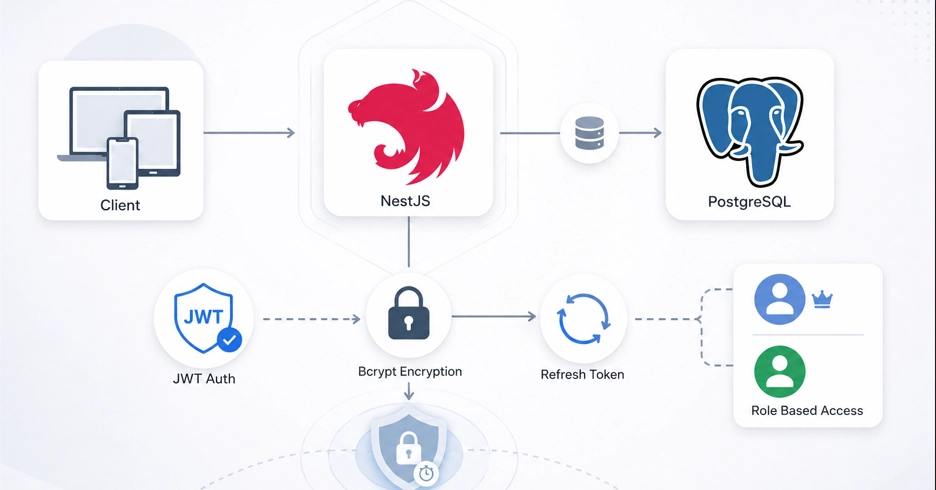
Banking software cannot afford to be casual about anything. Every transaction needs to be verified, logged, protected from tampering, and traceable if something goes wrong. This is exactly the kind of environment where NestJS quietly shines, since its architecture was built around structure and discipline from the start, not added on as an afterthought.
Financial institutions and fintech companies increasingly choose NestJS for banking applications, investment platforms, and trading systems, largely because it gives teams a consistent, testable structure for handling something as sensitive as money moving between accounts. Here is what that actually looks like underneath.
Why structure matters more in banking than almost anywhere else
In most applications, a messy folder structure or inconsistent error handling is annoying. In a banking application, it is a liability. If five different developers write five different ways of validating a transaction, you end up with five different ways something could slip through unnoticed.
NestJS solves this by enforcing a consistent pattern across the entire application, modules, controllers, providers, all following the same shape no matter who wrote them. A new developer joining a banking backend built with NestJS already knows where to look for validation logic, where authorization happens, and where a transaction actually gets processed, because the framework itself dictates that structure.