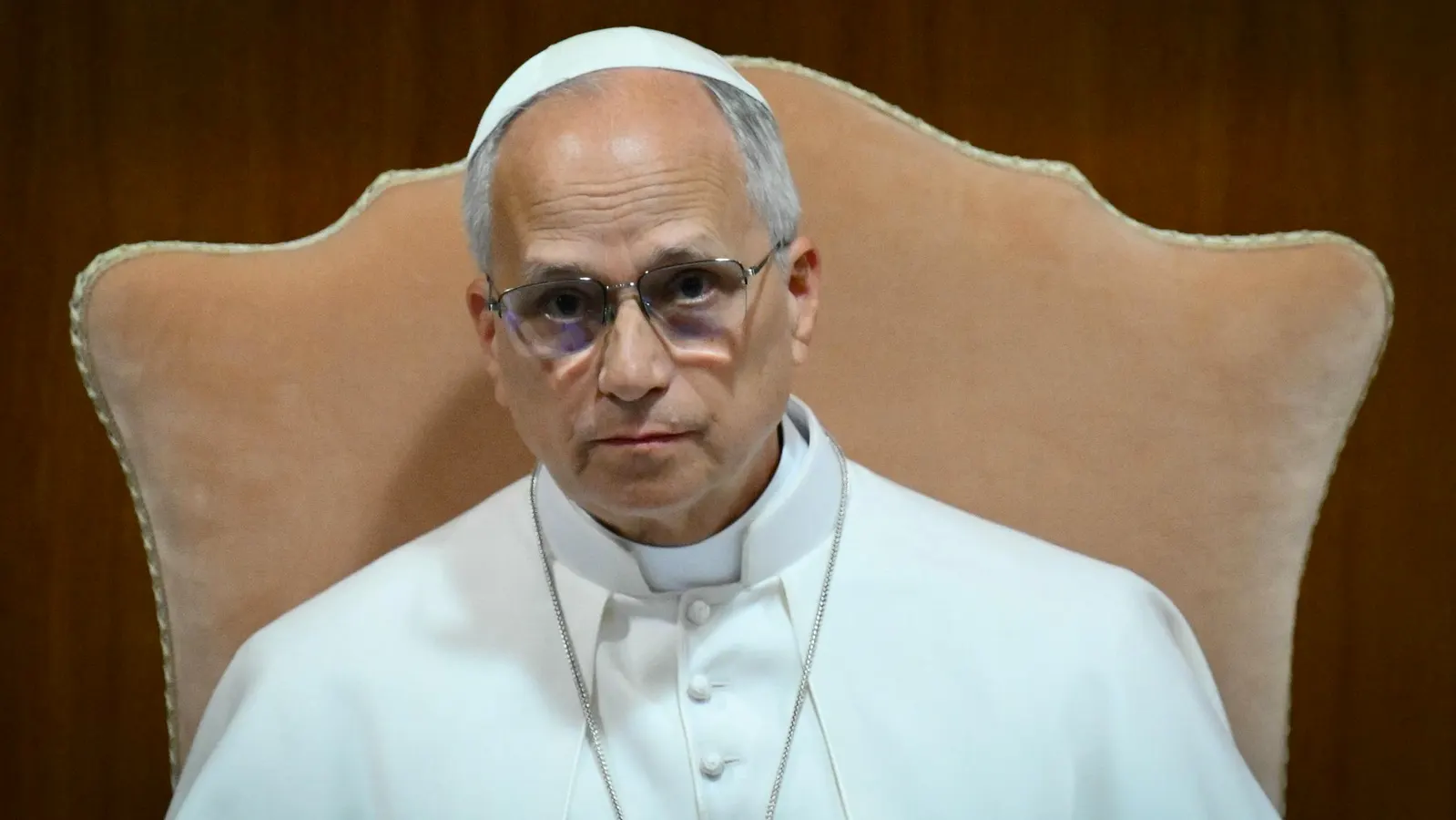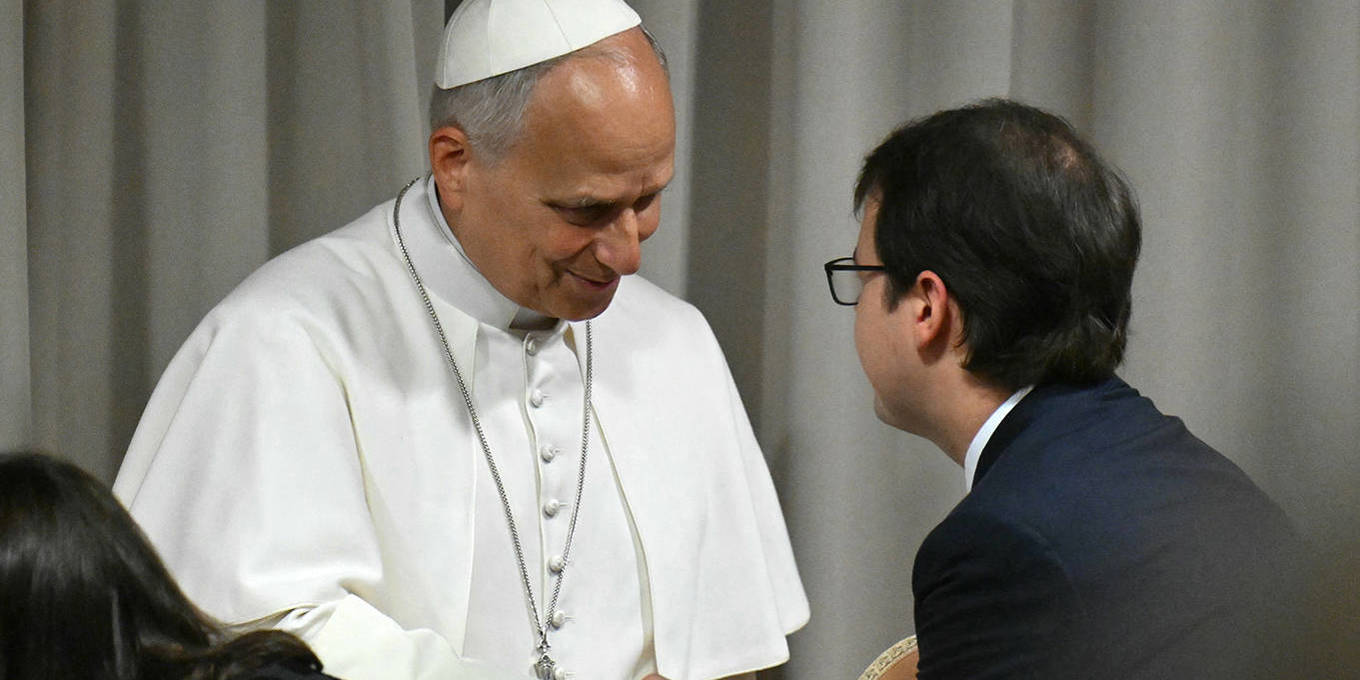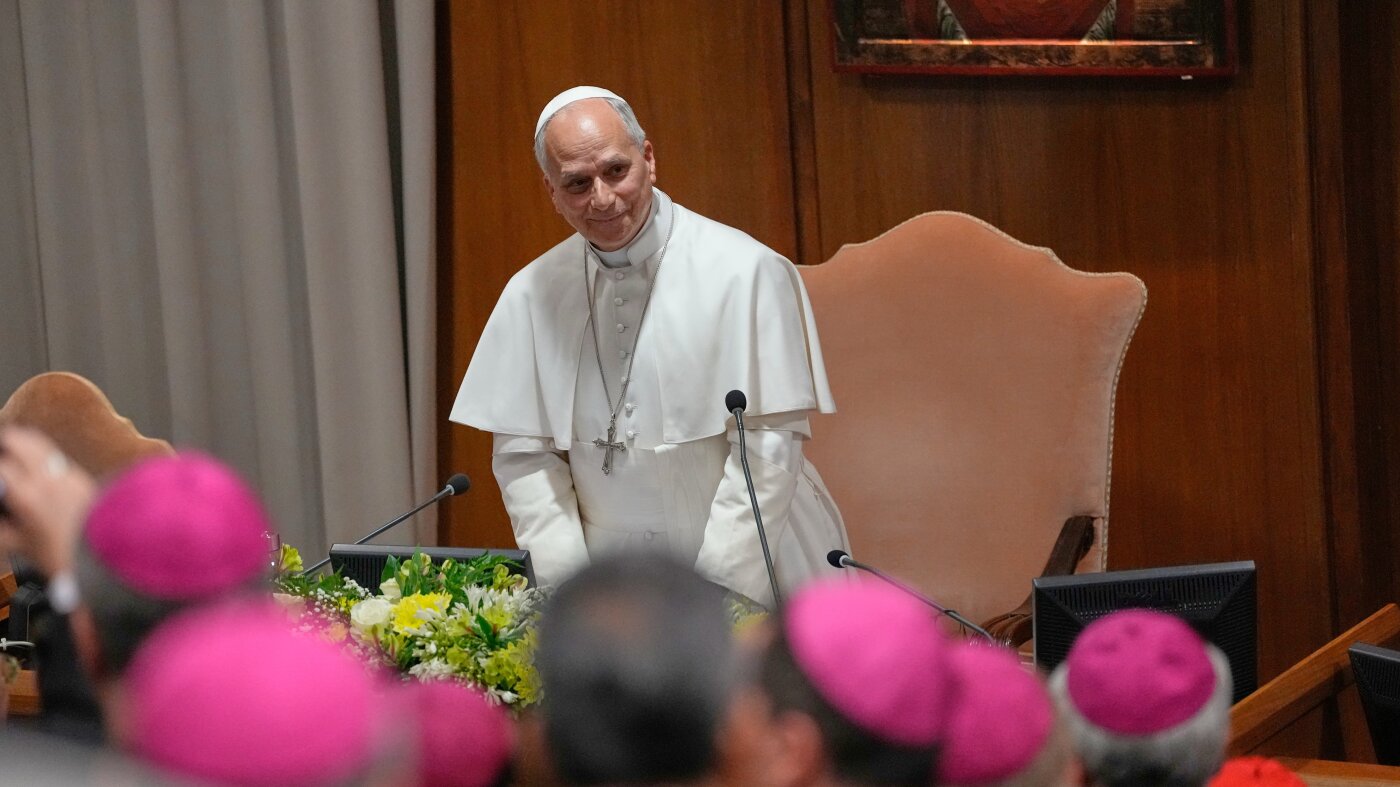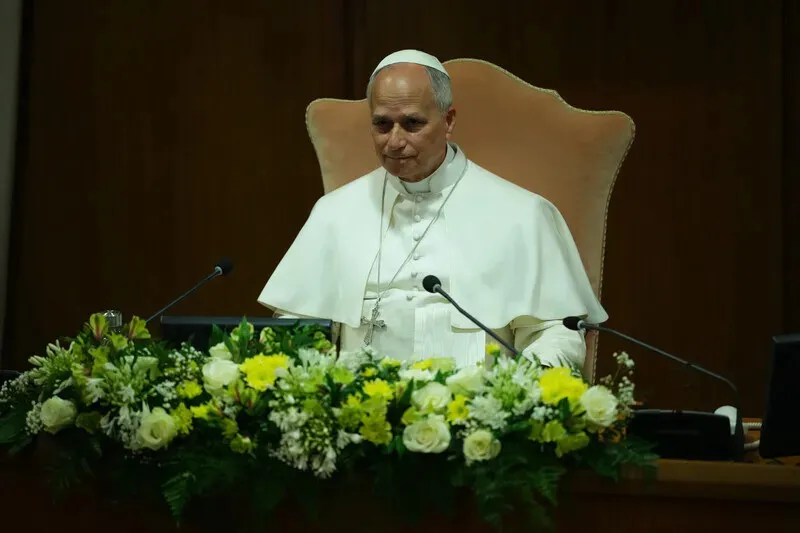
Pope Leo XIV attends the presentation of his first encyclical, “Magnifica humanitas: On Safeguarding the Human Person in the Time of Artificial Intelligence,” at the Vatican on May 25, 2026. (AP/Yonhap)
By Slavoj Žižek, Global Eminent Scholar at Kyung Hee UniversityToday’s unbridled capitalism is approaching a new, even more dangerous, stage: that of digital feudalism — unfettered, profit-driven AI risks concentrating wealth and algorithmic power into the hands of a few tech monopolies. There are many critics drawing attention to different aspects of this threat, but what we were missing till now is a clearly written broad overview which would provide an analysis of the role AI plays in our societies, avoiding both traps of rejecting AI as inherently evil and of elevating AI into an instrument of the miraculous solution to our biggest problems. What no politician or social theorist was able to do, Pope Leo’s encyclical letter “Magnifica Humanitas” did in an unsurpassable way. His starting point is that technology is never neutral, because it takes on the characteristics of those who devise, finance, regulate and use it. The pope insists on the need to ensure that technologies are not concentrated in the hands of only a few people, thereby widening the gap between those included and those excluded from the digital revolution. He also correctly rejects “any form of paternalistic or welfare-based management of societal life”; what we need is shared responsibility of all of us, not a new elite that masks its brutal power with a fake human face. And, to make this point even clearer, the pope insists that algorithmic development cannot be left solely to the “invisible hand” of the free market; a new form of social action is needed.The question we should ask here is: who, then, comes closest to the figure of the antichrist the pope is warning us against? The answer is easy: the very person who, in an act of brutal irony, is permanently attacking his opponents as figures of the antichrist. Peter Thiel, the founder of data intelligence company Palantir Technologies — the Pentagon contractor whose AI systems are being used in the US and Israeli attack on Iran — is preoccupied with the risk of a “one-world, totalitarian state” obstructing scientific and technological progress. Thiel depicts those who lobby for tech regulation as harbingers of the antichrist: “The way the antichrist would take over the world is, you talk about Armageddon nonstop. You talk about existential risk nonstop, and this is what you need to regulate. The thing that has political resonance is: we need to stop science, we need to just say ‘stop’ to this.” So what concrete features make the state a figure of the antichrist for Thiel? Thiel names “tax treaties, financial surveillance and sanctions architecture” as defining features of the international “antichrist-like system” of international governance. Thiel explains how “it’s become quite difficult to hide one’s money” in the wake of the Patriot Act, the “extensive” administrative state (the Treasury Department, in particular), and the international messaging network known as SWIFT, which banks use to process global payments. All of these factors make it impossible to “escape from global taxation if you’re a US citizen.” In this sense, Thiel is effectively a liberal fascist. He advocates a total dictatorship by AI, but grounded in conservative religion and state power to maintain social stability and cohesion. He is right in his presumption that in our societies that still maintain the appearance of openness, unity and cohesion cannot be enforced through a direct strong state and ideological measures (as in Russia and China). So why not do it through the digital space, controlling and regulating what people think and how they act by ruthlessly using their mimetic desires? In this way, we can combine total liberalism outside state control (of the AI neofeudal masters like Thiel) with the control of the individuals exerted by state and religion. This is why Thiel is not alone in his project. In mid-April 2026, Palantir released a 22-point summary of “The Technological Republic: Hard Power, Soft Belief, and the Future of the West,” the 320-page book that the billionaire CEO Alex Karp co-wrote and published in early 2025. The main points of his manifesto are that Silicon Valley owes a moral debt to the country that made its rise possible. The engineering elite of Silicon Valley has an affirmative obligation to participate in the defense of the nation: “The ability of free and democratic societies to prevail requires something more than moral appeal. It requires hard power, and hard power in this century will be built on software. The question is not whether AI weapons will be built; it is who will build them and for what purpose. Our adversaries will not pause to indulge in theatrical debates about the merits of developing technologies with critical military and national security applications. They will proceed.”Is this stance not the exact opposite of the pope’s call for AI to be “disarmed”? And are the topics that Thiel denounces as a threat to our freedoms — uncontrolled AI, environmental catastrophes, threats of a new global war — from the pope’s view not precisely the big problems that push us toward self-destruction? Is there no shared ground here? Does one have to make a choice? However, the pope goes here a crucial step further, towards the deepest philosophical and theological level. It is not enough to analyze the social, economic and political context of AI. The ultimate question is whether there is something in the very core of being human that resists the logic of AI. The pope’s answer is that there is, namely, the productive role of failure and limitation.“Everything that appears as a ‘limit’ — incapacity, illness, old age, suffering, vulnerability — tends to be seen primarily as a defect to be corrected, rather than as a reality through which our humanity matures and opens itself to relationship. And yet we must remember that humanity flourishes not despite limitations, but often through them,” he writes. “Herein lies the radical departure [for the Christian] from Promethean dreams: what saves humanity is not enhanced self-sufficiency, but a relationship that liberates, a communion that transforms [. . .] a technology that merely classifies and optimizes what already exists can, however unintentionally, becomes an obstacle to change and growth. For an algorithm, an error is a flaw to be corrected; for a person, however, an error can be a catalyst for profound change,” the pope goes on. I cannot emphasize enough the universal reach of these insights. Take “The House of the Rising Sun,” an old folk English song recorded dozens of times by many great names, white and black, from Pete Seeger to Nina Simone; its definitive version was done by the British rock band Animals in 1964. An ambiguity resides already in the nature of the “sin” mentioned in the song: there are hints at alcoholism (the house as a bar to get drunk), prostitution (a brothel), gambling (a corrupted casino), theft (the home of a gang of robbers), and, perhaps, the combination of some of them or all four. All these options are versions of the excess of enjoyment, so the very plurality of possible meanings draws its strength from remaining non-specified; all meanings refer to a vague excessive X of a jouissance which cannot be directly named. It is this very unsayability which makes the house function as a subject: the unsayable X is like an additional part of the excessive “thing.” My hypothesis is that an AI agent is not able to perceive this unsayable, blurred aspect as part of reality itself. The AI agent would continue to search for possible definitive meanings of the house and would count the failure of its search as a simple failure, not as a positive result.Some followers of Nietzsche argue that being-human is a failed passage from being-animal to some higher stage (“superman”), a thwarted progress, and that what we usually perceive as the indications of human greatness or creativity are precisely reactions to this fundamental failure. Can we then imagine a stage which would be a humanity that somehow overcame its constitutive failure, a humanity without sex and mortality? Today, we can do it easily: it would be a human being fully immersed in AI and, for this very reason, deprived of the spiritual dimension. This brings us back to the topic of the constitutive role of limitation in being-human. Our — that is, humanity’s — “highest” achievements are rooted in our very ultimate limitations (failure, mortality, and the concomitant sexuality), i.e., in what we cannot but experience as the obstacle to our “higher” spiritual existence. It is not only true that a human being is never fully transparent to itself: this non-transparency defines it ontologically.This is why a human subject only emerges when it is confronted by an impenetrable Other: being human is an unanswered question. Or, paraphrasing what Claude Levi-Strauss said, it is the answer to a question, but we don’t know which question. For us humans, limitation and failure are not just obstacles to be overcome; they open up the space for transcendence. You take away the limitation and you lose transcendence itself, what glimmers beyond it.So what does this have to do with Christianity? Everything. The uniqueness of Christianity is that it applies this insight of finitude as the only path to transcendence onto God himself: in Christ, God became a finite mortal human being not just to deliver a message to mortal humans but to fully become God. Divinity is not somewhere up there out of our world; it is something we have to struggle for in this miserable world.Please direct questions or comments to [english@hani.co.kr]