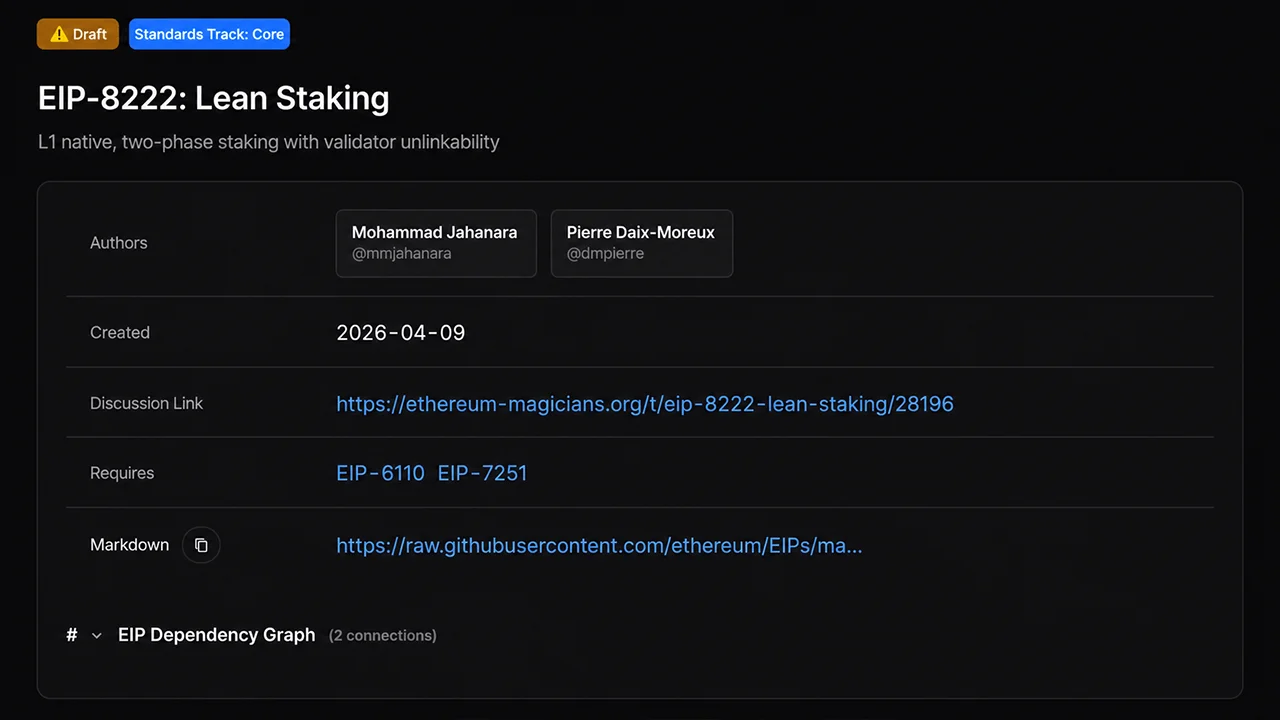
Here’s a question Ethereum has been dodging for years: if you stake ETH, should everyone on the planet be able to trace exactly who you are? The current answer, unfortunately, is basically yes. Deposit addresses, validator keys, and withdrawal credentials form a breadcrumb trail that makes stakers about as anonymous as someone wearing a name tag at a party.
EIP-8222, a proposal that surfaced on April 9-10, 2026, wants to change that. Called “Lean Staking,” it introduces a two-phase mechanism that decouples deposit addresses from validator keys and withdrawal credentials at the consensus level. If adopted, it would be the first L1-native construction to provide privacy guarantees for ETH transactions directly on Ethereum.
How Lean Staking actually works
Lean Staking creates a pending-deposit-to-pending-withdrawal pathway, meaning ETH can flow through the staking mechanism without requiring full validator activation. Your deposit can route directly to a pending withdrawal, breaking the on-chain link between who sent the funds and who receives them.
The technical elegance here is what the proposal’s authors call “two-sided plausible deniability.” Both the staker and the recipient become indistinguishable from anyone else performing standard staking operations.