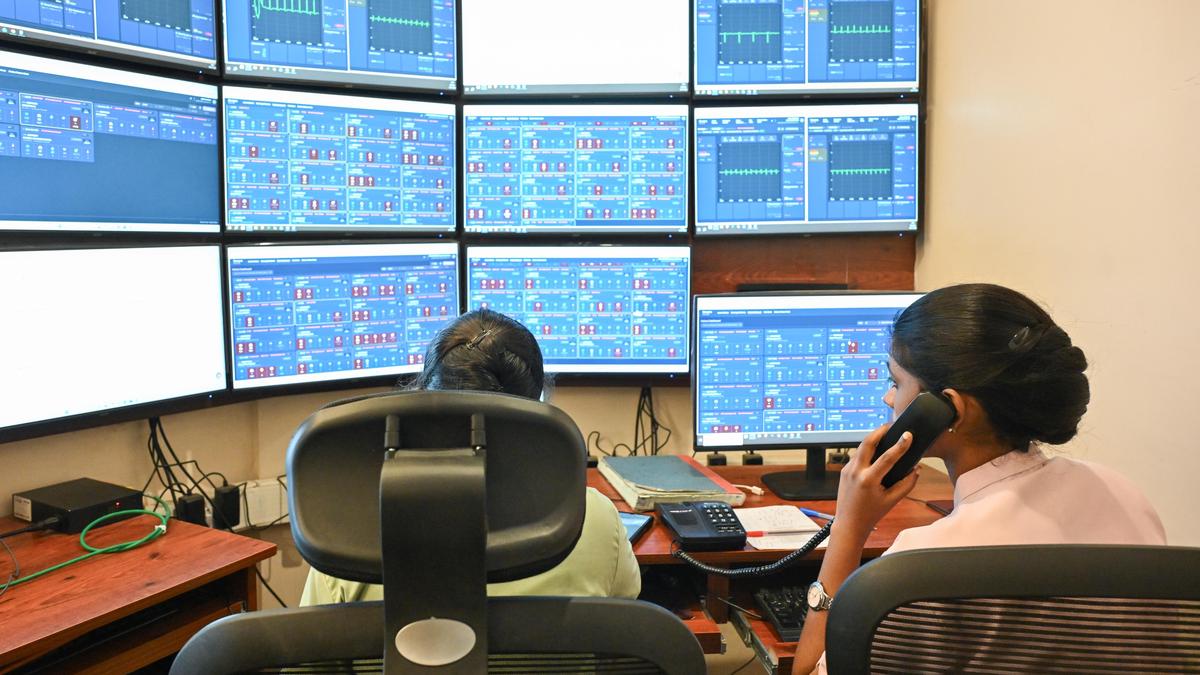
AI-powered patient monitoring system at Apollo Speciality Hospitals in Madurai.
| Photo Credit: R. ASHOK
In a major step toward integrating Artificial Intelligence into healthcare, Apollo Hospitals in Madurai has fully transitioned to AI-powered patient monitoring.This advanced technology enables doctors to detect clinical deterioration early, ensuring safer patient outcomes.By providing continuous, intelligent oversight, the system elevates patient care, streamlines clinical workflows, and supports scalable healthcare delivery, said Nikhil Tiwari, Chief Operating Officer – ROTN, Apollo Hospitals.According to Dr. Tiwari, the technology enables real-time tracking of vital signs—including ECG, heart rate (HR), respiratory rate (RR), SpO2, temperature, blood pressure (BP), and posture.Additionally, the predictive AI can identify early clinical deterioration up to six hours in advance while automatically calculating the National Early Warning Score (NEWS2) for every patient, he added.Around 150 inpatient beds are now under constant surveillance, making Apollo Madurai the first hospital in the State to cover all its beds with a centralised monitoring system.Dr. Tiwari further stated that Apollo Karaikudi is connected to the same network, allowing it to be monitored remotely by the central control system based in Madurai.According to Dr. V. Jude Vinoth, Senior Consultant and Incharge of the Department of Emergency Medicine, this monitoring system has helped reduce mortality rates by more than 80%.“Every patient in the in-patient ward is categorised into one of four zones: stabilization (green), enhanced care (orange), critical stabilization (red), or resuscitation (blue),” Dr. Vinoth explained.“The moment a patient’s condition worsens and triggers an orange code, the monitoring team instantly alerts the duty nurse and doctor.” This rapid alert system ensures that medical staff intervene long before a patient reaches the blue code, rather than discovering the deterioration after the fact.He stated that this AI-driven early intervention has significantly reduced the reliance on manual tracking, where human error in detecting subtle changes is highly possible.The device itself is exceptionally user-friendly and compact, attaching easily like a button to the patient’s chest for the duration of their hospital stay.“This eliminates the physical burden on patients, who are traditionally weighed down by heavy instruments and tangled wires,” he added.Dr. Tiwari said that the technology, developed by LifeSigns, will soon be expanded to monitor patients in their own homes immediately following their discharge from the hospital.Another major advantage is affordability; at only around ₹400 per day, the system is highly accessible to patients seeking remote monitoring and care.“Because all monitoring data is accessible through a dedicated application developed by the company, doctors can easily review patient vitals from anywhere,” he observed.By bringing AI and life sciences together, this technology is a major breakthrough for medical professionals who have long struggled to maintain seamless, comprehensive monitoring under their purview, Dr. Tiwari commented. Published - July 05, 2026 07:41 pm IST