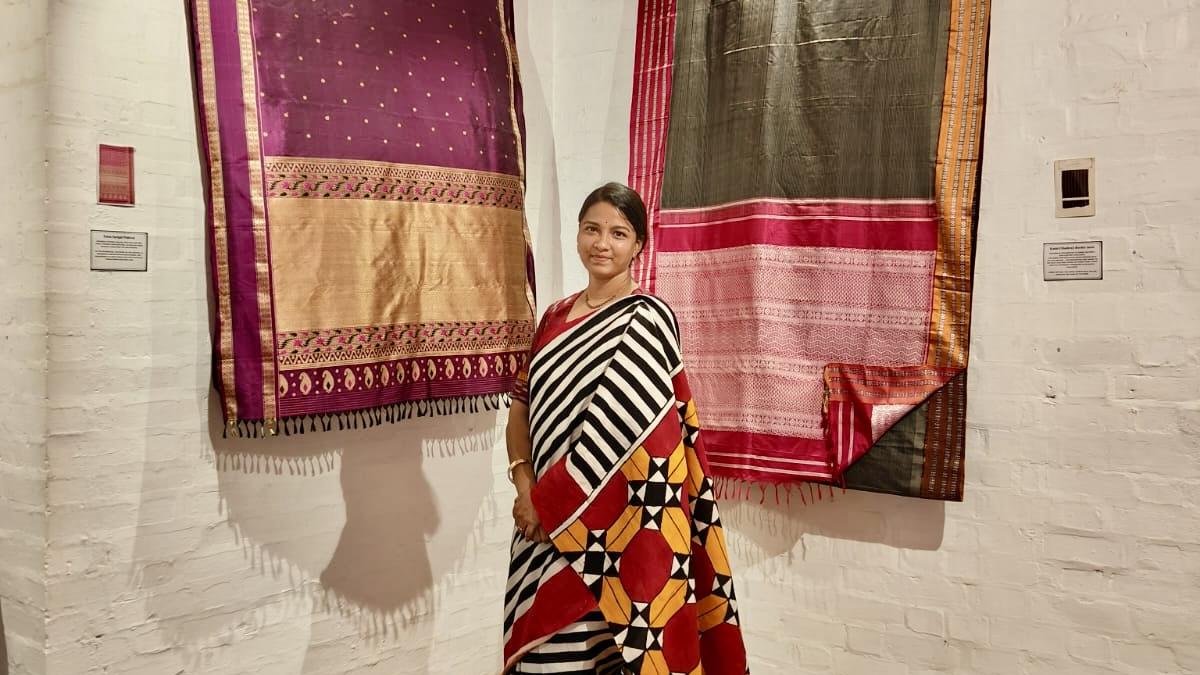
For most people, copying a page of text is a simple task. But recreating an entire sacred scripture by hand on a piece of cloth stretching nearly 280 feet is a different challenge altogether.That is exactly what Assam's master weaver Hemoprova Chutia accomplished. Despite not being able to read Sanskrit and not being fluent in English, she painstakingly embroidered and wove the complete Bhagavad Gita onto handwoven fabric, according to the Times of India. Her extraordinary contribution to traditional craftsmanship and textile art later earned her the Padma Shri, one of India's highest civilian honours.Her achievement has once again drawn attention to the dedication and patience behind India's handloom traditions.ALSO READ: Married at 12, gave her first Pandavani performance at 13, folk legend Teejan Bai took Chhattisgarh’s art to the worldA lifetime dedicated to Assam's weaving heritageHemoprova Chutia hails from Moran in Assam's Dibrugarh district, a region known for its rich weaving culture. Over the years, she has built a reputation for preserving and promoting traditional Assamese weaving techniques through her work.She has worked extensively with Muga silk, Assam's famous golden silk, and has experimented with different forms of textile art while staying rooted in traditional methods.ALSO READ: First-year college student earns Rs 4 lakh a month as sales intern, wins fully paid Thailand trip after becoming startup’s top performerUnlike conventional Assamese weaving, which often features floral and geometric motifs, Hemoprova introduced intricate beadwork into cotton and silk gamochas, adding a new dimension to one of Assam's most recognised cultural symbols.Her creations reflect not only craftsmanship but also a commitment to preserving cultural heritage through textiles.How she recreated a text she could not readOne of the most remarkable aspects of Hemoprova's work is that she recreated Sanskrit text without actually being able to read the language. Instead of reading the words, she focused on the appearance of every letter. Each character was studied as a visual pattern and then reproduced with thread and fabric.The process demanded intense concentration. Since she could not read the completed text herself, there was little room for error while recreating each character.What made the task even more difficult was the weaving process itself.The challenge of weaving words in reverseText woven on a loom has to be created in mirror image so that it appears correctly when viewed from the front side of the fabric.This meant Hemoprova had to work with letters in reverse while ensuring proper spacing, alignment and consistency throughout the cloth. Maintaining accuracy over thousands of characters required patience and precision over a prolonged period.The work was completed entirely by hand, without relying on machines or digital tools.The 280-foot Bhagwad Gita that took more than two yearsAmong her many creations, the English version of the Bhagwad Gita remains one of her most talked-about works. The handwoven cloth measures around 280 feet in length and approximately two feet in width. According to reports, the project took more than two years to complete.During that period, Hemoprova worked steadily, recreating every letter one by one until the entire text was woven onto the fabric.The scale of the project and the level of detail involved make it one of the most remarkable achievements in Indian handloom craftsmanship.The Bhagwad Gita was only part of her workThe Bhagwad Gita is not the only religious text Hemoprova has recreated through weaving. She has also woven the Naam Ghosa and the Gunamala, the devotional text written by Assamese saint-reformer Srimanta Sankardev.In addition to Assamese versions, she recreated these works in Hindi and English as well.Throughout her career, she has worked with a variety of materials, including cotton, silk, wool and finely cut bamboo, while continuing to use traditional weaving methods.Recognition that came after decades of workThe Padma Shri is among the highest honours Hemoprova Chutia has received, but it is not the first recognition of her contribution to handloom art.She has previously been honoured with the Assam Gaurav Award, Bakul Bon Award, Aai Kanaklata Award and the Assam Handloom and Textile Award. These awards reflect years of dedication to a craft that often requires long hours of detailed work behind the scenes.A story of patience, skill and traditionAt a time when technology can reproduce designs within minutes, Hemoprova Chutia's work stands as an example of what traditional craftsmanship can achieve through patience and consistency.She did not rely on machines or shortcuts. Instead, she spent years recreating sacred texts by hand, preserving both the written word and Assam's weaving traditions in the process.Her journey continues to inspire artisans and handloom enthusiasts across India, proving that dedication to a craft can leave a lasting cultural legacy.(With TOI inputs)
She couldn't read Sanskrit, yet this Padma Shri awardee spent over two years weaving the entire Bhagavad Gita on a 284-foot-long cloth
Assam's master weaver Hemoprova Chutia achieved a remarkable feat by hand-embroidering and weaving the entire Bhagwad Gita onto a 280-foot cloth, despite not being able to read Sanskrit. Her dedication to preserving traditional Assamese weaving, even introducing beadwork, earned her the prestigious Padma Shri. Chutia's extraordinary patience and skill in recreating sacred texts without modern tools highlight the enduring legacy of India's handloom traditions.
765 words~3 min read