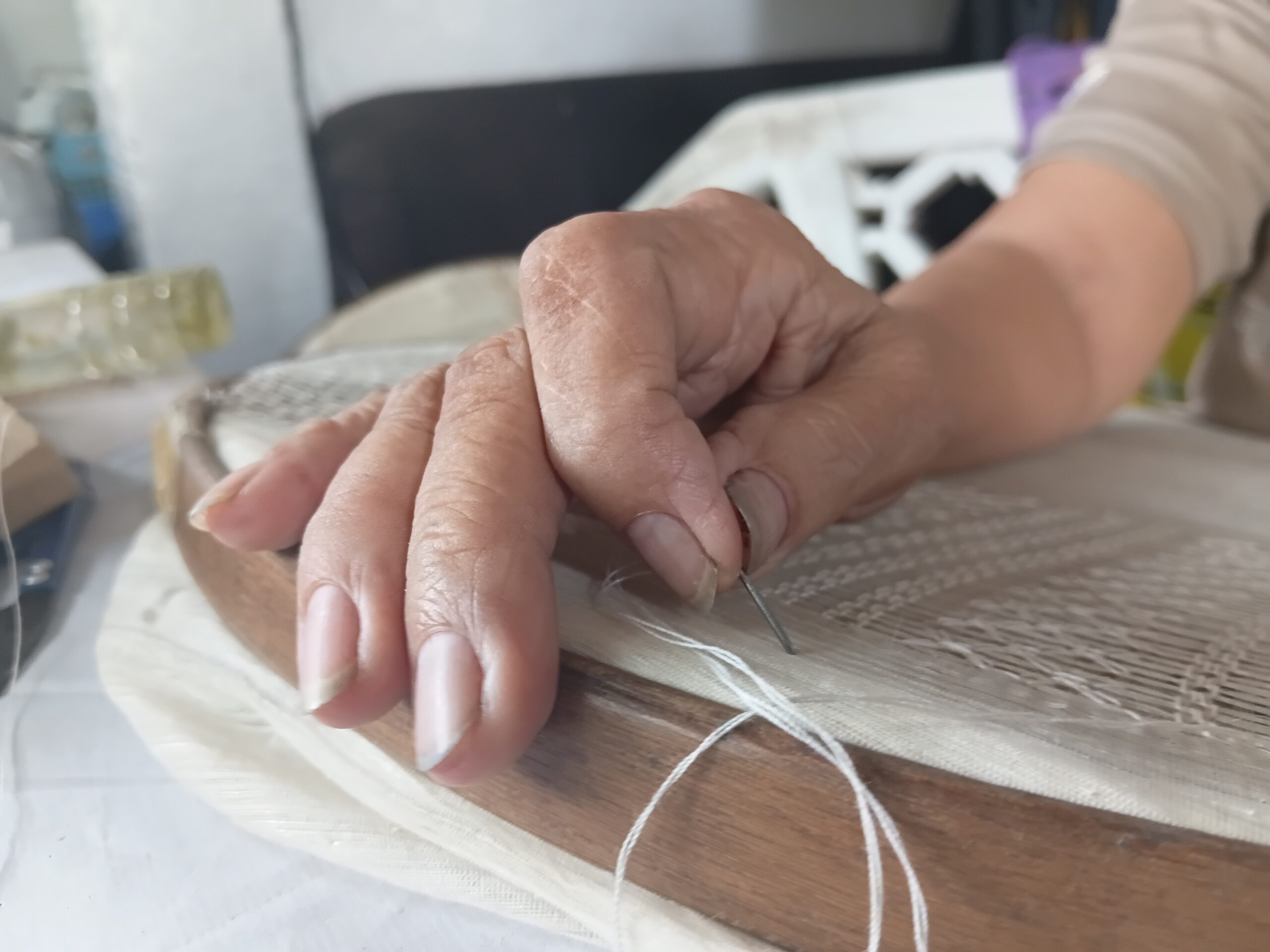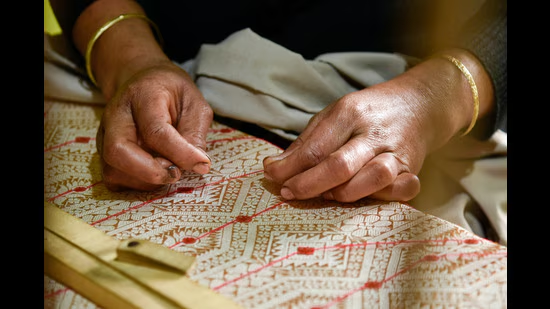
At the bottom right corner of a large framed work in red and black, two letters stand out in their idiosyncrasy. ‘AL’, it reads a little shakily, the ‘A’ smaller than the ‘L’, every bit as individual as a signature. It recalls the way legendary 19th century weaver Dubraj Das finished his Baluchari saris by incorporating his name in the Bangla script. It is the only material proof modern-day textile historians have of this pathbreaking weaver’s work.One can only guess at the prescience that led Das to mark his textiles for perpetuity, but it was hard convincing Anbulakshmi, the creator of the 57x29 inch work, to embroider her own initials as a final flourish for the piece.
Anbulakshmi, a Toda artisan, who is taking her art panel to Mumbai
Anbulakshmi’s Puthkuzhy panel
She had used symbols for sun rays (a radiating diamond form), buffalo horns, vultures (a decorative stacked ‘heart’) — all deeply embedded in the Toda vocabulary — and contemporary motifs. For millennia, across the world, women have toiled at work such as this, expecting no recognition or acknowledgement outside immediate circles of solidarity and companionship. To be encouraged to stamp their ownership on their creation is, frankly, an alien experience.The Art of the Toda