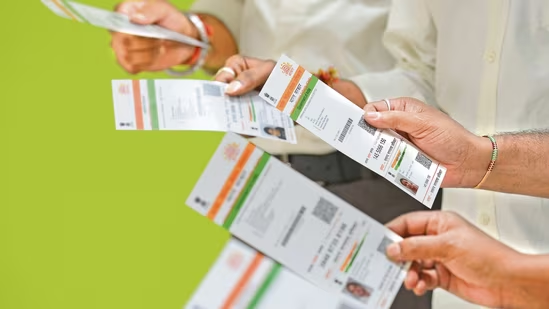
India has built world-class hospitals and trained brilliant doctors. What it hasn't built yet is the connective tissue, a health data layer that allows all of it to work together.Aadhaar cardImagine a family rushing a loved one to a hospital in an emergency. How do doctors piece together years of medical history? Some reports are in a drawer at home. Others are with a clinic across town. A few exist only in the memory of a physician who has treated the patient for years.The problem isn't a lack of health care. It's a lack of connected health care. Today, millions of Indians navigate a fragmented health care system where critical information is scattered across hospitals, clinics, laboratories, pharmacies and insurance providers. When medical history is incomplete, treatment becomes harder, decisions become slower, and opportunities for prevention are often missed.The urgency of this challenge becomes even clearer when we look at the growing burden of chronic diseases in India. Data from the National Family Health Survey (NFHS-5) points to rising levels of diabetes, obesity and other lifestyle-related conditions across both urban and rural India. The scale of the challenge is significant. According to the ICMR-INDIAB study, India has 101 million people living with diabetes and another 136 million with prediabetes. The same study found that 315 million Indians have hypertension, 254 million have generalised obesity, and 351 million have abdominal obesity. Millions of Indians are developing health risks long before symptoms appear. These are not people who consider themselves unwell. They go to work, attend meetings, drop their children to school and carry on with daily life as usual.The most effective health care intervention is often the one that happens before someone becomes a patient. But prevention requires visibility. And visibility requires connected data.India has made significant progress in expanding health care access. Government investment has increased, India's insurance penetration has experienced a gradual upward trajectory, moving from 2.71% in the early 2000s to around 4.2% a few years ago, and initiatives such as Ayushman Bharat have brought millions into the formal healthcare system. Yet a patient who visits a government hospital in Lucknow, a specialist in Delhi and a diagnostic centre in Mumbai often leaves behind three disconnected versions of their health story.The challenge is not the absence of data. It is the absence of connected data. Doctors often rely on whatever records a patient happens to carry with them, while important pieces of medical history remain scattered across different providers and systems. The challenge is no longer only about access. It is increasingly about intelligence.Before Aadhaar, identity verification across services was fragmented and inefficient. Aadhaar did not replace banks, welfare schemes, or government services. Instead, it created a common layer that allowed them to work together. Health care needs something similar. The Ayushman Bharat Digital Mission and ABHA IDs have already laid the foundation. As of June 2026, more than 73 crore ABHA IDs have been created, reflecting the growing adoption of India's digital health infrastructure. The vision is simple but powerful: a secure, consent-driven health record that follows the patient, not the institution. The opportunity now is to move beyond digital identities toward seamless, consent-based health data exchange that enables patients and providers to access the right information at the right timeConsider a 45-year-old professional whose blood sugar levels have been gradually increasing for years. Today, those reports may be sent across emails, laboratories, and hospital systems. Tomorrow, a connected health record could help identify that trend early enough for intervention before diabetes develops. Or consider an elderly patient visiting a new doctor. Instead of spending valuable consultation time reconstructing medical history, both patient and physician can focus on what matters most, diagnosis and treatment.This is not simply about convenience. It is about better decisions, earlier interventions, and improved health outcomes.However, In India especially, Health data is deeply personal. Any digital health ecosystem must be built on one principle: The patient remains in control. The answer to privacy concerns is not avoiding digital health infrastructure. It is building it responsibly, with strong consent frameworks, transparency, and accountability. Trust made digital payments possible. Trust will make digital health possible too.India showed the world how to build digital identity through Aadhaar and transform payments through UPI. Health care could be the next chapter. The data already exists. Technology is emerging. The policy foundation is taking shape. What remains is the collective will to connect it all together. Because the future of health care will not be defined only by the hospitals we build. It will be defined by how intelligently we connect them.Healthcare does not need another Aadhaar. It needs Aadhaar's lesson: that the right digital infrastructure can transform an entire sector. India's health system is ready for that moment.(The views expressed are personal)This article is authored by Kiran Kalakuntla, CEO and co-founder, ekincare.
Health care needs its Aadhaar moment
This article is authored by Kiran Kalakuntla, CEO and co-founder, ekincare.
804 words~4 min read