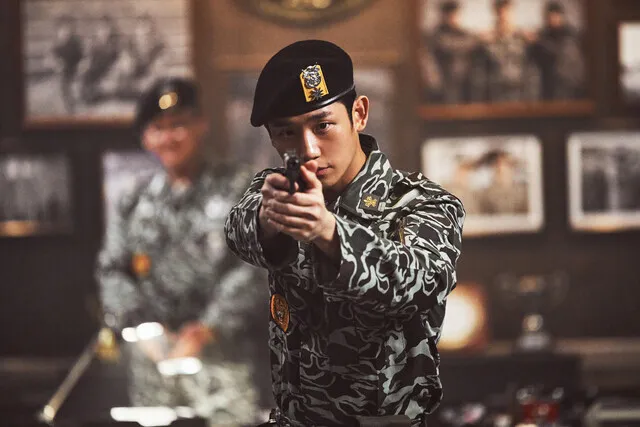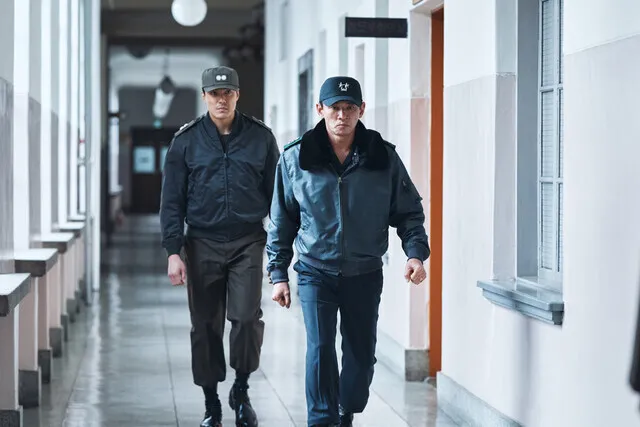
Hwang Jung-min as Chun Doo-gwang, the commander of the Defense Security Command, in the film “12.12: The Day.” (courtesy of Plus M Entertainment)
The newly released film “12:12: The Day” depicts the coup orchestrated by Chun Doo-hwan and his military clique on Dec. 12, 1979. The film focuses on combat between the clique behind the coup and the forces attempting to stop it during nine hours from the evening of Dec. 12 until the early hours of Dec. 13.How did Chun Doo-hwan, who at the time was a major general in charge of the Defense Security Command (DSC), manage to pull off that coup? To answer that question, we need to consider Hanahoe, as Chun’s clique was called, as well as Chun’s position at the head of the DSC.Since the 1960s, measures with multiple redundancies had been put into place to prevent a coup in the Korean military. Those safety measures had been taken by then-President Park Chung-hee, who himself had come to power through a coup on May 16, 1961. The core duties of the DSC, which Chun commanded, are to combat “subversion” — meaning a coup. In other words, its activities are meant to stop coups from happening.The concept of the DSC’s anti-subversion activities is not a matter of finding and removing overthrow threats. It is about preventing those threats from taking shape in the first place by detecting and preemptively eliminating any signs of subversion or by tracking down and managing any conditions where the threat of subversion is viewed as a possibility.To nip any potential coup threats in the bud, the DSC closely tracks the people officially and unofficially in contact with key military commanders and their activities. The landline and mobile telephone conversations of major military commanders are also monitored around the clock.Park Chung-hee appointed DSC commanders whom he believed he could really trust. Chun Doo-hwan, who was the commander of the Republic of Korea Army’s 1st Infantry Division at the time, was the one appointed to the position in March 1979.Chun had long been one of Park’s right-hand men. As a captain, he was selected by the then-general Park shortly after the May 1961 coup to serve as a civil affairs secretary for the office of the chairman of the Supreme Council for National Reconstruction.If a coup does happen despite the DSC’s preventive measures, the forces in Seoul are to be quelled by the Capital Garrison Command — which was stationed on Seoul’s Chungmu Road at the time in 1979 — or the Special Warfare Command in Seoul’s Songpa District. These units are sometimes referred to as “counter-subversion units.”This coup prevention and suppression system did exist on Dec. 12, 1979, yet it failed to stop the military clique’s rebellion. That’s because the ringleader behind the coup was Chun, command of the very DSC that was tasked with preventing coups.In “12:12: The Day,” the DSC can be seen listening in on the military communication network and tracking and responding to the counter-subversion forces’ movements with ease. In effect, the clique abused the authority to monitor military communication networks — something given to the DSC to prevent coups — in order to actually carry out its own coup. The foxes had been left in charge of the henhouse.The handful of Special Warfare Command and Capital Garrison Command leaders tasked with counter-subversion unit duties were the ones who headed the military rebels’ action groups.Special Warfare Command commander Jeong Byeong-ju attempted to put down the rebellion, but his subordinates — 1st Special Forces Brigade leader Park Hee-do, 3rd Special Forces Brigade leader Choi Se-chang, and 5th Special Forces Brigade leader Jang Ki-o — betrayed him, pointing their gun barrels at their own superior officer.