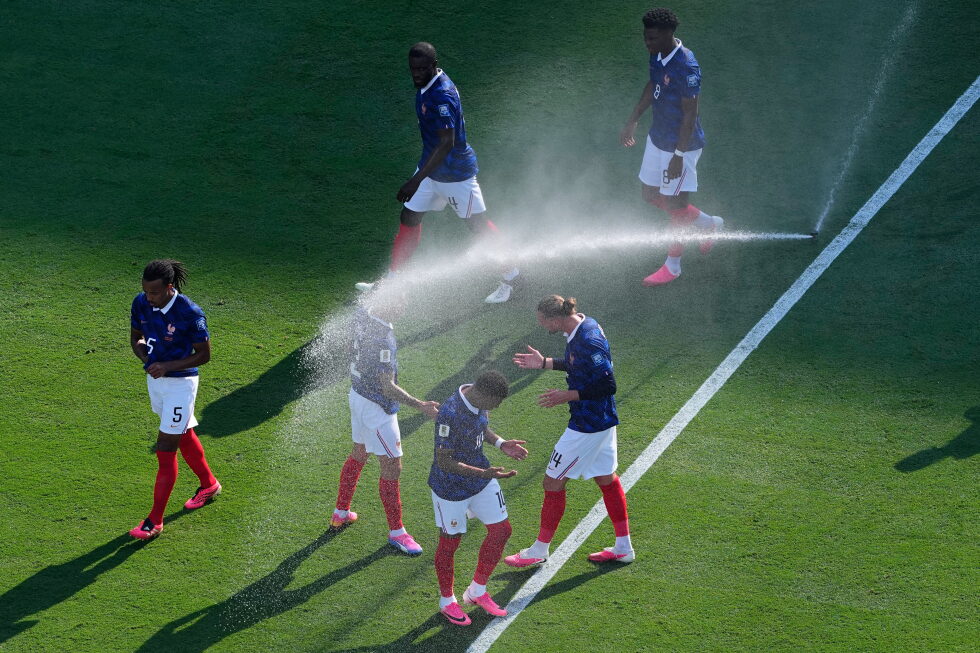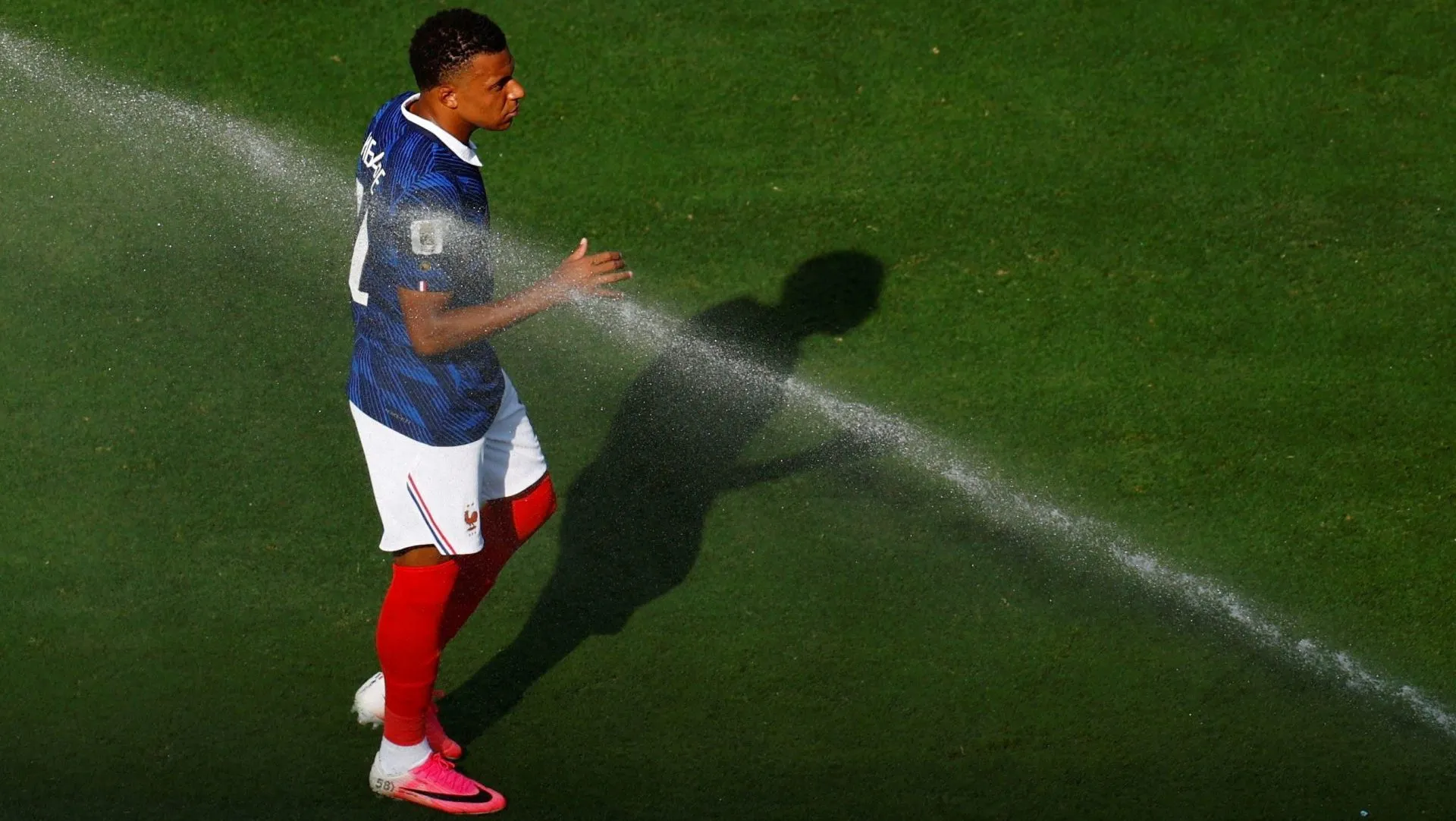
The heat has arrived. The first two weeks of this World Cup were relatively mild but with a heatwave gripping large swathes of the United States, temperatures have soared.The Athletic’s weather expert Aaron Mentkowski reports that an Extreme Heat Warning is already in effect for Philadelphia until 8 p.m. Saturday, with the game between France and Paraguay scheduled to start at 5 p.m.The high temperature forecasted in Philadelphia is 100F (38C), which is close to the record-high of 103F (39C), set on July 4, 1966. It will be dangerously hot, with a Heat Index between 105F (41C) and 115F (46C).The pitch during this match will be even hotter with a field temperature possibly exceeding 110F (43C). Fortunately for the players, they’ll be competing on natural grass, which is meaningfully cooler than artificial turf. FIFA banned artificial turf outright for 2026 and spent significant money on natural grass for all 16 stadiums. Still, 110-120°F (43C-49C) on the grass is brutal for players’ feet and lower legs, and radiant heat off the surface adds to the heat-stress players experience with an air temperature of 100°F (38C).Not only will the heat be a major concern for fans, players and the referees, but severe thunderstorms are possible after 5 p.m. Saturday. The main threat from these potential storms will be damaging winds.Researchers before the tournament warned that temperatures at 14 of the 16 stadiums being used in the United States, Mexico and Canada could exceed dangerous levels, with health experts warning FIFA of “worrying levels of heat stress” on players. In an open letter to FIFA, they called on the governing body to introduce better protections, including longer cooling breaks and clearer protocols for delaying or postponing games in extreme conditions.Those conditions are categorised by wet bulb globe temperature (WBGT), which estimates the combined effects of air temperature, humidity, wind and sunlight on the human body. The measure, initially used by the U.S. Navy and U.S. Marine Corps, defines safety standards as: 25C (77F) for very high exertion, 26C (78.8F) for high exertion, 28C (82.4F) for moderate exertion, 30C (86F) for light work and 33C (91.4F) at rest.At present, FIFA’s emergency care manual states that suspension or postponement of a match is only formally considered when WBGT is “near, at or above 32C (89.6F)”, at which point “there should be communication between the general coordinator/match commissioner, referees, the FIFA chief medical officer/venue medical officer and other persons managing the match”.But the open letter says this threshold is “impossible to justify”, while global player union FIFPro recommends that games should be delayed when WBGT exceeds 28C.But what actually happens in the human body when heat and physical exertion combine?To answer this, The Athletic consulted three leading experts: Chris Harris, sports scientist at Precision Fuel & Hydration; Dominic Rae, head of sports medicine at Ten Percent Club who has worked in the Premier League and is based in the UAE with Al Nasr FC; and Jamie Mitchell, performance scientist at 292 Performance.Rise in core temperatureThe human body is essentially an engine when it comes to sports performance, says Harris. As we move or exercise, we generate heat, quickly increasing our core temperatures. For elite athletes, who expend large amounts of energy, that means a lot of heat generated.“If you then put that human being into a particularly hot environment and ask it to do exactly the same thing, you’re receiving heat from outside of your body into you,” Harris adds. “That becomes problematic when the temperature is similar to or above your core temperature, which wants to be around 37C (98.6F). You’re speeding up the rate at which you’re filling your heat tolerance tank.”It’s the rise in core temperature that Harris says is the “danger factor”.“We have a pretty narrow window within which we can tolerate changes in core body temperature. There are always things that try to add heat and take heat away. When you get cold, you start shivering to generate muscle heat. And when you’re too hot, you start sweating.”The danger comes in, says Harris, when you continue to generate heat and push through your ability to cool down. “For most people, the ceiling would be somewhere around 39.5C (103.F). We’ve seen elite athletes tolerate temperatures as high as 40.5C (104.9F), which could kill the average person.”How Extreme Heat Could Decide The World CupJJ BullWidening of blood vessels and sweatingThe first line of defence to offload some of that extra heat is blood flow to the skin.“The reason people tend to go red is that your blood vessels are vasodilating (expanding) to get blood to go close to the skin surface,” explains Harris. “If the environment around you is cooler than you are, some of that heat will be dissipated.”The next line of defence to heat after the blood vessels have widened is for the body to initiate a sweat response. It isn’t the sweat itself that’s the cooling mechanism, says Harris, “it’s the evaporation of sweat”.He adds: “If you’ve ever done some exercise and then turned a fan on or walked out of a hot building into a cold space and suddenly felt chilly, it’s because your sweat isn’t doing much when the environment is hot, but it is doing a lot when it’s cold around you because then it starts to evaporate and you dispel that energy, which is heat, into the environment around you.”That’s why humidity makes heat more challenging, says Harris, because “the humidity is basically like moisture in the air. Anything over 50 per cent humidity and you will start to notice a real impact in how effective your sweat is. Suddenly it’s not cooling you anywhere near as much because the fluid can’t evaporate into the atmosphere, so it just sits on you.”Sweating is an essential part of performing in the heat, so before teams or individuals compete in hot climates, they will often undergo a period of acclimatisation, training in conditions similar to those they will expect to encounter (this was a factor in England basing their pre-World Cup training camp in Miami, Florida). Not only is this designed to get them used to the feeling, but it’s also designed to train their bodies to expel the heat more effectively by sweating more.HydrationThere are two issues related to sweating: loss of fluid and electrolytes.Electrolytes are used by your cells to conduct electrical charges, which is how your muscles contract. Those electrical charges also help with chemical reactions, especially for hydration and the balance of fluids inside and outside of cells.The electrolytes most lost through sweat are sodium and chloride, but not everyone loses the same amount, nor is the composition of that sweat identical either.“A heavy salt sweater will lose over a gram of sodium per litre of sweat,” says Rae. “That’s a lot. In a game we will see some players lose three to five kilograms (up to 11lbs) in fluid, so someone could be losing five grams of salt plus the other electrolytes that go with that.“Electrolytes are involved in the relationship between brain and muscle. If we’re losing that much electrolyte during a game, think what is then happening from a physical output point of view and the ability to rapidly fire muscle and contract tissue. These are important to perform but also to reduce injury.”Australia’s players take on liquid during a hydration break against Turkey (Dean Mouhtaropoulos/Getty Images)The individual differences mean that ideally, teams will have individualised hydration strategies for each player. “The elite teams will have done sweat tests on their players,” says Rae, “which is where you take a sample of their sweat and look at how much of it is sodium, potassium, magnesium, calcium, etc. You can then have an individualised replenishing strategy via electrolyte supplementation. Some players might need a high-dose sodium-based drink while others might need half that.”In the UAE, where Rae is based, he is used to having cooling breaks during games in the hottest periods of the year. He says the key during those breaks is to replace electrolytes, because “you can’t replenish enough liquids” in those short three-minute stoppages.“Let’s say a player loses five litres in a game, so logically we’re losing 2.5 litres a half and you’ve got 1.25 litres to replenish in that water break. It’s a lot of water to drink in three minutes and then go and play. We make 200ml bottles of water and concentrate them with high-dose electrolytes.”Gut problemsThe skin takes a larger proportion of blood flow than normal during exercise, as do your legs, heart and lungs, all of which can reduce blood flow to areas like the gut, which is not a vital organ during exercise.This, says Harris, can lead to “an increased risk of gastrointestinal (GI) issues during exercise in the heat. We see this a lot in the endurance space where people struggle with stomach issues.”While athletes often attribute this to struggling to consume certain things when exercising in heat, he explains that it is usually a hydration issue. “You sweat from the watery part of your blood – your blood plasma,” he says. “If that is then reducing blood volume, because you’re getting rid of some of it through sweat and not rehydrating properly, it can mean you’re not able to support the blood flow to the gut for necessary gut function.”Dizziness/feeling faintThis can be linked to blood flow, says Harris. “Imagine you’ve got a set quantity of blood that fills a certain space in your body, and when you’re at rest, that space is nearly full – the vasculature is the same size and shape as the blood that’s within it and therefore you have normal pressure regulation and blood flow.“As you start to remove some of the fluid from that blood (for sweat), the blood plasma volume decreases and the pressure has to go up, so you have to contract some of that vasculature to maintain the same blood flow to all the places it needs to go. If you then put additional stress onto that body, you reduce the likelihood that that vasculature filling is instant.”That’s what can cause the ‘woozy’ feeling or head rush when you bend down and stand up again. “You’ve got gravity fighting the blood pressure portion going to your brain, and it causes you to feel a bit weird,” Harris explains.Usually, he adds, this is down to dehydration compromising your blood volume, which affects blood pressure regulation throughout your body.Glycogen depletionThe body’s preferred energy source when exercising is carbohydrate (stored in the body as glycogen), but when exercising in the heat, the body burns through those stores even more quickly.“That muscle glycogen is essential to high-intensity performance,” says Mitchell. “So in the heat, as those levels get depleted faster, those high-intensity bursts — often the things that change a football game — become harder.”This also highlights the importance of getting carbohydrates back into players quickly after training and playing, to ensure swift recoveries.Rae also says that using the hydration breaks to get energy gels into players is a good way to keep those glycogen stores topped up. “You can also use a sugar-based drink”, he says, “but gels are probably the better solution because if you are going to utilise stomach space, you want that to be with as much fluid (and electrolytes) as someone can take.”Declan Rice takes on an energy gel against West Ham United in 2024 (David Price/Arsenal FC via Getty Images)Cognitive functionMitchell says that the brain is a “central governor when it comes to fatigue in exercise”, explaining that when it’s hot, cognitive functions — such as decision-making — can become more difficult.“People aren’t used to operating with such a high thermal strain. It’s a double whammy — you’re more physically tired, so your decision-making and coordination might be decreased, but then you’re also more mentally tired because your brain is working on overdrive.”Mitchell adds, however, that the brain can be tricked into thinking you’re cooler than you actually are by using external factors, such as an ice towel on the back of the neck.System shut downHeat illness has many definitions but is characterised, says Harris, by a few symptoms when the heat stresses your body so much it begins to shut down certain processes.First, it wants you to stop exercising because it’s trying to limit muscle contraction, which generates heat. “You might start suffering from muscle cramps, and your digestive system is going to shut down so you feel like you’ve got a stitch or like you can be sick,” says Harris. “There might be incredible thirst.”It’s the brain that controls your temperature but when things are pushed too far, it becomes unable to do anything to control it and basically starts to shut down.“As people overheat, they can actually start to shiver and feel cold,” Harris says. “In cases of severe dehydration, the body can stop sweating to conserve fluids, because that is a primary mechanism that it needs to hold on to, and that’s often what suddenly skyrockets the core temperature, because all of a sudden, you’ve switched off the major mechanism cooling you down.“The goal is to have strategies in place to stop you getting anywhere near those core temperature cut-offs.”There are long-term effects for those individuals who reach a point of heat exhaustion, says Harris. “Your brain learns that last time it got to these core temperatures it was in real danger.“So you end up lowering the threshold of when those things start to creep in and actually become more predisposed to having heat issues than you did before. So you want to avoid those things at all costs — because it doesn’t only impact your health and performance now, but it will have future implications as well.”
World Cup set for one of hottest games ever. This is what happens to a player’s body in extreme heat
Extreme temperatures do not simply affect performance – they can pose a serious risk to a player's health
2,282 words~10 min read