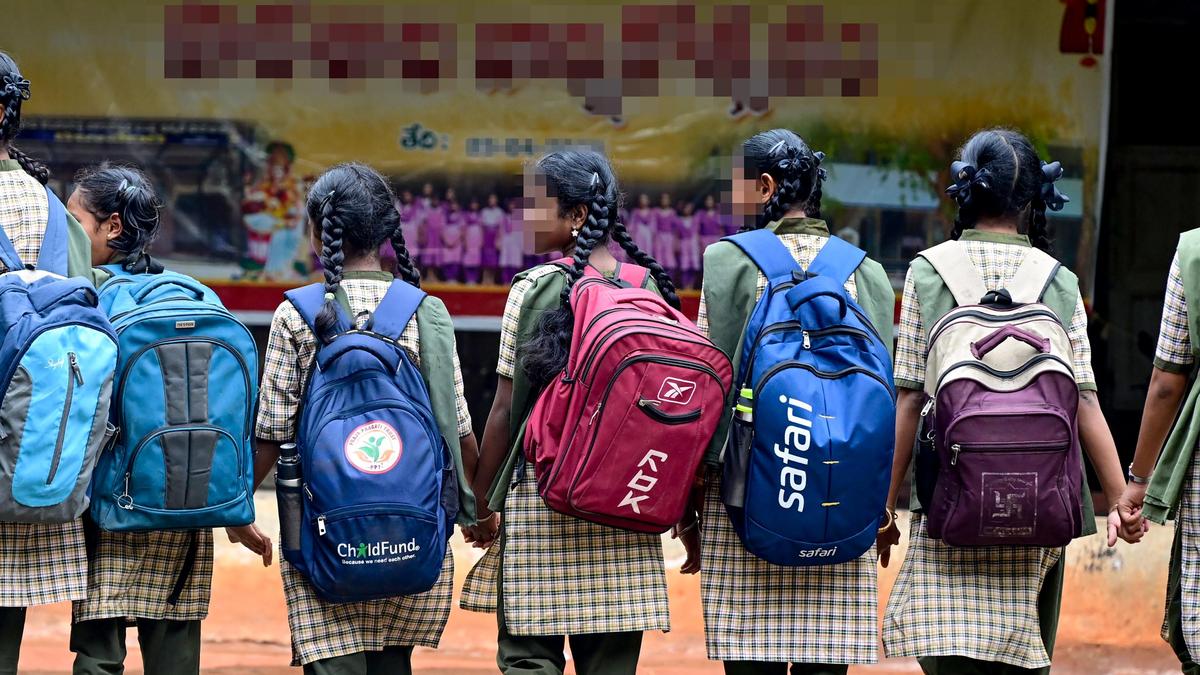
When the summer break came to an end, 10-year-old Adya Pandey, a Class 6 student of Seth Anandram Jaipuria School in Greater Noida West, packed her bag for school. She stuffed a bunch of books inside, including her French textbook, but then, on a sudden realisation, pulled it out and tossed it on the table.“It hasn’t sunk in yet that I won’t be studying French at school any more,” she said.Adya, who studies in an English-medium school, had been learning French and Hindi. She had chosen French as her third language a year ago, when she was in Class 5. In April, when the academic session of 2026-27 began, she attended French classes at school and diligently finished studying three chapters from her textbook.However, in the same month, the Central Board of Secondary Education (CBSE) directed all affiliated schools, with altogether about 40 lakh children, to implement the three-language formula under the National Education Policy (NEP), 2020, from Class 6. The policy requires that two of the three languages be native Indian languages (Bhartiya Bhasha).Following this, many English-medium schools, including Adya’s, issued circulars in May saying they would discontinue foreign languages such as French as the third language. The CBSE also considers English a foreign language, despite it being one of the 22 official languages in the Eighth Schedule of the Constitution.In place of foreign languages, many schools decided to offer Sanskrit as the third language. A circular from Delhi Public School in Greater Noida West explained, “Because of the linguistic diversity of our learners, implementation of any other native Indian language is not logistically viable. Therefore, as a school, we have decided to offer Sanskrit as the third language.”Editorial | Language decorum: On the three-language formula in CBSE schoolsAdya said she was shocked to receive a circular from her school asking students to stop learning German and French at school. “Around 25 of us had chosen French, 20 had opted for German, and only 15 had chosen Sanskrit. Now, all 60 of us will have to learn Sanskrit,” she said.Her mother, Monika, said that Sanskrit has become largely obsolete today. “Adya can fluently recite shlokas from Hindu scriptures such as the Ramcharitmanas and the Hanuman Chalisa. These are the values we inculcate at home, but I believe learning a foreign language will help her from a career perspective,” said Monika.The three-language formula proposed by the NEP, 2020, which mandates that students learn at least two native Indian languages, has departed from the previous policy of 1968, which had emphasised the study of Hindi, English, and a modern Indian language (preferably one of the southern languages) in Hindi-speaking States, and Hindi, English, and a regional language in the non-Hindi speaking States.The hasty roll-out of the policy, and the subsequent change in rules by the government, have caused chaos in CBSE schools across the country, with parents and students struggling with curriculum shifts and shortage of teachers.Backlash and brief respiteBani, 12, is a Class 8 student at Delhi Public School, Vasant Kunj. She was admitted under the Economically Weaker Section quota and has been studying French for the last four years. Her father, Navraj, works as a driver, while her mother, Saraswati, takes up cooking and housekeeping jobs to help support the family.In May, Navraj was among the many parents who moved the Supreme Court challenging another CBSE circular, issued on May 15. It stated that all Class 9 students — including those who had previously been studying foreign languages — would instead study three languages, two of which must be native to India. Until this circular was issued, Class 9 students were required to study only two languages.Although the directive applied only to Class 9, many schools forced students in Classes 7 and 8 to drop foreign languages as well, say parents. After the Court refused to stay the CBSE circular, the hopes of students of continuing to study the foreign language of their choice were dashed.On June 25, however, following a backlash, Union Education Minister Dharmendra Pradhan clarified that the CBSE would relax its requirement for the present students of Classes 7,8, and 9 to switch abruptly, mid-session, from studying a foreign language to studying a native Indian one. However, Classes 7,8, and 9 students will still have to study a third language native to India.For instance, if a student studying in an English-medium school chose French as her second language, she would, as per the May circular, have had to drop French and learn two languages native to India. But following the clarification, she can continue learning French but will still have to study a native tongue, which can be Hindi or any other regional language.Bani falls under this category. “I am glad I can continue learning the language I have been learning since Class 4,” she said.This indecisiveness on the part of the Ministry of Education regarding the language policy has caused confusion across schools. After the CBSE stated that Class 9 students would have to switch mid-session from foreign to native languages, many schools, such as Heritage Xperiential Learning School in Gurugram, either let go of their foreign language teachers or reassigned them to teach other subjects.What does NEP, 2020 state about languages? | ExplainedA principal from a private CBSE English-medium school in Mangaluru, Karnataka, said, “Earlier, we offered French, but after the CBSE circular in May, we let go of the French teacher. We also had an option for students to learn Konkani, but since we could not find a qualified Konkani teacher, we dropped it from the list. Now, we offer only English, Hindi, Kannada and Sanskrit.”CBSE-affiliated schools in Puducherry had dropped French from the 2026-27 curriculum. This raised concerns over the livelihoods of French teachers in schools in the Union Territory where French enjoys constitutional recognition.Also read | Foreign language teachers face displacement amid new CBSE language policyForeign languages impacted According to data accessed by The Hindu, about 4.5 lakh students in India study French in school, while nearly 1.5 lakh learn German. In many schools, students begin learning these foreign languages as early as Classes 4, 5, or 6.CBSE has stated that it has relaxed norms only for students in Classes 7, 8, and 9 who have already chosen a foreign language, but students in Class 6 will have to opt to learn three languages, of which two will have to be native to India. This essentially means that foreign language teaching will eventually be phased out of CBSE schools.This decision has ruffled feathers in diplomatic circles. Sources said that the German and French embassies, which invest “significant funds” running into millions of euros in developing teaching infrastructure, preparing course materials, training teachers, and conducting language exams jointly “pushed back” against the Indian government’s decision. A spokesperson of the German embassy said to The Hindu, “The embassy has confirmed that it is in contact with the Indian government on the issue.”The Centre’s decision to reduce the role of foreign languages such as French and German in schools appears to be at odds with its broader efforts to strengthen educational and diplomatic ties with European countries.Earlier this year, during Prime Minister Narendra Modi’s visit to Germany, he and German Chancellor Friedrich Merz noted the growing number of Indian students pursuing higher education in Germany and welcomed the creation of an Indo-German Comprehensive Roadmap on Higher Education, according to a statement issued by the Ministry of External Affairs.“Germany is an attractive market for skilled Indian labour and there is an ambitious plan in place there for the migration of skilled labour,” said a source. “Learning German is important for this community. How can you fulfil their ambitions if you don’t support foreign language learning?”Anuradha Karkun, a French language trainer and teacher based in the National Capital Region, said, “Students perceive learning foreign languages like French and German useful as it also helps them gain admission in renowned universities abroad. A working knowledge of the country’s language in which a student wishes to pursue higher education is favourable even if the course is being taught in English.”Karkun is also a qualified examiner for the Diplôme d’Études en Langue Française (DELF). The DELF and the DALF (Diplôme Approfondi de Langue Française) are official international French language diplomas issued by the French Ministry of Education and are recognised for study, work, and immigration in French-speaking countries.She explained that DELF certificates are in high demand among school students. According to data cited by The Hindu, around 11,000 candidates take the DELF examinations each year, including about 4,000 students who appear for DELF Junior, designed for school learners.“Candidates as young as 11 years old (Class 6) prepare for DELF A1 levels,” said Karkun. “By the time they are in Class 12, many progress to fairly advanced levels of B2. Early learning is made possible because they are already studying French at school. Learning a foreign language, in this case French, enables students to gain a broader intercultural world view empowering them as future ambassadors of India and global citizens.”The cost of compulsionThe NEP 2020 states that it offers greater flexibility in the three-language formula and that no language will be imposed on any State. It says that the three languages learned by students will be determined by the choices of States, regions, and the students themselves, provided that at least two of the three languages are native to India.However, data indicate that the implementation of the three-language policy varies widely across States. According to an analysis of the share of schools based on languages taught at the primary stage (Classes 1-5), conducted by the National Council of Educational Research and Training (NCERT) in 2009, Hindi-speaking States largely opt for Sanskrit as the third language in school. This is the last such data available on language preferences in schools across India, as no follow-up survey was conducted by the NCERT. It is not available in the public domain and was accessed by The Hindu through sources.
Inside India’s language conundrum
Explore the challenges and confusion surrounding India's three-language policy implementation in schools under the National Education Policy 2020.
2,400 words~11 min read