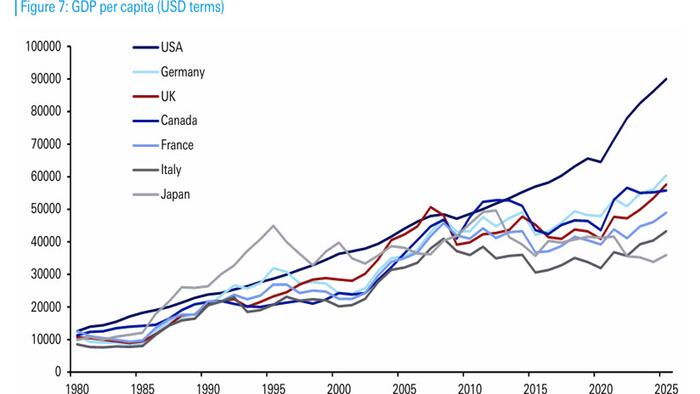
To mark the 250 year anniversary of the US Declaration of Independence, Deutsche Bank has published a report looking at how the US emerged as a global superpower, and why it’s likely to remain one despite new challenges.First, DB considers how the US went from being a comparatively small country to the world's pre-eminent global power. These reasons range from the US' natural advantages, like favorable geography, to factors like its institutional stability and risk-tolerant capital markets.DB then considers the challenges that threaten US outperformance: China’s rapid growth means the US faces its biggest rival since its own emergence as the world’s dominant power. China's rise also coincides with several other issues: the rules based international system that the US helped create is under immense strain; the reserve currency status of the US Dollar is under pressure; and the country's public debt-to-GDP ratio is set to hit new records in the coming years.Finally, the bank's analysts Peter Sidorov and Henry Allen look at why the US is likely to sustain its outperformance, thanks to a collection of reinforcing advantages. In fact, the US has consistently emerged from challenging periods successfully, be that after the Great Depression, the malaise of the 1970s, and again around the GFC and its aftermath. The bank concludes with a few lessons for investors and for the rest of the world.1. The Lessons from History: What underpins America’s Success?Before delving into the drivers of US success, let us bring with a few highlights of its historical outperformance. Since the United States' founding, the country has achieved remarkable economic success on a whole range of metrics. For one, the US saw rapid growth in population. It started as a comparatively small entity at its founding, but it quickly surged to overtake the large European countries in the mid 19th century and has continued to outpace them since. And with more people, it was little surprise that US GDP rapidly outpaced other countries too.This success extends beyond GDP growth. Unlike France or Germany, the US has never had a bout of hyperinflation in its history, with its currency maintaining its value comparatively well. Meanwhile, the US’ long-term equity performance has also been very strong. In the time since equity data is available from the late-19th century, real returns have outpaced the UK and Germany by substantial marginsSo what has caused this incredible success?The first reason, and one of the most critical historically, has been the US’ political and institutional stability. Clearly, there have been moments of intense turmoil, most notably with the Civil War in the 1860s. Its historical path also should not be over-romanticised, with US territorial expansion during the 19th century having many similarities to that of the Old World colonial empires. Nonetheless, the US is incredibly rare in that its political system is recognizably the same over the last 200 years. This relative stability and early development of property rights provided a fertile environment for long-term investments, which in turn has aided economic growth over the centuries.The second reason is its geographic advantages. The US possesses vast arable land, navigable rivers, large coastlines, and access to two oceans. It therefore found itself more insulated from the destructive effects of the world wars, with productive capacity not impacted in the same way. Moreover, the country borders Mexico and Canada, who in both population and GDP terms are much smaller than the United States, meaning it didn’t face the security risks that many European powers faced over the 19th and early-20th centuries.The third reason has been its abundance of energy resources, particularly relative to Europe. In large part a corollary of its geographic strengths, this energy abundance has given the US several advantages. First of all, lowering costs for households and industry, which has helped the economy be more resilient against geopolitical shocks. Moreover, with the US becoming a net energy exporter in recent years, it also strengthens the external position.The fourth reason for the US' relative success was that its main competitors in Europe were deeply affected by the world wars and wider political turmoil. Their productive and financial capacity was severely degraded, with the destruction causing huge loss of life as well. Even among those who survived, many scientists, engineers and entrepreneurs left for the US in the first half of the 20th century. Whilst not a US “success” as such, this meant that on a relative basis, the US’ divergence widened considerably. Indeed, in the first half of the 20th century, the US economy grew by 5.7 times, Germany by 3.4 times, the UK by 2.0 times, and France by 1.8 times.The fifth reason for the US’ outperformance is scale. It has a large domestic market of over 300m people, with high average incomes, a common language, and low internal barriers to trade. This has given firms the ability to reach a large-scale domestically before expanding abroad. Indeed, it is notable that 8 of the world’s 10 largest firms are based in the US, whereas none are in Europe.The sixth reason is the structural advantage of the US Dollar, which remains dominant in global trade and FX reserves. This dollar demand matters because it lowers borrowing costs and raises demand for US Treasuries. In turn, it leaves the US with an exceptional capacity to run bigger fiscal and external deficits without facing a funding crisis, and expands the geopolitical leverage that the US possesses. This has been dubbed the “exorbitant privilege”, and has been a major advantage in recent decades.The seventh reason is financial depth. The US has a large banking system, but also a wide range of non-bank financing, which means startups have access to other sources of capital. In fact, in the decade from 2013 to 2023, annual venture capital financing was 0.7% of GDP in the US, compared to just 0.2% in the EU. This financial depth is important because innovative firms can often be loss-making for lengthy periods, so countries with bigger pools of patient risk capital are better placed to commercialise new technologies.The eighth reason is its self-compounding advantages in education and research. The US has many of the world’s strongest research universities, including 7 of the top 10 in the Times Higher Education World University Rankings for 2026. Moreover, this research also has an economic angle, as scientific discoveries feed into startups, workforce training and industrial scale-ups. In turn, this becomes self compounding, because top global talent is attracted to the US, and ensures it remains at the forefront of new sectors such as artificial intelligence.The ninth reason is its pro-business architecture, including a greater tolerance of business failure than many European systems. For instance, Chapter 11 reorganisation is designed to preserve and restructure viable firms rather than liquidate them. This more positive approach to business failure ties into the empirical literature, which suggests that more debtor-friendly and efficient insolvency frameworks are associated with greater entrepreneurship and innovation.The tenth reason is adaptability. The cultural acceptance of failure and capacity to reinvent itself have boosted US ability to adapt to the changing world. This has allowed it to navigate repeat boom-and-bust cycles, as well swings of the policy pendulum – between openness and isolationism, between protectionism and free trade – without threatening overall the institutional stability we highlighted above. And while capitalism has been a key underlying driving force, it is pragmatism rather than ideology that have driven continued success over time.It is also important to note that these advantages do not play out individually, but are mutually reinforcing, with the interaction between them allowing the US to benefit from network and externality effects that few if any countries can match.US history has been marked by challenges and recoveriesThat said, this success story was far from a straight line. US outperformance has frequently been questioned, yet it has repeatedly defied the sceptics, including at numerous points in the last century.Right from the country’s founding, questions were raised about its long-term potential, and in the Civil War of the 1860s, the nation’s survival was at stake after less than a century.Even over the past 100 years, which has ostensibly been a period of US pre eminence, there have frequently been doubts. For example, after the Wall Street Crash of 1929, the Great Depression saw unemployment peak above 25% and remain above 10% for an entire decade. The associated stock market collapse saw the S&P 500 fall by -86% from peak-to-trough, not reaching its 1929 peak again until 1954. This was a global shock, but it undermined faith in the US system of freemarket capitalism.However, the country eventually pulled out of the slump. That started with Franklin Roosevelt’s New Deal program, which helped to restore confidence and economic activity. Then the start of WWII saw economic activity surge even further, particularly as there wasn’t fighting on US soil. By the end of WWII, the US had never been in a stronger position relative to its peers, not least with Europe having to rebuild after the war.Similar doubts were clear as the US grappled with the various crises of the 1960s and 70s. This period saw major political turmoil and multiple assassinations, including President Kennedy in 1963, his brother and presidential candidate Robert Kennedy in 1968, and civil rights leader Martin Luther King Jr. in 1968. A few years later, Richard Nixon became the first president to resign from office amidst the Watergate scandal. US military power was also facing questions at this time, as the Vietnam War turned into a protracted conflict that also faced substantial domestic opposition.Then on the economic front, inflation started to gather pace from the late-1960s, surging further after the first oil shock of 1973, leading to a 16-month recession. Measures were imposed to conserve energy, including the National Maximum Speed Limit, which wasn’t repealed until 1995. Then in 1979, a second oil shock drove inflation up again.This turmoil raised questions about whether policymakers could effectively tackle the crises of the day. In 1979, President Jimmy Carter delivered what was widely referred to as the “malaise” speech, although it was actually called “A crisis of confidence”. He said there was “growing doubt about the meaning of our own lives and in the loss of a unity of purpose for our nation.” He spoke of a “growing disrespect” for institutions, and said how the public often “see paralysis and stagnation and drift.” Even the US president was acknowledging that the country was facing huge issues.Nevertheless, the US then recovered strongly into the 1980s and 90s. Inflation was tamed, albeit with drastic monetary tightening, and the economy saw rapid growth once it recovered from the early 1980s recession. In 1991, the dissolution of the Soviet Union marked an end to the Cold War, and the 1990s were widely considered a unipolar moment where the US was left as the unmatched global superpower. So
US At 250: Why America Has Been So Successful And Can It Continue
how the US emerged as a global superpower, and why it’s likely to remain one despite new challenges.
5,145 words~23 min read