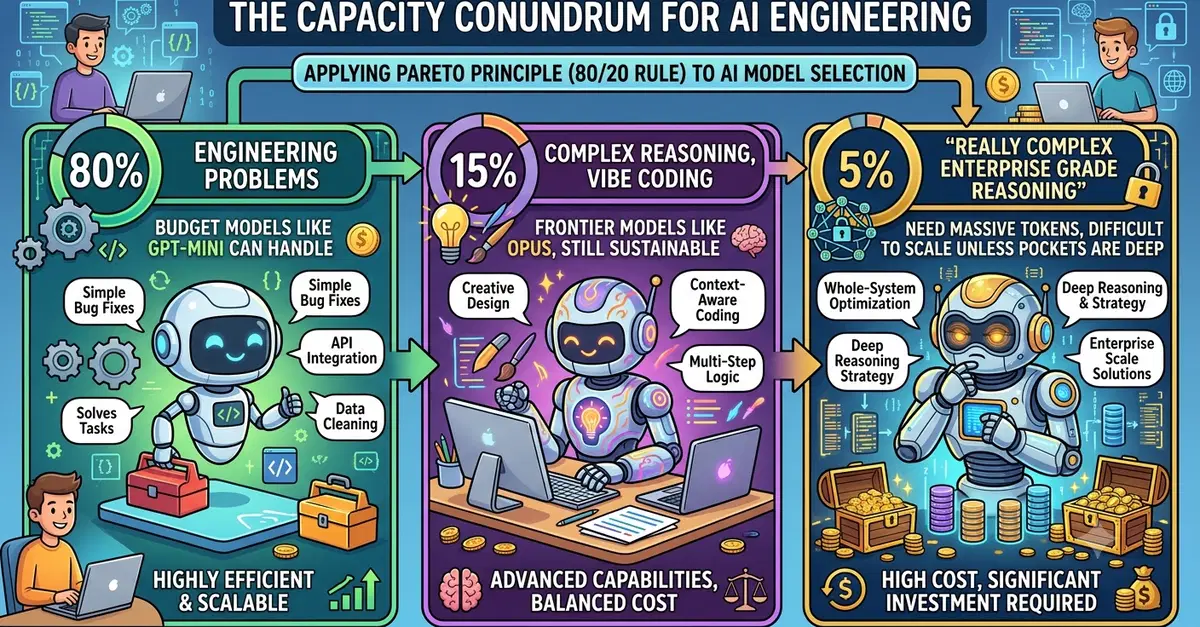
In the gold rush of modern software development, a new kind of engineering has taken center stage: AI Engineering. But as developers and enterprises rush to integrate Large Language Models (LLMs) into their workflows, they quickly run into a jarring reality check. It’s what we call the Capacity Conundrum—a structural bottleneck that mirrors the classic Pareto Principle (the 80/20 rule), completely shifting how we think about computing budgets and model selection.
If you try to throw the biggest, smartest model at every single problem, your bank account will bleed out long before your product hits production. Conversely, if you rely entirely on lightweight models, your system will crumble the moment it faces true enterprise complexity.
To build sustainable, scalable AI systems, you have to understand the three distinct tiers of the AI Engineering pyramid.
1. The 80% Tier: The Blue-Collar Workhorses (Highly Efficient & Scalable)
The Rule: 80% of everyday engineering problems can be handled by budget models like GPT-Mini.