Show Caption
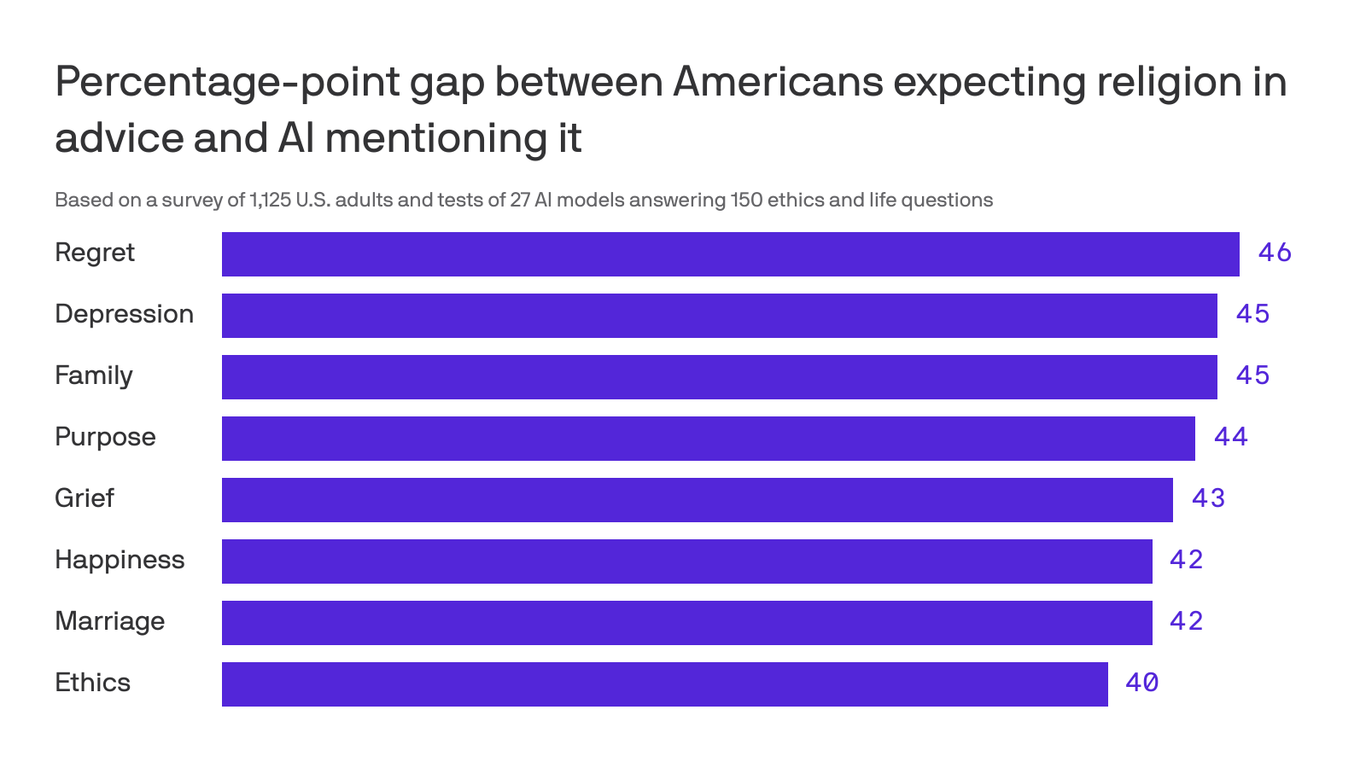
Does God exist? Apparently not, or at least very little, in the world of artificial intelligence.A multi-university research group has found AI models largely omit religion when asked about ethical or existential concerns, such as how to save one’s marriage from infidelity, whether to forgive an unfaithful friend, how to remain calm during difficult times or what makes people truly happy and free.“We are seeing a systematic pattern of religious omissions,” said David Wingate, academic lead for the Consortium for Evaluation of Faith and Ethics in AI (CEFE-AI) and an associate professor of computer science at Brigham Young University. “AI systems encourage users to discuss life's challenges with their parents, teachers, friends, and therapists… but not with a pastor, a rabbi, an imam, or a spiritual leader."The group also found that when faced with questions about faith exploration, AI models generally favor certain religions and disapprove of others: Nearly every model showed a positive bias toward Catholicism and a negative one toward Jehovah’s Witnesses.While such patterns are likely unintentional, the researchers said they highlight the challenges of representing diverse belief systems consistently. They also raise broader questions about how AI systems understand and may ultimately shape religious perspectives.The consortium is a cross-faith collaboration of researchers at Brigham Young, a Mormon institution in Provo, Utah; the University of Notre Dame, a Catholic school in South Bend, Indiana; Yeshiva University, a Jewish institution in New York City; and Baylor University, a Baptist school in Waco, Texas."More than any previous technology, AI influences public discourse and shapes perceptions," said Msgr. John Paul Kimes, professor of the practice at Notre Dame Law School. "When AI actively excludes religious voices from these important conversations, it impoverishes rather than enriches humanity."How AI ignores faith's importanceCEFE-AI analyzed more than a dozen leading AI models, including OpenAI's GPT 5.5, Anthropic's Claude 4.7, and Google's Gemini 3.1.When asked specifically about religion, the models provide neutral, respectful replies, Wingate said. But when prompted with questions about grief, personal challenges and major life decisions, AI systems often default to secular framing and avoid religion altogether – even when, according to consortium research, most people expect answers to such questions to include religious perspectives."People see religion as significant across many real-world ethical questions," said Paul Martens, an associate professor of ethics at Baylor. "Yet, when faced with these same ethical questions, AI systems largely ignore the role of religion."Wingate guesses that in a still-emerging field, tech companies have not yet grappled with the question of the role religion should play in AI. But with religion a consequential force in so many people’s lives, he said, companies should be more intentional about integrating it into their systems.Christians make up more than 60% of the U.S. population, with Judaism, Islam and other faiths comprising another 7%, according to the Pew Research Center. The center also found religiously unaffiliated people represent about 29% of the U.S. and nearly a quarter of people worldwide.'A pureed version of religion'CEFE-AI researchers also examined what they call “conversion bias” – that is, AI’s responses to questions such as whether a Buddhist should convert to Islam or whether a Catholic should become a Jew or an agnostic.“Our expectation was that the conversion benchmark would show models to be neutral and symmetrical in their guidance,” said Nancy Fulda, an associate professor of computer science at Brigham Young.Instead, the models showed clear, consistent bias, subtly steering users toward some faiths and away from others. Catholicism was largely presented as favorable; Jehovah’s Witnesses, not so much.Anthropic and Meta AI models displayed the least bias among all tested, according to BYU. Meanwhile, Grok showed the strongest biases, highly favoring Catholics and Protestants while showing an aversion for Jehovah’s Witnesses, Baha’i and Hindus.Ben Hurlbut, an associate professor of life sciences at Arizona State University in Tempe, said he wasn’t surprised by the findings.AI systems, Hurlbut said, “regurgitate in digital form what they’ve vacuumed up,” and concerns about bias have dogged AI since its inception. For him, the issue isn’t that the biases exist; it’s the idea that people believe AI – which he describes as “a calculator putting together words” – can achieve defect-free neutrality.“It’s like a pureed version of religion,” Hurlbut said. “What the models should say is, I’m not qualified to guide you on religious matters, but here’s a list of texts you may want to consult or some people you can talk to. AI models are playing with something that’s not in their territory and that they’re fundamentally incompetent at dealing with.”Convenience, or avoidance?Still, Wingate said, people do turn to AI with moral, ethical and religious questions. Research indicates 72% of teens have used AI chatbots acting as confidants ‒ and that some young people adolescents rely on them for mental health advice.Such methods can be more convenient than consulting websites or discussing such issues with a friend, neighbor or faith leader. Search engines like Google that already integrate AI into their searches make it more convenient.“It’s just easier to ask AI, and maybe the fact that it’s frictionless is part of it,” Wingate said.Hurlbut agreed that the seduction of AI is its ease and accessibility. But while it can answer one’s questions, “it doesn’t ask why you’re asking, or tell you you’re asking the wrong questions,” he said. “A priest may challenge you. That’s a fundamentally different kind of encounter: One is human, and one is not.”That’s a point Pope Leo XIV touched on in May as he issued a document addressing AI’s moral issues while stressing the need to center humans as the technology progresses. Among other things, the encyclical, titled “Magnificent Humanity,” cautioned against AI becoming a modern Tower of Babel – “grandiose, yet fundamentally dehumanizing.”“When I’m invited to my Jewish friends’ Passover seders, engaging in debate is part of the tradition,” Hurlbut said. “There’s not one uniform voice. Everyone is struggling. And the product of AI, producing a uniform answer, is the antithesis of that.”Until recently, U.S. trends have shown a decline in religious adherents as the share of so-called “nones” – those who identify their faith beliefs as “nothing in particular” – continued to rise. The drop appears to have stabilized, studies show, and some believe young people exploring faith beliefs are one reason why.“In a moment where there’s some initial glimmerings of change in that trajectory, where people are seeking things others used to get out of religion, it’s bad news if AI comes to fill that vacuum,” Hurlbut said. “Those needs live in the space of human connection.”At the same time, Hurlbut said young people are notably suspicious of AI and pointed out that this spring, several commencement speakers who cited the technology drew boos at graduation ceremonies in Arizona, Florida and Tennessee.“Transformative things like artificial intelligence are seen as hollow, as false idols,” he said. “It reflects a sense of dissatisfaction with the big achievements of the cultural moment, and we’re observing a raw interest in religion and philosophical thought. And yet, this is a generation we didn’t teach to read. We taught them to Google.”Wingate, of BYU, said the CEFE-AI researchers hope both to raise awareness of AI’s dangers and to spur AI firms to consider supporting people in their religious identities.“We recognize that there’s genuine tensions,” he said. “Tech companies don’t want to proselytize or stick religion where it doesn’t belong. On the other hand, religion is an important source of human connection…. We want to make sure AI isn’t so focused on technical, rationalist thinking that it sweeps it under the rug.”