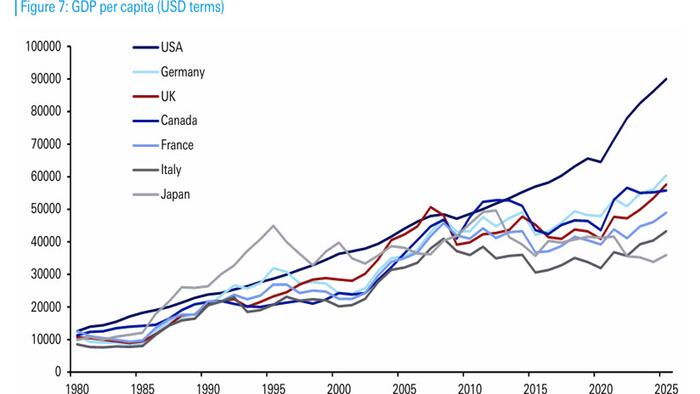
As the United States celebrates its 250th birthday, the American Chamber of Commerce Ireland (AmCham) marks 65 years since its establishment in 1961. Today 1,002 US companies have operations here. Between them they directly employed just under a quarter of a million people by the end of last year, up 16 per cent on the previous year. In addition, there are 781 Irish-owned companies in the US, directly employing 202,000 people. Ireland is now the fifth-largest source of foreign direct investment (FDI) in the USA. The relationship continues to deepen. The most recent AmCham quarterly FDI insights survey shows 85 per cent of respondents rate the strategic importance of the Irish operations within their organisation’s global footprint as equally if not more important than it was five years ago. “People sometimes assume JP Morgan is a relatively recent arrival in Ireland but our roots here actually go back to 1919,” says Marc Hussey, head of Ireland, JPMorganChase, the USA’s largest bank. “We’ve been part of the fabric of Irish financial services for over a century, and the relationship has only deepened over time. Back in 1968, we became the first international bank to obtain a licence to service offshore funds in what would go on to become the IFSC, and we’ve been helping to shape Ireland’s funds industry ever since.” Fund administration is a key part of the bank’s global securities services division. “Ireland is truly a world leader in that space. It’s no coincidence that our global head of that business, Tim Fitzgerald, is Irish and is based here,” says Hussey. Today JP Morgan employs nearly 600 people in Dublin and Cork, servicing more than $657 billion (€573 billion) in assets under administration and, more widely, offers services in fund accounting, custody banking, the servicing of exchange-traded funds, financial reporting and tax services. Its Irish office is also its European hub to service alternative funds, hedge funds and private-equity firms. Dublin is one of the central locations for the company’s global payments business, which processes more than $10 trillion every day across over 120 currencies in more than 160 countries. Marc Hussey, JPMorgan Chase: 'The fundamentals are simply compelling' “Our 2022 acquisition of Cork-headquartered Global Shares – now JP Morgan Workplace Solutions – is one of my favourite examples of what Ireland can do and has to be one of the best companies we have bought in recent years,” says Hussey. “It’s a home-grown Irish business that manages the employee share programmes for many of the world’s leading companies and is now a key offering of our wealth management business.” Such opportunities are just one reason it continues to invest in Ireland. “The fundamentals are simply compelling – an attractive corporate tax regime, a pro-business regulatory environment, and a highly skilled, English-speaking workforce that has become even more strategically important since Brexit.” In 2020, when it was looking for a location to build a key part of its cybersecurity operation within its tech division, Dublin was the obvious choice, and the company has continued to hire people locally for that ever since. “Ireland has talent, ambition and an open, outward-looking economy. We’re proud to be part of that story, and we have every intention of keeping it that way,” says Hussey. Analog Devices Inc (ADI), a global semiconductor leader, is another long-term investor with deep roots here. “Ireland has been central to ADI’s story for over 50 years. We established our first manufacturing presence outside the United States in Limerick in the mid-1970s, marking a significant milestone both for ADI and for Ireland’s emerging semiconductor sector,” says Martin Cotter, senior vice-president, global vertical business units, at Analog Devices and president ADI EMEA. Martin Cotter, senior vice president, global vertical business units, at Analog Devices and president of ADI EMEA “Over time, this early investment helped lay the foundations for Ireland’s reputation as a hub for advanced manufacturing and engineering excellence.”What began as a manufacturing operation has grown into a strategic centre that today spans research and development, manufacturing, and commercial functions.Ireland continues to play a critical role in ADI’s global operations. “We are lucky to benefit from several enduring strengths that support our presence here, including access to a highly skilled talent pool, strong collaboration between industry and academia, and a stable, supportive business environment,” says Cotter.“Looking ahead, ADI sees Ireland as an important long-term location for advancing next-generation technologies and supporting its global ambitions, particularly as demand grows for intelligent, connected systems that link the physical and digital worlds.”The presence of US multinationals such as JP Morgan and ADI has had a transformative impact on the indigenous sector. “Strong US FDI has helped build a highly competitive domestic enterprise base by fostering innovation, skills transfer and global business practices,” says Aidan McKenna, head of Americas at Enterprise Ireland. “Indigenous firms have benefited from proximity to leading multinationals, which has driven productivity improvements and encouraged Irish companies to scale internationally. At the same time, the success of Irish firms abroad – evidenced by Enterprise Ireland-supported exports to the US reaching €6.71 billion in 2025 – shows how this ecosystem has strengthened indigenous export capacity.” Being part of US multinationals’ supply chains is particularly valuable in supporting export performance.“Irish firms embedded in global value chains gain credibility, access to large-scale procurement opportunities, and exposure to advanced technologies,” he explains. “This integration enables them to refine their products and services to meet global standards, making them more competitive internationally.” Following decades of investment by US multinationals, Ireland has a particularly strong reputation in technology, life sciences, medical devices and financial services. “These investments have generated significant employment, increased tax revenues and contributed to Ireland having one of the highest levels of GDP per capita in the European Union,” says Louise Kelly, partner and global trade strategy and resilience lead at Deloitte Ireland. Louise Kelly, partner and global trade strategy and resilience lead, Deloitte Ireland But Ireland must keep an eye on headwinds. “Geopolitical uncertainty, changing trade policies, the introduction of global tax and increasing competition for US multinational investment from other countries are external challenges that have come to the fore. Closer to home, infrastructure constraints, including the availability of housing, pose a threat to investment if not addressed.” Last year’s commitment on capital spending by the Government in energy, water, housing and transport was welcome, but must be delivered. “Further Government investment in innovation, including incentives for R&D and innovation, will be required for Ireland to maintain its strong standing as key location for US MNC investment as we move through the fourth industrial revolution that AI has unveiled,” Kelly adds.
USA 250: Legacy of US companies in Ireland endures
Politics and increasing competition yet to undermine strategic and deepening relationship across the Atlantic
1,101 words~5 min read