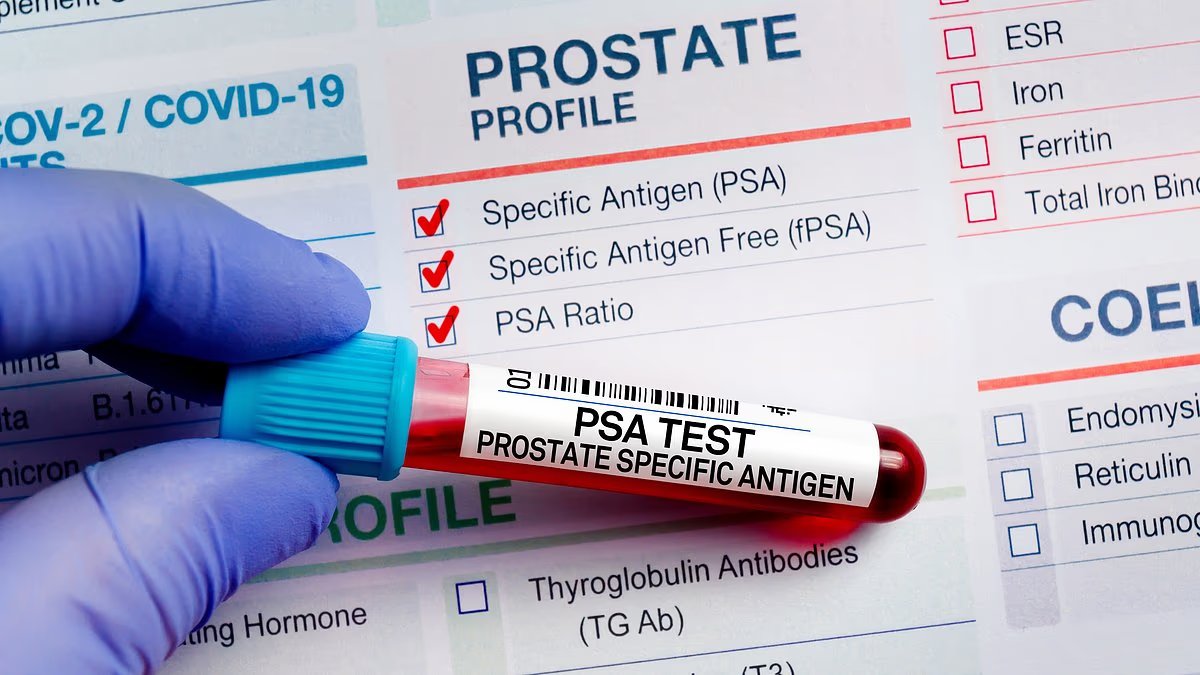
Imagine your father died of prostate cancer. Or your brother. You know that family history significantly increases your own risk of developing the disease.Or imagine you are a black man. You know your lifetime risk of prostate cancer is one in four – the highest of any major group in the UK.Now imagine being told that despite your elevated risk, the health system still will not proactively invite you for screening. That is the reality facing millions of men across Britain today.This is a disease that kills more than 12,000 men every year. We know that finding it early dramatically improves the chances of successful treatment. Yet despite that, the Government’s answer to the overwhelming majority of men at increased risk remains the same: no proactive invitation for screening.That is the extraordinary reality created by last week’s decision to accept the recommendation of the UK National Screening Committee on prostate cancer.Behind the technical language lies a simple truth. The overwhelming majority of men at increased risk of prostate cancer will continue to be excluded from screening. That includes most black men and most men with a family history of the disease.For those families, this is not a policy debate. It is a question of who gets the chance to find cancer early and who does not.The National Screening Committee insists that its recommendation relates to organised screening rather than PSA testing itself. Prostate cancer is a disease that kills more than 12,000 men every year. We know that finding it early dramatically improves the chances of successful treatment The majority of men at increased risk of prostate cancer will continue to be excluded from screening. That includes most black men and most men with a family history of the diseaseTechnically, that is true. Men remain free to ask their GP for a PSA test. But anyone who has tried to access one from their GP or understands how public policy works knows that this distinction will be lost on many people.What millions of men and doctors will hear is much simpler: the experts looked at screening and decided it was not worth doing.That perception matters. Men are already less likely to seek medical advice, less likely to attend appointments and more likely to ignore warning signs. Some men who might otherwise have come forward will now conclude there is no need.Some cancers that could have been found earlier will be found later. And when it is found later, the consequences can be devastating. Discouraging early detection does not eliminate cancer. It simply changes when you find it.What makes the decision particularly difficult to understand is that medicine has moved on. MRI scans, targeted biopsies, active surveillance and better risk assessment have transformed prostate cancer diagnosis, yet the National Screening Committee approaches screening as though these advances barely exist.The committee was created to save lives. Increasingly, however, it appears to have become an organisation more interested in explaining why screening cannot happen than how it can.Faced with black men at one-in-four lifetime risk, it says no. Faced with men carrying a family history of the disease, it says no. Faced with emerging technologies that promise to improve the balance between benefits and harms, it appears more interested in identifying obstacles than opportunities.The composition of the committee raises questions of its own. A committee that rejected targeted screening for black men appears to contain no black members. The National Screening Committee insists that its recommendation relates to organised screening, not PSA testing, which men remain free to ask their GP forA committee making one of the most important prostate cancer decisions in modern British history contains no practising oncologist.Who exactly is in the room when these decisions are being made, and who is not?The decision also raises uncomfortable questions about the people leading it. Sir Mike Richards, the chair of the National Screening Committee, knows better than most the value of early detection because he has experienced it himself.His prostate cancer was found early, he received treatment and he survived. It is precisely the outcome we should want for every man diagnosed with this disease.Yet it is impossible to ignore the contradiction at the heart of this decision. A man whose life may have been saved by early diagnosis now finds himself defending a system that refuses to proactively offer the same opportunity to millions of men at significantly increased risk.Defenders of the decision will argue that no man is being denied a PSA test. Technically, they are correct. But organised screening programmes exist for a reason.Healthcare should not depend on who shouts loudest, who understands the system best or who happens to read the right article.The men who are most confident, best informed and most able to navigate the system will continue to seek testing. Many others will not. It is the most disadvantaged who pay the price. Sir Mike Richards, the chair of the National Screening Committee, knows better than most the value of early detection because he has experienced it himselfIf Sir Mike has become the public face of this decision, Professor Anne Mackie has become the guardian of the culture that made it possible.As the senior official responsible for overseeing the National Screening Committee’s programme of work, few people have had more influence over screening policy.Under her watch, every innovation seems to arrive accompanied by another reason to wait, every opportunity by another review and every advance by another warning. What began as scientific caution increasingly resembles an institutional instinct to say no.Scientific caution is important but there comes a point when caution stops protecting patients and starts failing them. What began as scientific scepticism appears to have hardened into institutional dogma.The question is no longer whether the committee is sufficiently sceptical. It is whether it has become so committed to saying no that it has forgotten its primary purpose: saving lives.The prostate cancer decision is not an isolated example. For years, the committee resisted a national lung cancer screening programme despite growing evidence and increasing clinical support.The NHS has since moved ahead with targeted lung screening, raising an obvious question: is the committee’s instinct too often to delay rather than lead?All of this might sound like an argument about process, policy or scientific debate. It is not. The consequences of this decision will not be felt in committee rooms, consultation documents or government offices. They will be felt by patients and families.They will be the men who never receive an invitation, the black father who assumes he is not at risk because nobody contacted him, the son whose family history should have triggered earlier action and the husband whose cancer is discovered only after symptoms appear.No screening programme is perfect. Every decision involves balancing benefits against harms. But the purpose of a screening committee is not to eliminate every uncertainty, it is to save lives.The National Screening Committee appears more interested in explaining why screening cannot happen.When the science changes, it does not appear to adapt. When patients speak, it does not appear to listen. When experts raise concerns, it presses ahead regardless.The question is no longer whether the National Screening Committee got this decision wrong. The question is whether the committee that says ‘no’ is still fit to decide Britain’s screening policy.
NICK JONES: The panel denying cancer screening isn't fit for purpose
Imagine your father died of prostate cancer. Or your brother. You know that family history significantly increases your own risk of developing the disease.
1,206 words~5 min read