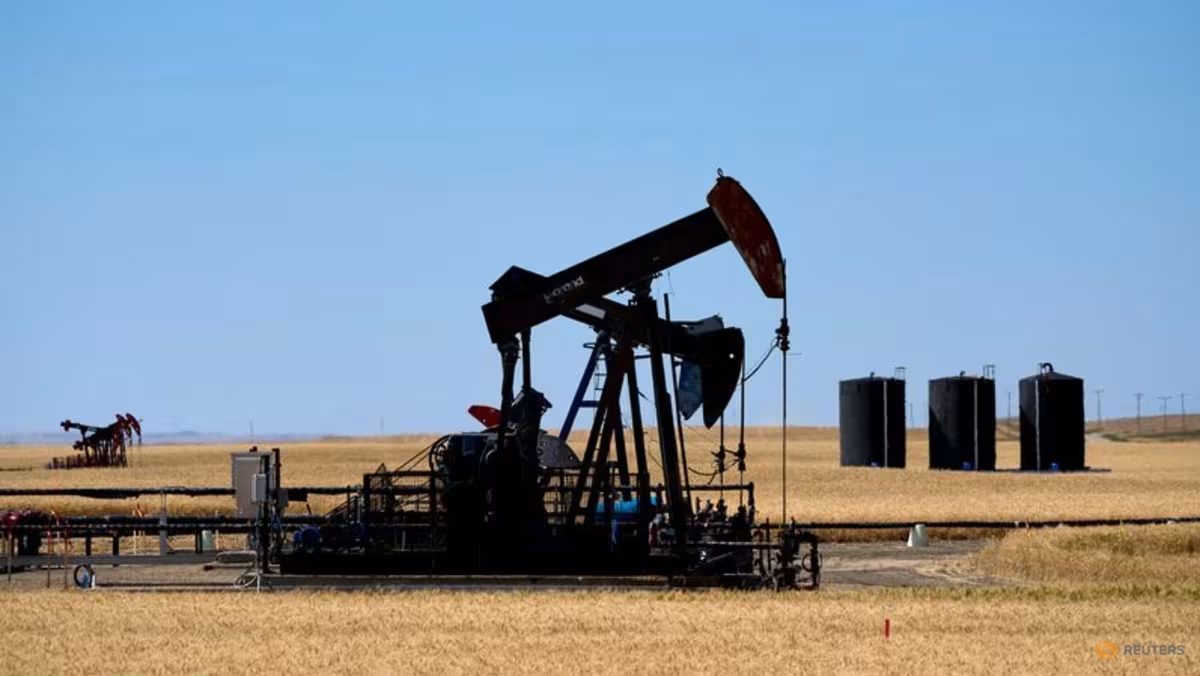
The seven-member group of OPEC+ oil producers that has been restraining production since 2023 is set to extend a series of output quota hikes they launched after the U.S. and Israeli strikes on Iran that set off the latest war in the Middle East. Yet the UAE is already shipping record volumes of crude abroad, right after it quit OPEC.According to unnamed sources who spoke to Reuters, the OPEC seven, including Saudi Arabia, Russia, Iraq, Kuwait, Algeria, Kazakhstan, and Oman, will likely decide to boost their production quotas for August by another 188,000 barrels daily, after last month agreeing a same-size production boost for July, which, unlike the previous hikes, may actually take place.OPEC+ has been hiking production almost since the war began, but these hikes have remained on paper as production in the Persian Gulf remained paralyzed by the hostilities and Iran’s decision to close the Strait of Hormuz. That decision forced Gulf producers to stock up what they could and then start shutting in wells. Iraq was especially hard hit by the Hormuz shutdown, with its production dropping from over 4 million barrels daily to less than 2 million barrels daily. The hikes until now were likely aimed at calming traders that once it was possible to boost production, the Gulf states would do so, while producers such as Russia and Kazakhstan, unaffected by the Hormuz situation, would ramp up to ease the shock of the Middle East supply crunch.Meanwhile, however, the UAE decided to quit the oil-producing group. After six decades as a member, the Emirates decided it was time to go it alone and pulled out, sparking predictions that they would immediately start boosting production. For now, they are only boosting exports—and considerably.Reuters again reported this week that the UAE shipped a record volume of crude abroad in June, at an average daily rate of 3.7 million barrels daily, according to data from Kpler. Vortexa calculated even higher export volumes, at up to 4 million barrels daily last month.“The rise can be attributed to multiple factors, including a resumption in flows via the Strait of Hormuz, helping to free trapped vessels,” Johannes Rauball, a senior oil analyst at Kpler, told Reuters. “At the same time, we have been observing a ramp up in supply from the UAE, which we estimate is closing in on pre-war levels,” he added.The Kpler analyst noted, however, that the record volumes are at least partially coming from oil kept in storage during the hostilities over the past five months. This implies that volumes may weaken as storage drains and before production ramp-up materializes. The question this situation poses is one that analysts have been asking for at least five years now: has OPEC lost its relevance?Based on Kazakhstan’s statement, it has no plans to leave OPEC+ and Iraq’s swift U-turn after suggesting it might quit OPEC in order to boost production, the answer is, for now, negative. But that it has lost some of its clout on global oil markets is a fact, resulting mostly from the rise of the U.S. as the biggest oil producer in the world. It is interesting that the UAE decided to quit in this context—the U.S. is a massive competitor and capable of ramping up its own production very fast, as evidenced by the latest record, booked in May of close to 14 million barrels daily.What all this means is persistent pressure on oil prices, which are not what any producer, either the U.S. or the UAE—or indeed OPEC+ —wants. Global benchmarks are already back to pre-war levels, thanks to the U.S. production record and all the reports about recovering tanker traffic in Hormuz. One wonders how low the non-OPEC majors would let prices fall before they act.By Irina Slav for Oilprice.comMore Top Reads From Oilprice.comKyrgyzstan Scrambles for Backup Fuel Supplies as Russian Shortage BitesRussia Ramps Up Pressure on Kyiv With Deadliest Strikes in MonthsTrump Targets California Again In SpaceX Feud
OPEC+ Plans Another Output Hike. The Market Barely Notices. | OilPrice.com
OPEC+ is expected to approve another production quota increase for August as Gulf oil output gradually recovers following the reopening of the Strait of Hormuz.
656 words~3 min read