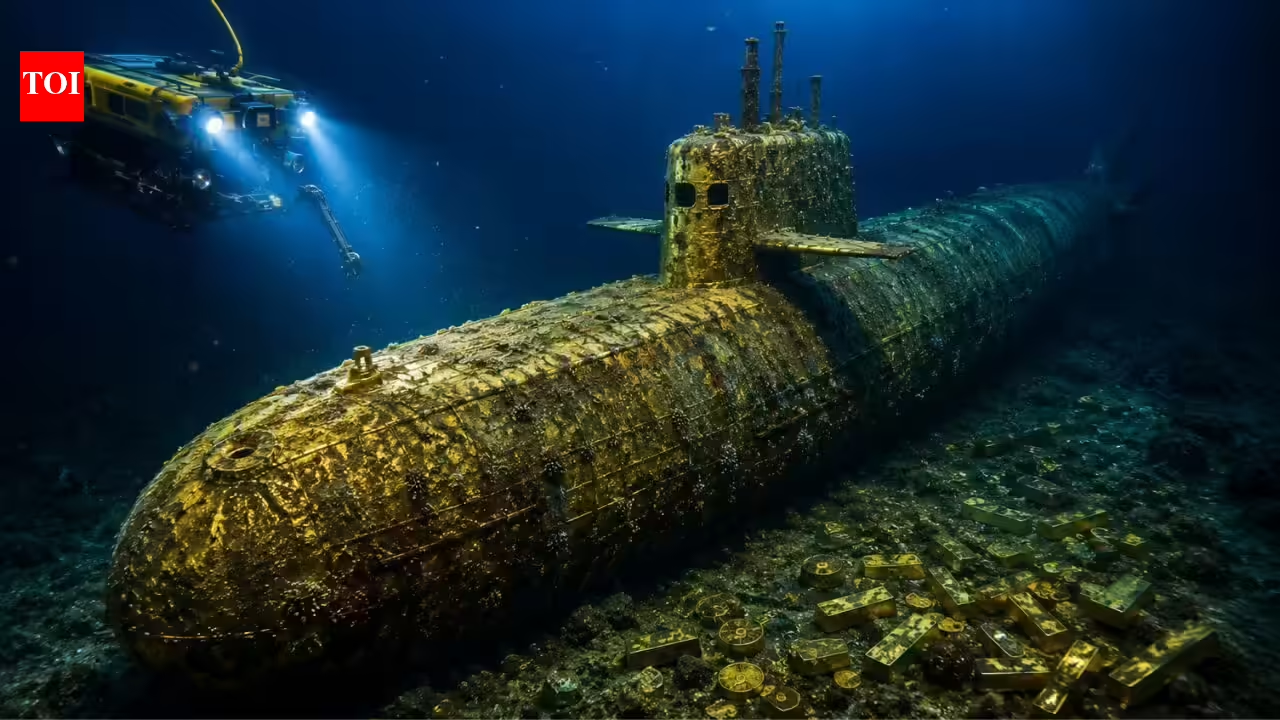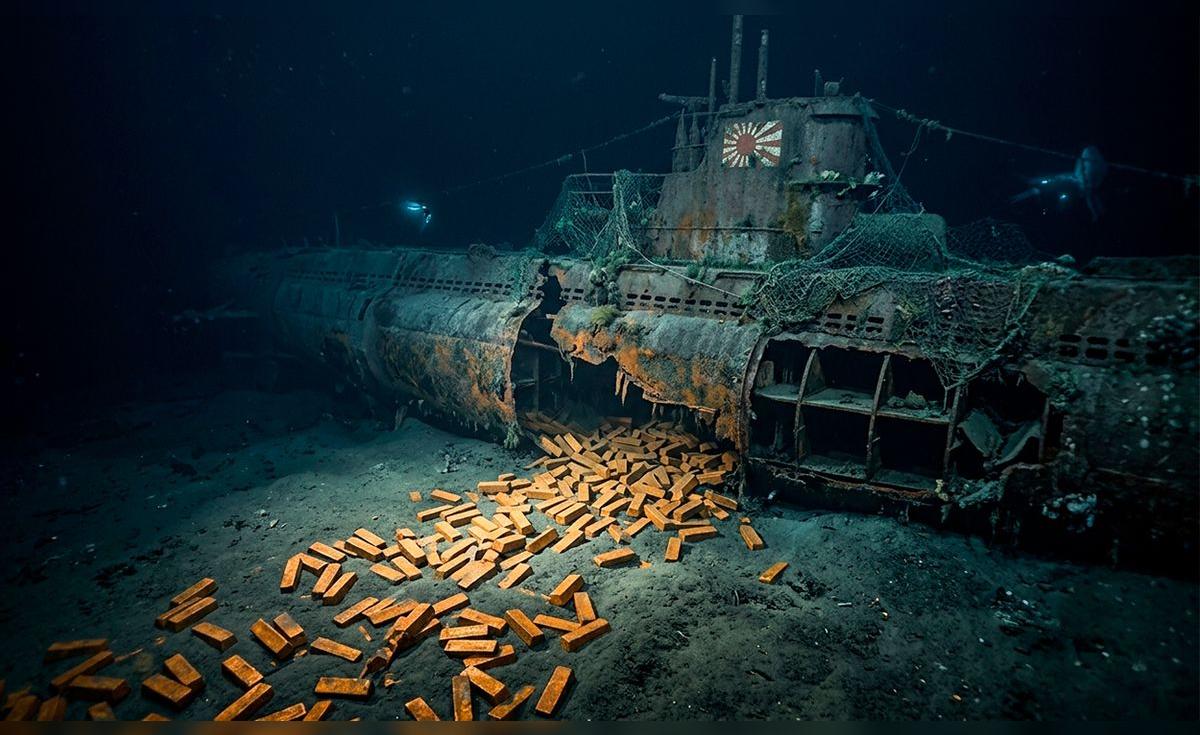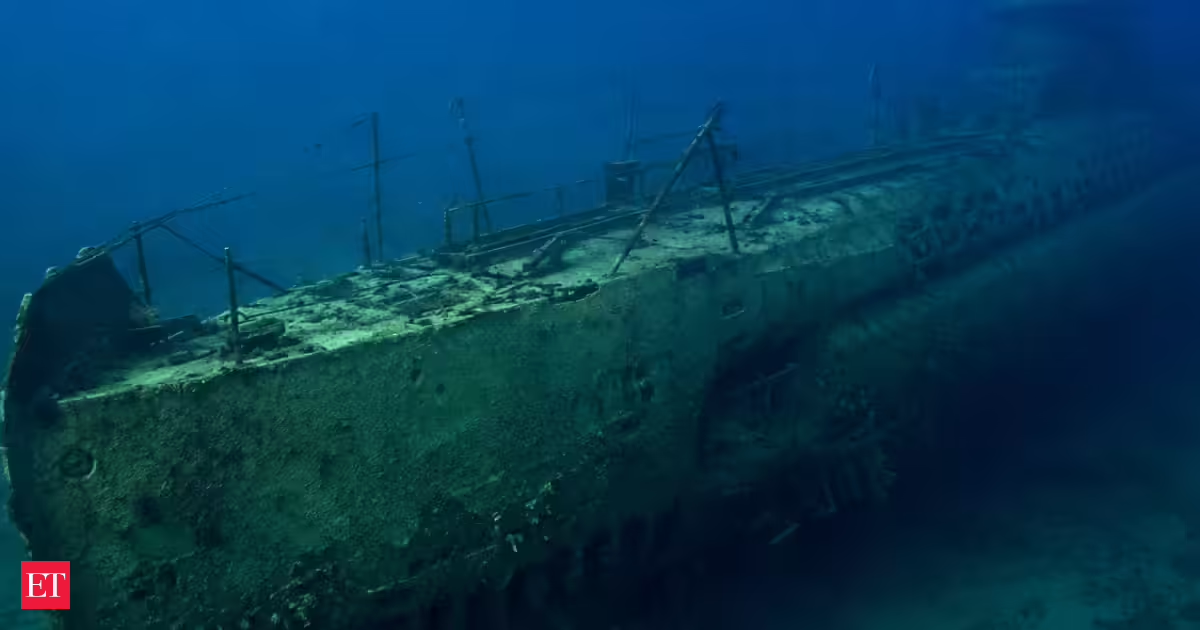
Three miles under the Atlantic Ocean, a Japanese submarine has been sitting upright on the seafloor since 1944, and it's still carrying roughly two tons of gold. According to Nauticos, LLC, the ocean exploration firm that helped locate the wreck, the gold was meant to be payment to Nazi Germany for military technology and never reached shore. Nobody has managed to lift it, almost 80 years on.Why was a submarine carrying a fortune in goldBy 1944, most normal shipping between Japan and Germany was cut off by Allied blockades, and the two countries turned to specially built submarines to exchange supplies. The I-52 was loaded in Singapore with tin, medical supplies, and rubber, and two tons of gold to buy German optical technology, Nauticos says. The submarine was about 356 feet long and weighed roughly 2,500 tons, according to the ocean-history nonprofit National Underwater and Marine Agency (NUMA). It was bound for a base in Nazi-occupied Lorient, France.Unbeknownst to the crew, American codebreakers had already cracked the Japanese naval codes. According to Nauticos, US intelligence intercepted and decoded messages which showed exactly what the I-52 was carrying, and a carrier task force was dispatched from Norfolk, Virginia, with instructions to find and sink it.Japanese submarine I-52 on sea trials. Image Credits: Wikimedia CommonsThe night everything went wrongThe I-52 met German submarine U-530 the night of June 23, 1944, 800 miles south of the Azores, in the middle of the Atlantic, according to NUMA. While the two subs exchanged crew and equipment, a US Avenger torpedo bomber flown by Lieutenant Commander Jesse Taylor picked up the I-52 on radar. Nauticos notes that Taylor saw the sub about 11:40 pm, made a bombing run that missed, then circled and fired an acoustic torpedo that homed in on the sound of its propellers. Hours later, another pilot, Lieutenant William Gordon, dropped a second torpedo after sonar buoys detected sounds from the damaged sub. The U-530 slipped away untouched. The I-52 did not.The following day, US ships spotted floating rubber and other debris, but there was no sign of survivors or gold, and the wreck remained undiscovered for the next fifty years, according to Naval History Magazine.A researcher who wouldn't let it goAccording to NUMA, Paul Tidwell, a Vietnam veteran and certified diver, spent years digging through the National Archives and the Library of Congress trying to pinpoint where the I-52 went down. He raised more than $1 million from investors and chartered a Russian research vessel, the R/V Yuzhmorgeologiya, to search. The Nauticos team said the expedition set sail from Barbados in April 1995, but after two weeks of scanning the seafloor, the sub was nowhere to be found where Tidwell's team had concentrated their search.The paper notes that Nauticos chartered the Russian oceanographic vessel R/V Yuzhmorgeologiya, which could tow sonar, video, and still cameras through thousands of miles of the mid-Atlantic. After two weeks of scanning the seabed three miles down, with food and fuel running low, the team concluded its original search patterns were off target and called in Meridian Sciences to rework the coordinates.USS Bogue (CVE-9), the US escort carrier that launched the attack on the I-52 in June 1944. Image Credits: Wikimedia CommonsThat’s when engineer David Jourdan, using a navigation-correction system called RENAV, went back into decades-old ship logs and reworked the figures. Jourdan had recalculated the position of the wreck, Nauticos said, and found it was more than 10 miles away from where the Navy recorded it in 1944. The search ship raced to the new coordinates, and on May 2, 1995, the sonar finally picked up the shape of a submarine resting on the bottom, upright, at a depth of more than 17,000 feet.Diving back down and coming up shortNUMA notes that in 1998, Tidwell returned to the site aboard the research ship R/V Keldysh and explored the wreck in a Russian Mir submersible on a National Geographic expedition. The dive recovered shoes and other personal artefacts, which Tidwell later returned to families in Kure, Japan, the sub's home port, NUMA said. He used the Mir's mechanical arm to place a Japanese flag on the hull. The gold itself was out of reach. According to NUMA, Tidwell believes it’s most likely still in the area near the bow of the sub, a spot that later divers have not fully explored.In the later expedition, Tidwell returned aboard the R/V Keldysh as an advisor to a National Geographic Magazine project, then used the Mir’s manipulators to place a Japanese flag on the hull. The article says the dive also brought up shoes and other personal artefacts, which were later returned to families in Kure, where the crew and shipyard were based.What the gold is worth, and why it's still down thereThat same cargo of gold was valued at $25 million when Tidwell began his search in the early 1990s and more than $100 million by 2020. Raising it would mean another expedition costing an estimated $8 to $10 million, according to NUMA, on top of navigating Japan's designation of the site as a war grave, since the sub's crew of more than a hundred men, according to Nauticos, went down with the ship.Today, the I-52 rests in the same spot it sank eight decades ago, a pristine time capsule three miles down in the Atlantic, its cargo waiting for someone with the money and patience to finish what Paul Tidwell began.
A war veteran and team found Japan's lost WWII gold submarine after more than 50 years, in 1995, but its 2 tons of gold remains missing
After over 50 years, the elusive Japanese WWII submarine I-52 has been found with approximately two tons of gold still onboard, valued at over $100 million. Explore the gripping story of its discovery and the challenges of retrieving its hidden treasure.
902 words~4 min read