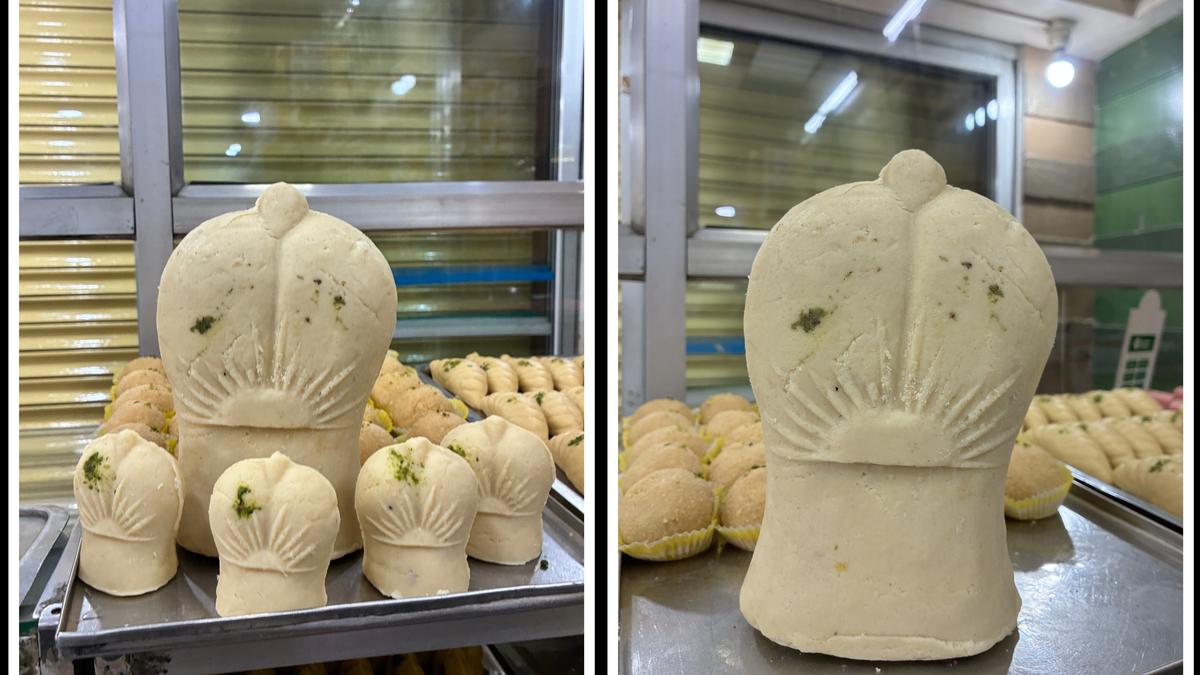
History has many hiding places. In West Bengal’s Chandannagar, it settled inside sandesh. This old French river town entrusted its memory to a sweet no larger than the palm of a hand. It looks ordinary but beneath its unassuming exterior lies a trick worthy of a magician: a pocket of fragrant syrup that somehow refuses to escape.
Surjya Modak , creator of the Jalbhara
| Photo Credit:
Shreya Banerjee
On June 26, 2026, the jalbhara was awarded the Geographical Indication (GI) tag. The sweet, made by Surjya Modak and his son Siddheshwar Modak, has officially been acknowledged as a confection inseparable from the town where they imagined it nearly 220 years ago. It has outlived empires, survived the departure of the French, the fading of the zamindars, shortages of sugar, changing tastes, refrigeration, express couriers and global migration. It has travelled folded into luggage, packed into tin boxes, tucked between clothes on journeys to Kolkata, to Delhi and to the world.But for nearly two centuries, jalbhara has left every first time visitor wondering the same thing: How can a sweet hold liquid without letting it escape?To unravel this mystery, we drive 45 kilometres from Kolkata to Surjya Kumar Modak in Chandannagar, the birthplace of the jalbhara. Off-shoots of its popularity and fame, Chandannagar teems with several other Surjya Modaks. The main shop is located at 247, Grand Trunk Road East, Barasat Chandannagar, in the Hooghly district of West Bengal. Alongside the new shop is the old shop where Surjya with his son Siddheshwar created the sweet around roughly 1843-1844. Their only legitimate branch in Kolkata is in New Town Eco Park’s Misti Hub at Gate number 3.