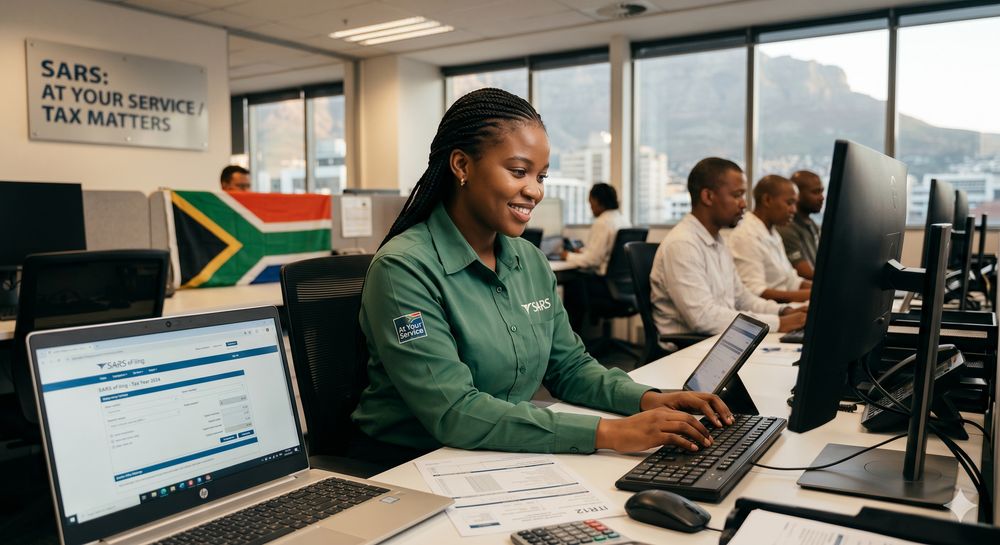
SARS is pushing taxpayers onto digital channels as it chases a record revenue target. (Graphic: Nicola Mawson | Magnific) The South African Revenue Service (SARS) – which has been tasked with collecting R2.1 trillion for the 2026/27 fiscal year – is rolling out new technology this year to not only simplify the filing process but also push more people onto digital channels.“Compliance requirements are tighter than ever,” says the South African Institute of Taxation (SAIT). It points to several enhancements with eFiling season having opened yesterday, including a WhatsApp filing solution.SAIT explains that taxpayers who are not registered on eFiling, or don’t have a registered e-mail, can now file via WhatsApp. They will receive an encrypted Notice of Assessment – ITA34 form – and be able to upload supporting documents via the messaging service.Although its target this year is R16.2 billion less than projected at the time of last year’s budget, the taxman overshot the 2025/26 target by R24.7 billion, surpassing the R2 trillion mark in a historic first. This was up from a base of R114 billion at the dawn of democracy.SARS says on its website that it is evolving its digital channels into a fully-integrated digital platform aimed at improving accuracy, reducing fraud, increasing accessibility and streamlining taxpayer interactions. See also In addition to auto assessments − which it calls “a world-class innovation” − this forms part of its broader Modernisation 3.0 programme overhauling how the revenue service interacts with taxpayers across all channels.Another new development is the Auto Assessment Waiting Room, which enables taxpayers to read their auto-assessment information while they wait for the platform to become available during busy periods. SARS has also introduced a MobiApp to manage periods of heavy traffic.South African Revenue Service commissioner Dr Ngobani Johnstone Makhubu. (Source: SARS) “Taxpayers can also use the waiting room to perform select actions, such as making payments, updating banking details, or viewing correspondence, with full eFiling access automatically restored once traffic subsides,” says SAIT.Commissioner Dr Ngobani Johnstone Makhubu, who took up the role on 1 May, says: “We understand that filing season involves more than just deadlines and forms; it is about creating certainty, reducing unnecessary effort, and assisting taxpayers in complying in a manner that is easier, faster and more seamless.”SARS has increasingly been using artificial intelligence (AI) as it clamps down on non-compliant taxpayers, with a particular focus on high-net worth individuals. At its disposal are tools such as advanced data analytics and AI “to detect tax-compliance risks, close the tax gap and improve overall compliance rates,” it says on its website.An overview of the filing season timeline. (Image made with GenAI) SARS’s data analytics abilities seek to identify patterns, anomalies and potential cases of tax non-compliance, while machine learning systems improve detection of those who avoid paying tax. “By integrating expanded third-party data sources, such as banking and payroll information, the system can increasingly automate tax assessments and more effectively identify underreported income,” it adds.SARS’s 2026 filing season begins with the auto assessment period from 1 to 12 July, with around six million auto assessments expected. The main filing season opens on 13 July and runs until 23 October, while provisional taxpayers and trusts have until 22 January 2027.Auto-assessments are generated from information supplied by third-parties, including IRP5 data from employers, medical-aid certificates from medical schemes, retirement-annuity certificates from funds and investment-income certificates from financial institutions.SARS says taxpayers who are due a refund under the auto assessment period can expect the money within 72 hours, unless legitimate reasons such as incorrect details hold up a payment. Last year, SARS paid out more than R35 billion during filing season, with refunds worth R10.6 billion paid by 21 July.However, SARS places an onus on the taxpayer to ensure the information is correct. “You must make sure your assessment is complete. For example, if you received rental income or other income, or have deductions in addition to what we reflected in your assessment, you must file a tax return,” it says.Common items that may be missing from an auto assessment include:Freelance, side-hustle or other self-employment incomeRental incomeForeign incomeSection 18A donations to approved organisationsQualifying out-of-pocket medical expensesHome-office expensesBusiness travel claims against a travel allowanceDirect retirement annuity contributions not reported by a fundAndre Bothma, head of tax at TaxTim, explains that auto assessments are a data story. “SARS now pre-populates returns by receiving third-party data directly from employers, banks, medical schemes, retirement funds and investment houses. That’s a large-scale data integration and matching operation.“Auto assessment isn’t something to fear. It’s a convenience if your affairs are simple – but accepting it blindly can cost you a legitimate refund if you have deductions SARS doesn’t know about,” Bothma adds. “SARS can only assess what it can see. If income or deductions aren’t in the data SARS receives, your assessment won’t include them, so it’s your responsibility to fix it.” SARS urges taxpayers not to visit service centres during the auto assessment period, saying its digital channels, contact centres and branches have sufficient capacity to handle demand.
Now you can file your tax return via WhatsApp
From WhatsApp filing to AI-powered compliance tools, SARS pushes taxpayers onto digital channels as it chases a record revenue target.
837 words~4 min read