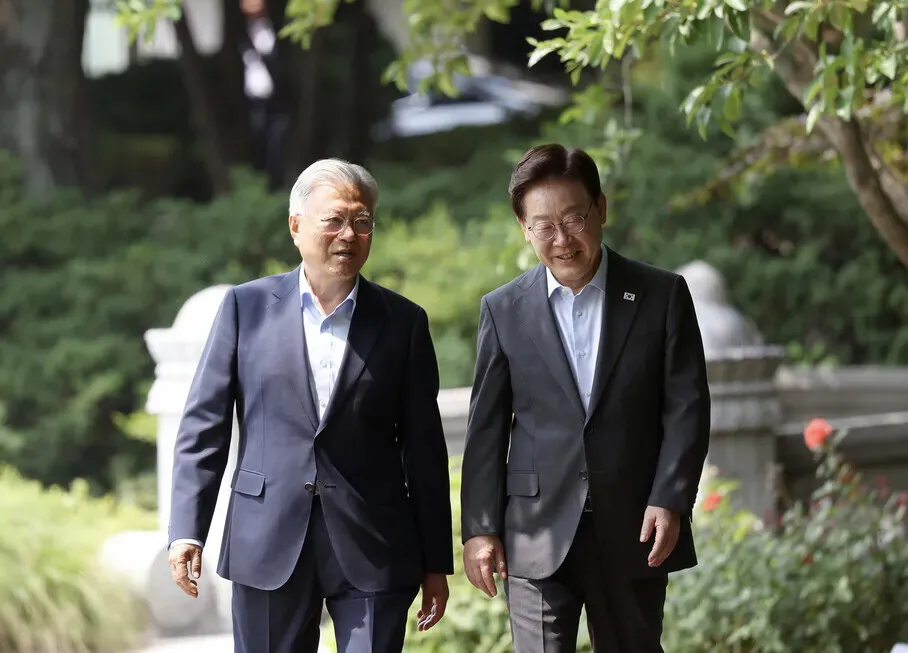
Former President Moon Jae-in and current President Lee Jae Myung walk through the grounds of the Blue House ahead of their luncheon there on July 1, 2026. (pool photo)
Aiming to project unity ahead of the ruling Democratic Party’s Aug. 17 convention, President Lee Jae Myung and former President Moon Jae-in met for lunch Wednesday amid concerns over growing internal divisions and infighting within the party. It remains to be seen whether the meeting will help bridge widening factional divisions, as the pro-Lee wing of the party appears to be lining up behind Prime Minister Kim Min-seok to lead the party, while Moon’s wing of the party is coalescing around Jung Chung-rae as he seeks another term. “Lee is the only person in Korea capable of achieving unity within the Democratic Party, greater unity within the democratic reform camp, and unifying the country. I hope that you demonstrate even greater leadership to achieve your dream of being a president for everyone,” Moon said in an opening statement at the luncheon, which was held at the Blue House. “Internal unity is important, and at the same time we must continuously broaden our outreach to build a stable structural majority. A balance must be maintained between those two efforts,” Lee responded. Moon’s remarks could be read as emphasizing internal unity, while Lee’s comments could be interpreted as stressing the need to broaden the Democrats’ base. The Blue House explained that the two positions were not mutually exclusive. “Only through unity is it possible to create a broader coalition, and unity while pursuing such a coalition is how a democratic administration will succeed,” said Hong Ihk-pyo, the senior presidential secretary for political affairs, during a briefing at the Blue House press center after the meeting. “They agreed that hurting each other with rumors and pejoratives doesn’t serve anybody’s interests.” According to Rep. Youn Kun-young, Moon said that the meeting had been “satisfactory” and that they had spoken candidly about governance overall. He added that, compared to how he felt on his way to Seoul, he now felt “much lighter” as he headed home to Pyeongsan, South Gyeongsang Province. The former and current presidents seem to be signaling concerns about growing rifts within the party that are turning increasingly contentious ahead of its national convention. Supporters of the Democratic Party have recently split into factions on online communities, where they have traded insults and coined pejorative nicknames that group key figures from both the pro-Lee and pro-Moon camps together. Even party leadership candidates and prominent commentators have joined the fray in the debate over who is the party’s “legitimate” heir. When Jung sold himself as someone carrying the mantle of former President Roh Moo-hyun, Rep. Song Young-gil of the Democratic Party claimed that Jung was absent at Roh’s funeral, only to apologize not long afterward. Writer Rhyu Si-min appeared on Kim Ou-joon’s YouTube channel, criticizing the president’s strategy of broadening his support base by saying, “It seems that Lee is not listening to what his supporters want, which is not an expansion of the tent, but a complete renovation.” A series of opinion polls has shown a decline in support for Lee and the ruling party in the wake of these developments. Against this backdrop, the former and current presidents, who had not met at the Blue House since Lee took office last summer, came together to underscore the need for unity. Prominent contenders to lead the Democratic Party responded positively to the message from the former and current presidents. “One must maintain dignity even in disagreement with an opponent, so it should go without saying that the same applies when speaking amongst comrades. Respect and restraint are party traditions that have run through the eras of Kim Dae-jung, Roh Moo-hyun, Moon Jae-in, and Lee Jae Myung. We need to regain these values,” Kim Min-seok posted on X. Jung also convened with reporters ahead of North Jeolla Gov. Lee Won-taeg’s inauguration ceremony in Jeonju on the same day. “We must achieve a grand unification within the Democratic Party, bringing together supporters of former Presidents Kim Dae-jung, Roh Moo-hyun, and Moon Jae-in. Expanding our base is the path our party must opt for if we are to remain the ruling party in the next administration,” Jung said. Song also posted on Facebook, stating, “We will be able to honor the wishes of both presidents by achieving results through unity and expansion and creating a true ruling party that proves itself through those results.” In a telephone interview with the Hankyoreh, Rep. Kim Nam-joon remarked, “It seems that the current and former president warned against factional strife as many have become fed up with the method of bringing up the past to bad-mouth one’s opponents.” “Now is not the time to linger on the past and its negativity, but to compete to be a truly competent ruling party,” noted one first-time lawmaker. However, many within the party believe it will be difficult to rein in the situation, as the leadership race — set to shape candidate nominations for the general elections in two years — has already become heated. During their meeting, Lee and Moon also exchanged opinions on prosecutorial reform and inter-Korean relations. “Both agreed that prosecution reform is a vital agenda of this administration and a crucial reform initiative that, if successfully pursued, will aid the democratization of our country and prevent the abuse of power by the prosecution,” Hong said. “Moon also stated, ‘Speed is important, but the administration must take care to be meticulous so that our people are not harmed and to prevent negative side effects.’” On the topic of inter-Korean relations, Moon advised that “knocking on the door of dialogue will create opportunities.” Lee voiced frustration, saying that inter-Korean relations had been “damaged beyond repair,” adding that the previous administration’s military pressure on North Korea to justify its self-coup had left “lasting repercussions.” He also pledged to continue pursuing policies aimed at peaceful coexistence between the two Koreas, beginning with the Sunshine Policy adopted by earlier Democratic Party-led administrations.By Seo Young-ji, staff reporter; Kim Chae-woon, staff reporterPlease direct questions or comments to [english@hani.co.kr]