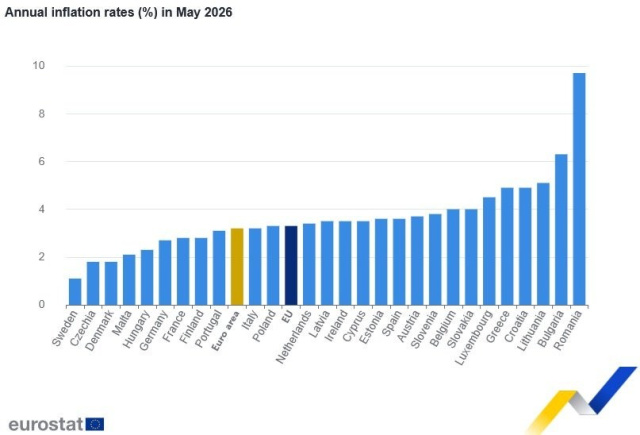
Eurozone inflation eased further in June, falling to 2.8% from 3.2% in May, according to preliminary Eurostat data. The reading came in below market expectations of 3.0% and marked the lowest level since March.
In Bulgaria, annual harmonized inflation also declined, dropping to 5.3% from 6.3% in the previous month. Despite the slowdown, the country recorded the second-highest inflation rate in the euro area, behind Lithuania, where inflation rose to 5.5%. At the other end of the scale, Malta posted 1.9%, while Estonia and France recorded 2% each, and Germany stood at 2.4%. Croatia (4.2%) and Cyprus (4.0%) also remained above the eurozone average.
On a monthly basis, inflation in the euro area decreased by 0.1%, while Bulgaria registered a more pronounced monthly decline of 0.4%.
Eurostat data show that the moderation in eurozone inflation was mainly driven by slower price growth across key categories. Energy prices rose by 8.7% in June compared to 10.8% in May, services inflation eased to 3.2% from 5.5%, and food, alcohol and tobacco increased by 1.6% compared to 1.9% a month earlier.
Core inflation, which excludes food and energy, also continued to ease, slowing to 2.4% from 2.6% in May.