Bulgaria recorded the highest inflation rate in the euro area in April, according to Eurostat data, despite a slight downward revision from the initial estimate. Annual inflation stood at 6.0 percent in April 2026, down from the earlier forecast of 6.2 percent, but still placing the country at the top of price growth within the eurozone and among the highest in the European Union.
Across the euro area, inflation rose to 3.0 percent in April, up from 2.6 percent in March, while a year earlier it was 2.2 percent. In the wider European Union, the rate reached 3.2 percent compared to 2.8 percent in the previous month, indicating a general upward trend across the bloc.
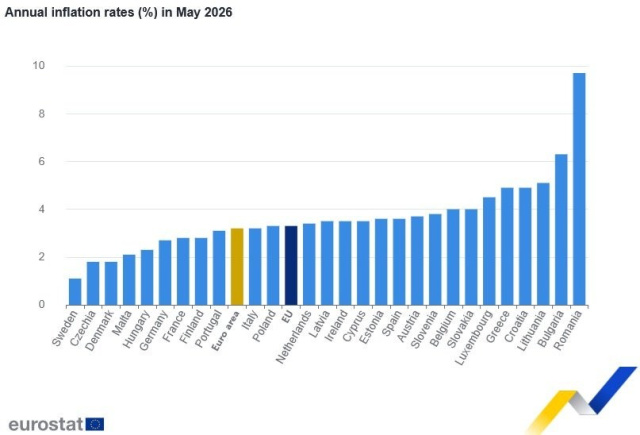
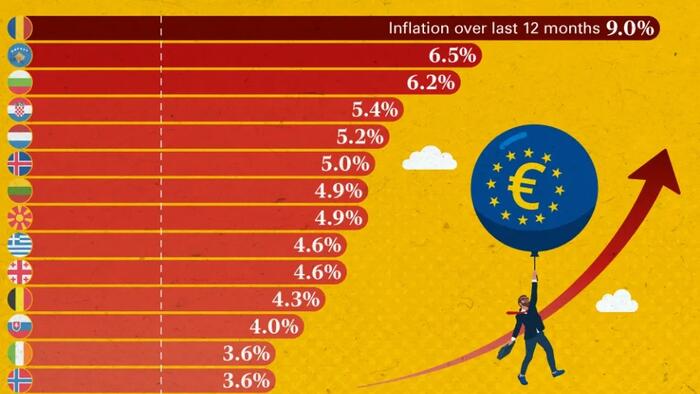
At the lower end of the scale, Sweden reported the weakest inflation at 0.5 percent, followed by Denmark at 1.2 percent and the Czech Republic at 2.1 percent. At the other extreme, Romania registered the highest rate at 9.5 percent, ahead of Bulgaria at 6.0 percent and Croatia at 5.4 percent.
Eurostat data also show mixed movements across member states compared with March 2026: inflation declined in five countries, remained unchanged in one, and increased in the majority of 21 states.
In terms of drivers of inflation in the euro area, services contributed the most, adding 1.38 percentage points to the overall figure. Energy followed with 0.99 percentage points, while food, alcohol and tobacco contributed 0.46 percentage points, and non-energy industrial goods added 0.20 percentage points.