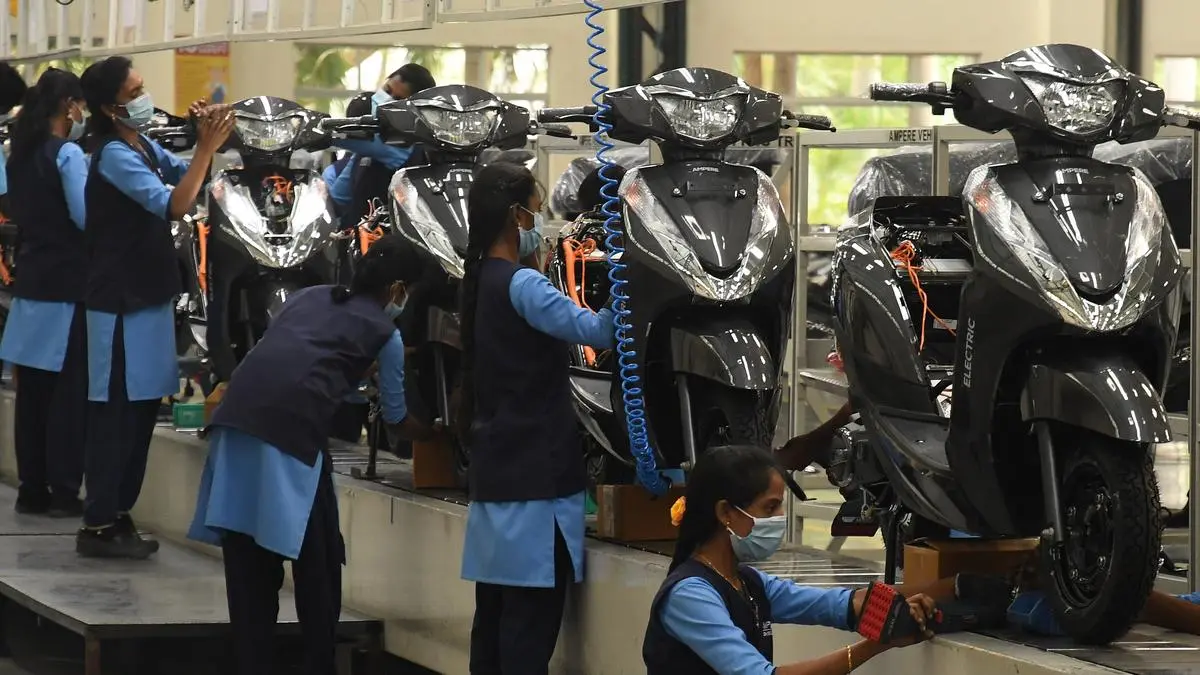
File pic: Women on the Greaves Electric production line
| Photo Credit:
India’s electric two-wheeler market is no longer driven by its leaders alone. An analysis of Vahan retail registration data by businessline shows Hero MotoCorp, Ather Energy, Greaves Electric Mobility, River and BGauss together contributed 190,054 of the industry’s 325,286 additional electric two-wheelers sold during H1 CY26, accounting for 58.4% of incremental sales.Their combined market share expanded to 37% in H1 CY26 from 26% a year earlier, suggesting India’s EV market is evolving from one dominated by a handful of manufacturers into one with a broader competitive base.Challenger pack gets strongerThe most significant structural shift is taking place below the market leaders. Greaves Electric Mobility, River and BGauss are beginning to transform what was once a fragmented tail of smaller manufacturers into a commercially meaningful middle layer, reducing the industry’s dependence on a few dominant players.Greaves delivered one of the strongest all-round performances. H1 registrations rose 65.2%, comfortably ahead of the industry’s 51.4% growth. Q1 registrations climbed 94.4%, significantly outpacing the industry’s 63.9% expansion, while June registrations surged 31.1% over May — the strongest month-on-month gain among leading OEMs. Greaves registered over 10,000 registration in June 2026.“Crossing the four-lakh milestone reflects the growing trust customers have placed in Ampere as electric mobility moves into the mainstream. Our focus has been on building products engineered for Indian roads with a low total cost of ownership while expanding access through a stronger retail and service network. As the market matures, long-term growth will be driven by safe, durable products, wider customer choice and an ownership experience that gives consumers the confidence to switch to electric,” said Vikas Singh, Managing Director, Greaves Electric Mobility.River also continued to scale rapidly from a small base, while BGauss maintained strong momentum. BGauss’ H1 registrations increased 82.1%, Q1 volumes more than doubled and June registrations rose 12% over May.“As customers become more confident about electric mobility, they are evaluating products on quality, reliability, safety and after-sales support. That is creating room for multiple manufacturers with differentiated products to scale sustainably, making the market broader and more competitive,” said Hemant Kabra, Founder and Managing Director, BGauss Electric.Hero MotoCorp, meanwhile, has emerged as the industry’s biggest breakout story. H1 registrations more than tripled to 104,417 units from 34,379 units a year earlier, taking the country’s largest two-wheeler manufacturer from an EV challenger to a serious volume player. The momentum strengthened further in Q1 FY27, when registrations jumped 155.8% year-on-year, indicating that Hero’s electric strategy is beginning to scale.Ather Energy has also reinforced its position as India’s leading pure-play electric two-wheeler manufacturer. Despite intensifying competition from legacy OEMs, Ather nearly doubled H1 registrations to 167,176 units while maintaining strong Q1 momentum, demonstrating that specialist EV companies can continue to expand alongside larger incumbents such as TVS Motor and Bajaj Auto.Running-cost economics reinforce the shiftAnalysts say the market’s expansion reflects both structural and cyclical factors. While EV adoption had plateaued across several vehicle segments earlier this year, the rise in fuel prices following geopolitical tensions in West Asia widened the operating-cost advantage of electric two-wheelers. That benefit has coincided with a broader product portfolio, improving technology and growing consumer awareness.“Two-wheelers remain India’s most price-sensitive vehicle category, but the EV shift is supported by running-cost economics,” said Ankit Patel, Co-Founder & Partner, Arunasset Investment Services.The improving economics are translating into higher adoption across the market.“Electrification gathered momentum during H1 CY26, with EV penetration increasing across almost every major vehicle segment compared with H1 CY25. The improvement became more pronounced during June, suggesting demand momentum strengthened further in recent weeks.Electric two-wheeler penetration increased to 8.5% in H1 CY26 from 6.6% in H1 CY25, while June recorded an even stronger penetration rate of 10.5%, indicating that the electrification trend continues to accelerate,” said Mihir Vora, Lead Analyst, Equirus Securities.The numbers also point to a more balanced competitive landscape. Rather than incremental demand flowing disproportionately to the largest incumbents, a growing share is being captured by challengers with differentiated products, expanding retail networks and improving execution. That diversification is broadening consumer choice and reducing concentration in a market that was until recently dominated by a few players.Published on July 2, 2026