view more
Well-being is increasingly regarded as an important indicator of societal progress, extending beyond economic growth to capture how people experience and evaluate their lives. It is also closely connected to health, longevity, productivity, and quality of life. It has also been included in the Sustainable Development Goals (SDGs) as Goal 3: “Ensure healthy lives and promote well-being for all at all ages.” In this context, the residential environment may play a particularly important role. Housing is where people spend much of their time, rest, interact with others, and experience everyday comfort, safety, and security. However, while residential environments are often evaluated for energy efficiency, physical health, and comfort, their broader relationship with subjective well-being remains insufficiently understood.
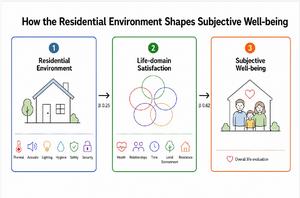
To address this gap, Associate Professor Shun Kawakubo and Shiro Arata, a doctoral student at Keio University, explored the association between subjective well-being and the residential environments, focusing on six environmental conditions. “Although housing forms the basis of everyday life and people spend a significant portion of their daily lives in residential environments, the structural relationship between residential surroundings and subjective well-being has not been thoroughly studied. This inspired us to explore the relationship between subjective well-being and various aspects of the residential environment, and whether life-domain satisfaction mediates this relationship,” shares Dr. Kawakubo. The findings were published in the Journal of Happiness Studies on April 24, 2026.