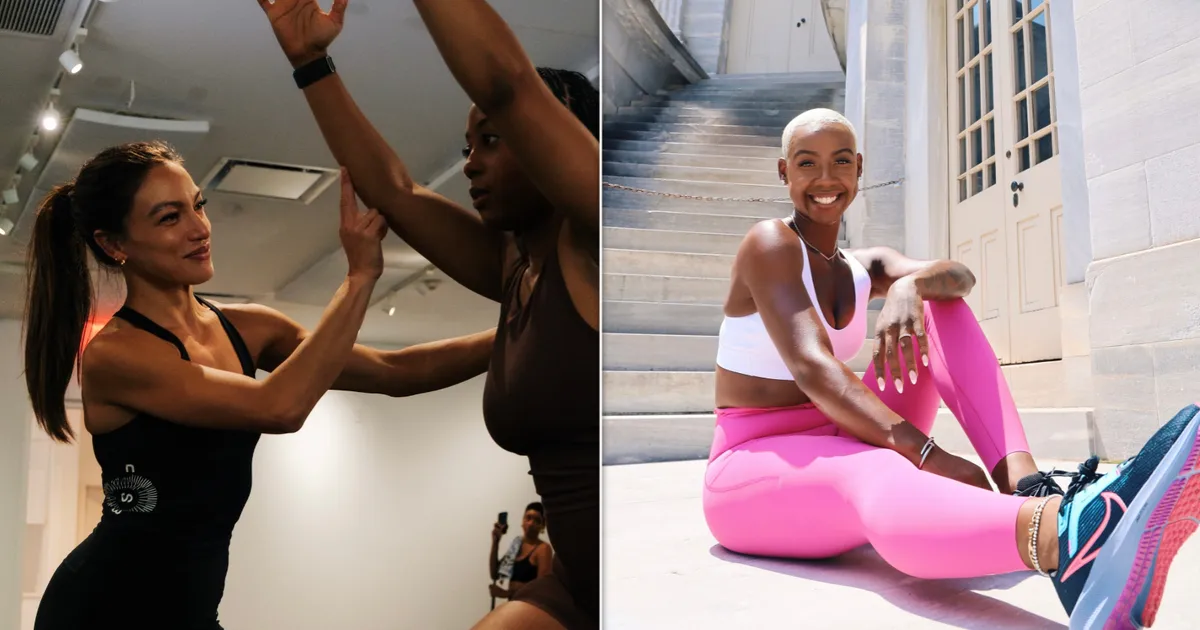
Straying from your regular fitness routine can be a humbling experience, even if you’re fairly adventurous with your workouts. So when I decided that I’d finally try Pilates, I was apprehensive. Would I snap one of the weird cords on the medieval torture-device-looking reformer machine or simply fall off, ’90s-sitcom-style? I mentally prepared myself for the worst. Sometimes, though, the worst isn’t actually about embarrassing yourself in a new practice; it’s feeling you’re not authentically welcome or represented in the space. Some fitness enthusiasts of color (e.g., me) are more sensitive to this than others. And given how racially homogenous some gyms or workout classes are in the wildly diverse city I reside in, it’s a topic worth dwelling on. I’ve been writing about the lack of inclusivity in certain exercise practices for quite a while. Lately, I’ve zoomed in on how leaders in Pilates, in particular, foster belonging for Black and brown women and femmes. While the details of the rise of Pilates are shrouded in myth, the practice originated around the turn of the 20th century by Joseph Pilates, a German trainer, as a sort of rehabilitative and strength-building practice. Little-known fact: Kathleen Grant, a Black American dancer, studied under Pilates after he brought the fitness concept to the States and was instrumental in spreading the practice far and wide.Apparently, Pilates didn’t always center whiteness. So how did we get here in 2026? While I don’t want to fall all the way down that hole, I surmise that it has something to do with the expensive equipment involved and a general air of exclusivity that’s been both consciously and subconsciously perpetuated for decades. One astute Redditor, in a conversation on the subject, also pointed out how Pilates studio practice is “marketed with a certain body type that is more aspirational for Asian/White women, which is separately problematic.”The messaging that we, as people who love group fitness, ingest online and in the streets is incredibly powerful. This could’ve contributed to why I had, at my big age, never been to a reformer class. And so, I started dabbling this year. One thing I noticed during a class at FS8 a few months ago was that through both my core-activating struggles on the reformer and arm sets on the mat, I was dancing a little. And I don’t mean that tremble that happens when your body is being tested during a good workout — like, I caught the beat and the spirit.The instructor was playing Bad Bunny and Lil Wayne. And deeper cuts, not just the stuff you hear at the bar. Her playlist was like a bat signal of sorts, and I was activated, not just because it was what I like to listen to when I’m working out at home, but because on some level, playing music by Black and Latino artists indicates something.“I try to create an experience that I didn’t always receive,” says fitness instructor Cristina Chan. “Or have seen other people not receive.”Courtesy of F45 Training“It can be a vibe check at times,” Cristina Chan, the Southern California-based Pilates teacher who led that very class, tells me. “Music is part of creating a safe space. It’s welcoming because it feels like home. It’s the same as if you walk down the street and smell a food you love that conjures what you remember from home.” I immediately think about one of my favorite HIIT instructors who sometimes blares bhangra music when we’re doing weight work. Little else has ever motivated me more.“I try to create an experience that I didn’t always receive,” Chan says. “Or have seen other people not receive.” The way Pilates has been presented culturally makes many people feel like it isn’t made for them, but, she reminds me, the practice was created with the intention of accessibility and inclusivity.For her and other Pilates teachers of color who are trying to disrupt elitist perceptions of the practice, that means running class less like a boot camp and more like a space for customizable fitness. “I know what it feels like to walk into wellness spaces and wonder if you belong,” says Philadelphia-based Pilates instructor Zhane Dodson, better known as Coach Zha. Because of that, I’ve always been intentional about creating environments where we don’t have to code-switch, prove ourselves or earn our place. We can just show up exactly as we are.”In all of the spaces where Coach Zha teaches, she prioritizes workouts that are both effective and sustainable.James Johnson Jr.Aside from teaching in more traditional settings such as Solidcore and Lumos studios, Dodson co-facilitates workshops and 3-hour day parties that mix Pilates and yoga with dance and other activities that encourage connection. “One of the biggest lessons my community has taught me is that people aren’t just looking for a workout,” she says. “They’re looking for somewhere they feel safe. They’re looking for belonging.”Part of that sense of security, as Black and brown consumers, is about being able to comfortably afford classes and workshops that we want to attend. At the studios Chan and Dodson teach, classes cost between $30 and $35 a pop — which is pretty standard. This is the part, I feel, that can be the most challenging for a fitness instructor championing inclusivity: attempting to make your services more affordable while still making a living. Many studios that employ Pilates instructors of color have “community” classes that are free or discounted, but other than that, the financial hurdles of a fancy gym membership are real. And so many teachers of color are fighting for equity themselves.In all of the spaces where Dodson teaches, she prioritizes workouts that are both effective and sustainable. It doesn’t need to be all-or-nothing for us, she tells me. A fitness lifestyle that feels manageable and consistent is the goal. This perspective, it seems, has built her a following of participants who uplift each other naturally rather than staying on their own mats, in their own worlds, feeling too isolated or self-conscious to interact with their peers.“Hearing similar music that I listen to, and seeing people that look like me feels so welcoming,” says Dymon Pendleton, a content creator in Philadelphia who has attended Dodson’s events. “Everyone is cheering each other on. I like it; this is my culture. It feels kind of like the cookout or something.”For Black and brown communities especially, I believe wellness is an act of self-preservation,” Dodson says. “Taking care of ourselves isn’t selfish, and it isn’t a luxury.” Being surrounded by your peers for an hour to rejoice and move your body, though, can feel luxurious for some of us. Some of Dodson’s students have told her that this is the only hour of the day they get to focus on themselves. And for that reason, Pilates practice, for them, needs to prioritize balance and self-empowerment.At the core of it all, Pilates is about simultaneously healing and building strength. Everyone who practices, though, does so for their own reasons. “The practice is designed to be inclusive in terms of physical capabilities,” Chan reminds me. “It’s a therapeutic approach, a corrective exercise or physical-therapy-style approach where all bodies should be able to participate. But it might not always be delivered in this way.” It’s true. And so, it might be time for yet another Pilates rebrand. Both Chan and Dodson tell me that they’ve shaped and reshaped their pedagogy around what individuals like them — Black and brown women seeking stimulating exercise and the mental benefits that align with it — need in order to thrive. And above all, it’s the ability to feel strong and peaceful in a world that often tries to shrink us.When I feel safe and happy in a Pilates or yoga class when we’ve all given it our all, I like to turn to the person next to me at the end and tell them it was good practicing with them. It’s a small, intimate gesture that transforms my solo effort into something bigger than myself.“That’s what’s beautiful about the human connection of this work,” Chan tells me. “We just want to be seen and heard. It’s as simple as that. Fundamentally, this is all we want and need in life.”
A Growing Movement Is Making Pilates More Inclusive — And It's Long Overdue
The practice was meant to be inclusive — but it doesn't always come across that way. So new leaders are working hard to create a meaningful shift.
1,368 words~6 min read