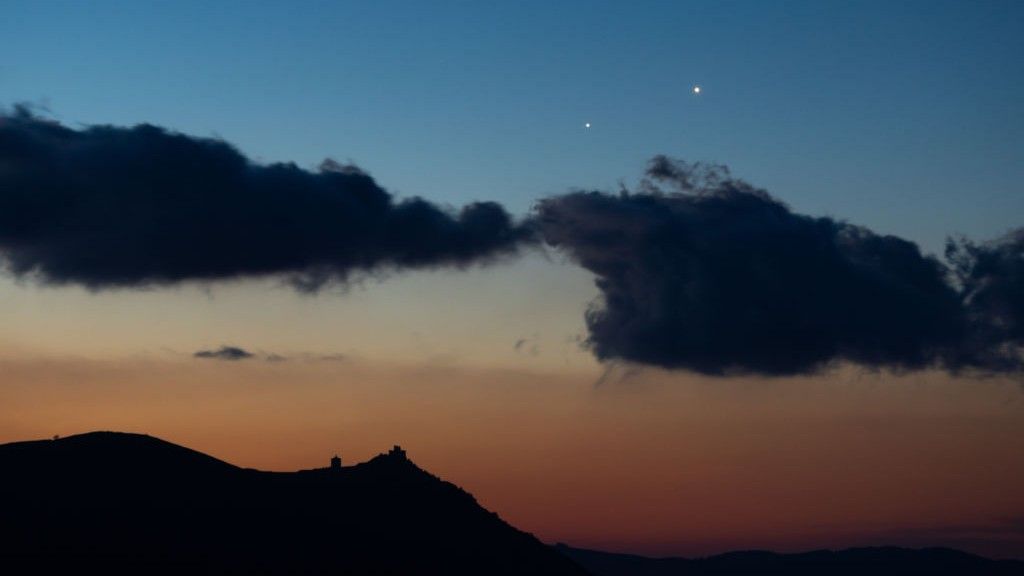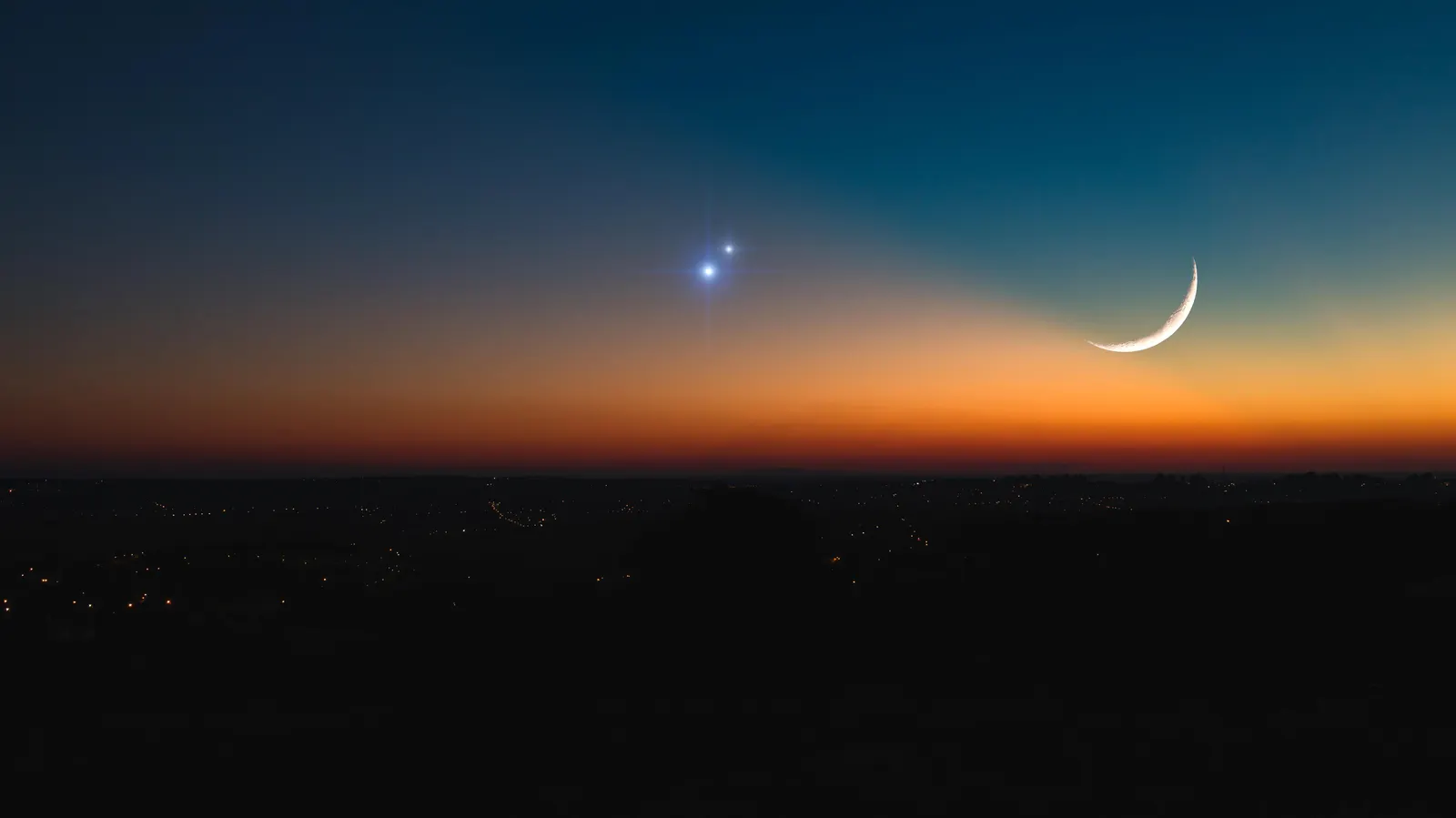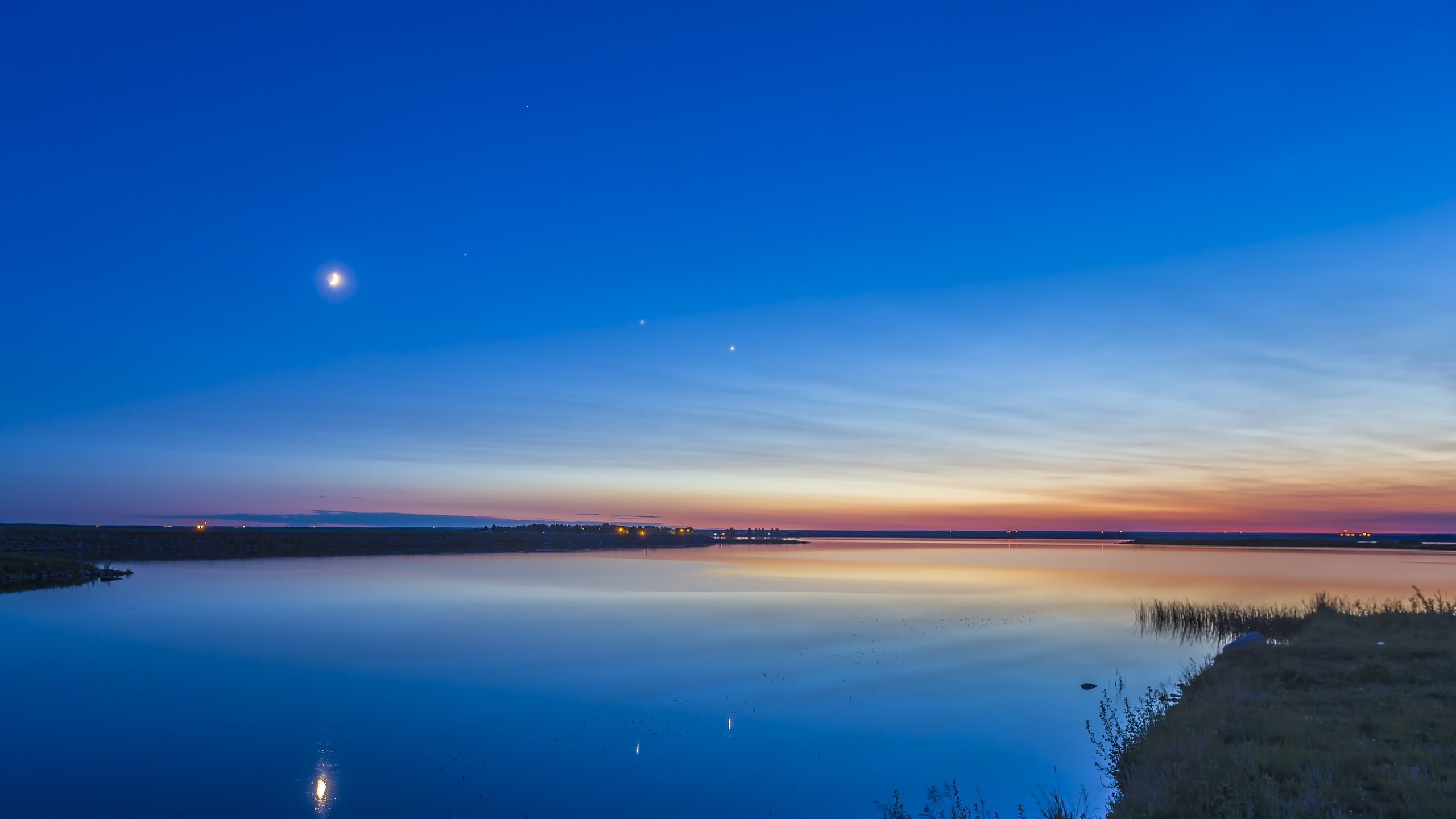
Venus dominates the evening sky while Saturn, Mars and Uranus put on a show for early risers. In this photo, the evening planets of Venus (right) and Jupiter (left), to the right of the waxing crescent Moon on the evening of the summer solstice, June 21, 2015.
(Image credit: Alan Dyer /VW PICS/Universal Images Group via Getty Images via Getty Images)
The three-planet evening show that graced June's twilight sky has now dwindled to one lone survivor.Mercury and Jupiter are now swinging behind the sun and are lost in the bright solar glare. Only Venus remains evident after sunset, and even here the dazzling evening star itself is showing subtle signs of slowly dropping down into the sunset fires; it is getting noticeably lower in the western sky with each passing week. It will pass close to the brightest star in Leo the Lion, Regulus, during the second week of July.Saturn is in a fine position to be viewed just before the break of dawn in the east-southeast. The famous rings are now tilted some 9 degrees toward Earth, once again making this planet a showpiece for telescopic observation.Mars rises about 2.5 hours before sunrise but is ever-so-slowly becoming more conspicuous as it brightens while climbing a bit higher in the eastern sky. It will also serve as a benchmark to locate the much fainter planet Uranus early on the morning of July 4; this distant greenish world will then be positioned only about 7 arcminutes (less than one-quarter of the apparent width of the moon) above Mars. Certainly, if you have never seen Uranus before, this will be an excellent opportunity to sight it, either with a small telescope or binoculars, or even possibly with your unaided eyes.In our schedule, remember that when measuring the angular separation between two celestial objects, your clenched fist held at arm's length measures roughly 10 degrees. Here's where and when to look for each planet during July.MercuryMercury passes inferior conjunction and enters the morning sky on July 12. It's too low and dim to detect until about July 26 or maybe later. By Aug. 2, Mercury will reach a greatest western elongation of 19 degrees from the sun.VenusVenus is conspicuous as July's long evening twilights fade. If you live at mid-northern latitudes and look to the west about 45 minutes after sunset, you'll find Venus shining brightly about 15 degrees high this month. This is noticeably lower than it was in June.The planet starts July by setting more than two hours after the sun and follows the sun down to the horizon somewhat sooner by month's end. Venus is still rather small in a telescope this month, but there's no doubt that it has a gibbous phase. It will be larger in apparent diameter but smaller in phase, down to about half lit, when it reaches greatest elongation from the sun in mid-August.On July 9, you will notice a much dimmer but still reasonably prominent point of light near Venus: the bluish 1st magnitude star Regulus. Venus burns only 1 degree to the upper right of Regulus, which is 150 times fainter. They're less than 3 degrees apart from July 7 through July 12. On July 17, the 3.5-day-old crescent moon will sit 5.5 degrees to the left of Venus.