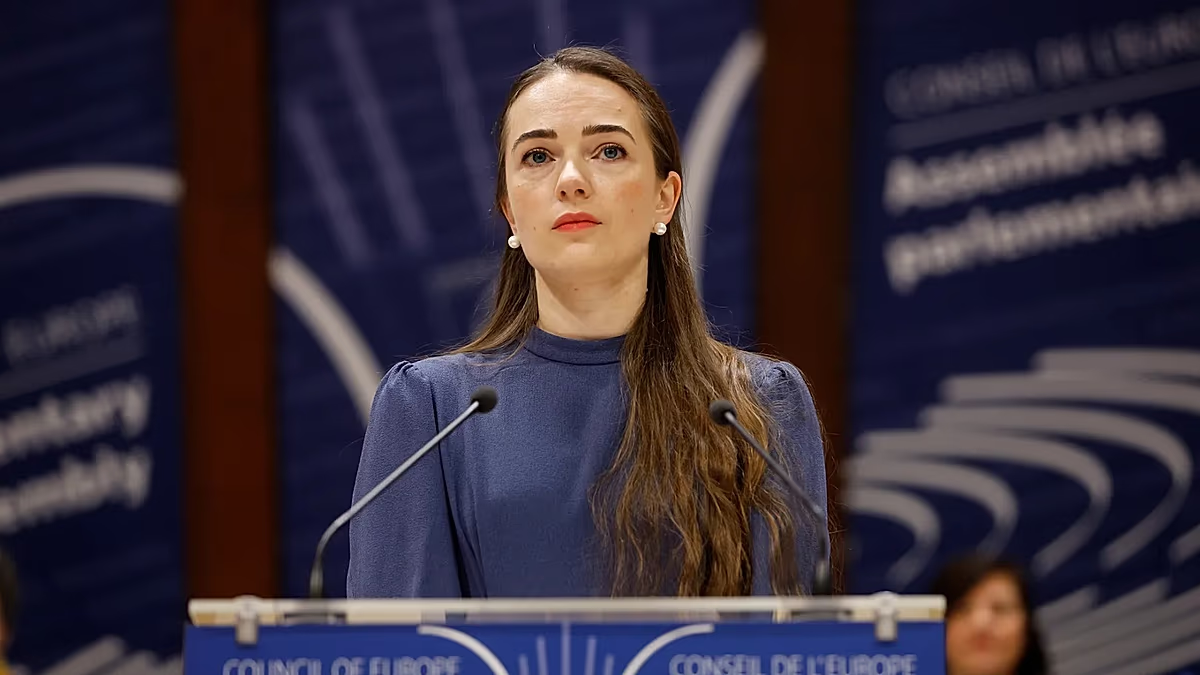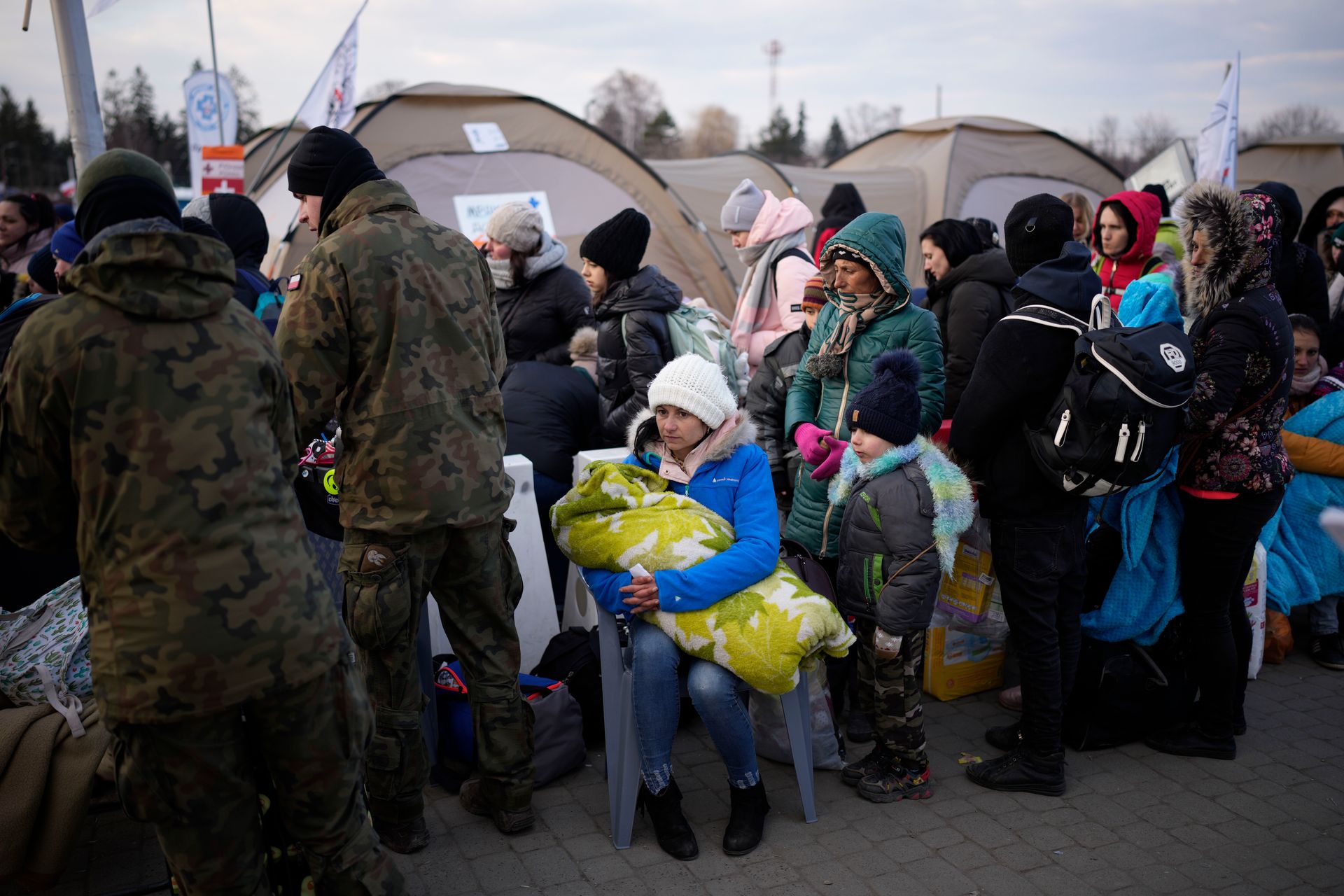
Refugees fleeing Ukraine after the Russian full-scale invasion arrive at the Medyka border crossing in Poland on March 10, 2022. (Daniel Cole / AP)BRUSSELS, Belgium — The Council of Europe's Human Rights Commissioner is pushing back against the continent-wide rollback of protections for over 4 million Ukrainians. Michael O'Flaherty spoke with the Kyiv Independent about just what is at stake, and why it is in Europe's own interests to keep strong support measures in place."We gave an awesome and fantastic welcome in 2022, but there's been a weakening in the welcome, which is unfortunate, as the protection needs are as great as ever," O'Flaherty, the Council of Europe's Commissioner for Human Rights, told the Kyiv Independent.Across Europe, countries have started to put restrictions in place on the so-called "temporary protection" measures, which have been in place since 2022. Those measures give Ukrainians a status somewhere between an asylum seeker and a foreigner with a legally valid visa, but in the EU, they have to be renewed yearly in order to remain valid.Michael O'Flaherty, Council of Europe commissioner for Human Rights, poses in Strasbourg, France, on April 16, 2024. (Frederick Florin / AFP / Getty Images)The three top destinations in Europe for Ukrainian refugees — Germany, Poland, and Czechia — have all drafted restrictions to temporary protection.On June 25, Denmark issued a change excluding Ukrainians eligible for the military, unless they have an exemption, from applying for temporary protection in the future.The morning after, the EU's Migration Commissioner Magnus Brunner announced the whole bloc would do likewise.Although O'Flaherty's mandate covers 46 European countries, he has expressed himself on the EU because "many non-EU countries have copied and pasted the Temporary Protection Directive. They've taken it as the best practice model and applied it."On the EU's most recent change, he was also not 100% critical."First, I welcome the fact that there is a serious push to extend temporary protection. This was badly needed," he said.EU protections for Ukrainians were set to end in March 2027. With the June 26 announcement, those protections will continue until March 2028, giving countries time to discuss how to transition to a longer-term arrangement.However, O'Flaherty warned that the new restrictions "will have to be compliant with the international legal obligations of the host countries."Specifically on men eligible for military service, O'Flaherty envisages there could be a few scenarios that host countries should still have to consider, such as conscientious objectors.An EU official speaking on condition of anonymity told journalists after the June 26 announcement that "evasion of military service is not a ground for international protection," but added that any Ukrainian could still apply for entry to the EU as an asylum seeker, rather than through the temporary protection route specifically for Ukrainians.O'Flaherty conceded that "there is some theoretical truth in that," but nonetheless has concerns, because granting asylum is a national rather than an EU decision, and therein lies a patchwork of approaches.For example, in some countries, asylum seekers are not permitted to leave the host country, but O'Flaherty says, "it's really important to give people the chance to come back and forth to check out the conditions, to see if they can return."He is also conscious of creating a two-tiered system of Ukrainian refugees in the EU, where some can move around the bloc freely but others cannot."That has a bit of discrimination about it," O'Flaherty said.Ukrainian refugees arrive at the Medyka border crossing in Poland on April 3, 2022, after the Russian full-scale invasion. (Wojtek Radwanski / AFP / Getty Images)Human capital and human rightsBecause temporary protection is, by definition, temporary, a lot of the discussion about its reform is also with a view for Ukrainians across Europe to one day return home.In EU Commissioner Brunner's June 26 announcement, for example, he floated a new voluntary return and recovery pilot program for those who want to go back, and new discussions to prepare for returns once the situation allows.However, it is not clear that Ukrainian refugees necessarily want to return. Less than half (43%) plan to do so, according to a January survey commissioned by the Center for Economic Strategy think tank.O'Flaherty noted that many highly skilled Ukrainians have sought refuge in Europe, but that they're still working way below their education level, principally because of administrative issues and failure to recognize their qualifications."This is not a problem to be solved, it's an opportunity for people to be grabbed," O'Flaherty said."These Ukrainians form an important part of the human capital that will play an essential role in the reconstruction of Ukraine," he added.But he does not think that it helps to push them back prematurely."We need to put in place conditions for a safe, dignified, and voluntary return, " O'Flaherty said.Perhaps unsurprisingly for the Council of Europe's lead on human rights, he said of temporary protection, "ultimately it is an issue of human rights," and he called for Europe to keep that central to its approach."We have to invest as much in the 75-year-old retired couple that I met a couple of weeks ago who don't have a penny, as we do for the doctor or the physicist, or whoever else … because human rights is about taking care of the most vulnerable, the most marginalized, the most forgotten people," O'Flaherty said.
Prioritize Ukrainians' dignity as you did in 2022, urges Europe's human rights head
BRUSSELS, Belgium — The Council of Europe's Human Rights Commissioner is pushing back against the continent-wide rollback of protections for over 4 million Ukrainians. Michael O'Flaherty spoke with the Kyiv Independent about just what is at stake, and why it is in Europe's own interests to keep strong support measures in place. "We gave an awesome and fantastic welcome in 2022, but there's been a weakening in the welcome, which is unfortunate, as the protection needs are as great as ever," O'Fl
878 words~4 min read