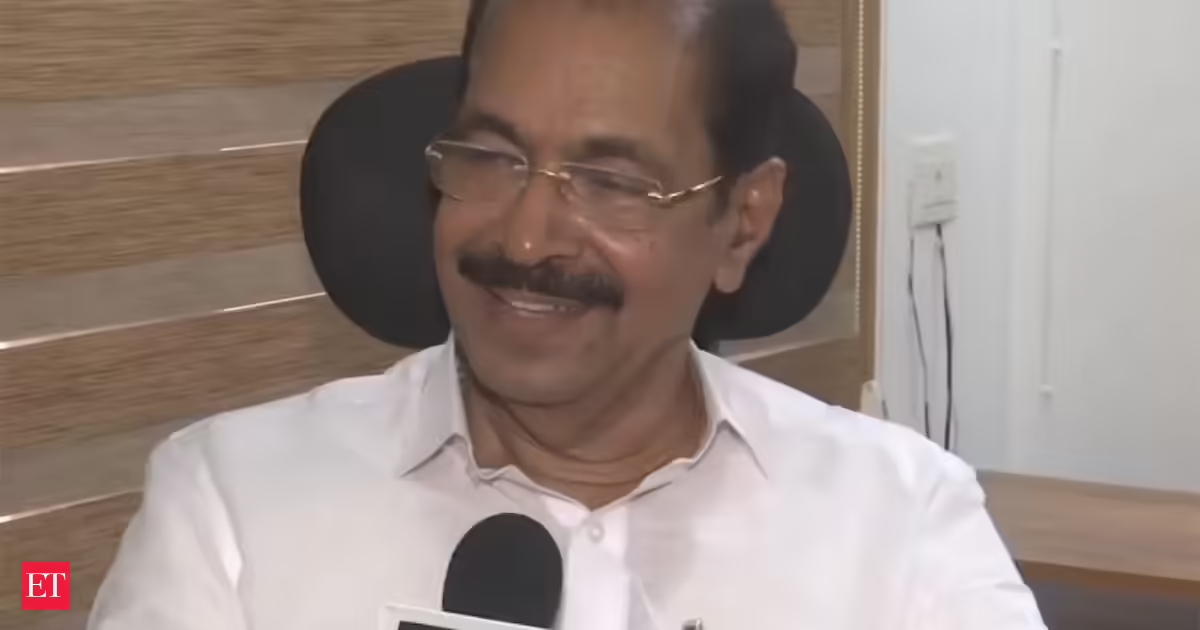
Thiruvananthapuram: Kerala will expedite battery energy storage projects and strengthen long-term power procurement to address recurring electricity shortages, Minister Sunny Joseph told the Assembly on Wednesday.Speaking under Rule 300 of the Rules of Procedure and Conduct of Business, the state electricity minister said the power restrictions imposed on certain days in recent weeks had become necessary because of an unprecedented gap between electricity demand and supply.He attributed the situation to poor inflows into hydel reservoirs due to deficient rainfall, persistently high temperatures, and a nationwide reduction in power availability triggered by the El Nino phenomenon.Read More: LDF walks out of Kerala Assembly, accuses CM Satheesan of 'misleading' House on fund cutsAlthough the southwest monsoon reached Kerala on June 1, rainfall has remained inadequate, preventing any significant drop in temperatures and keeping electricity consumption unusually high, he said.While the state had expected a peak demand of around 4,100 MW, it touched nearly 4,900 MW, resulting in a shortfall of around 900 MW despite receiving 1,700 MW from its own generation, 1,701 MW from Central Generating Stations, and 612 MW through long-term power purchase agreements.Joseph said Kerala had borrowed electricity from other states during March and April under swap arrangements to meet summer demand and has been returning 6.58 million units every day since June 16 under the agreement, which will continue until September 2026.The minister said water storage in the state's reservoirs has dropped sharply to 870 MU, or 21 per cent of capacity, compared with 2,475 MU (59 per cent) during the corresponding period last year.Against a daily average consumption of 88-90 million units, Kerala currently generates only 15-16 million units internally, while around 74-75 million units are procured from outside the state.Consequently, only 17-18 per cent of the state's daily power requirement is met through domestic generation, with the remaining 82-83 per cent sourced externally, he said.Joseph noted that Kerala's dependence on hydel power makes generation highly vulnerable to variations in rainfall.Despite an installed hydel capacity of 2,196 MW, only 150.636 MW has been added over the past decade through new hydel projects, accounting for just 6.8 per cent of the state's hydel capacity and around three per cent of the state's peak demand of nearly 5,000 MW.Read More: Govt approval mandatory for Adani stake transfer in Vizhinjam port: Kerala CMHe said that almost the entire solar capacity connected to the grid is not backed by battery storage, while the cumulative utilisation factor of solar power remains only 11.43 per cent.The minister said KSEB had attempted to procure power through the Discovery of Efficient Electricity Price (DEEP) portal in anticipation of low rainfall, but the attempt was unsuccessful because of the nationwide power shortage caused by El Nino.He said power restrictions had to be imposed from June 16 to 19 and again on June 26.Similar restrictions were enforced between April 22 and 27 and on May 11, 12, 20, and 21 this year.Joseph said meeting peak-hour demand currently requires the state to purchase electricity from the market at rates of up to Rs 10 per unit, while daytime power, aided by solar generation, is available at much lower prices.As a long-term solution, the government is focusing on increasing domestic generation capacity, entering into economical long-term power purchase agreements, upgrading existing hydel stations, and implementing pumped storage projects, though these will take time to materialise.To address peak-hour shortages, the government is giving priority to Battery Energy Storage System projects.Six such projects-at Mylatti, Sreekandapuram, Mulleria, Areekode, Pothencode, and Brahmapuram-are expected to add 500 MW of capacity and 1,500 MWh of energy storage, with five of them likely to be commissioned by the end of 2026.The minister said the Kerala State Electricity Regulatory Commission had, on June 29, approved the tariff and granted permission for KSEB to procure short-term power through the DEEP portal for the period from June 15 to December 31, 2026.Joseph expressed confidence that these measures would substantially ease the state's power situation.He called for public cooperation in reducing electricity consumption during peak hours and assured the House that efforts were continuing to improve power supply and address consumer grievances.
Kerala to fast-track battery storage projects to tackle power crisis: Electricity Minister Sunny Joseph
Kerala is accelerating battery energy storage projects and strengthening long-term power procurement to combat recurring electricity shortages. Minister Sunny Joseph attributed recent power restrictions to an unprecedented demand-supply gap, exacerbated by deficient rainfall, high temperatures, and El Nino's impact on national power availability.
681 words~3 min read