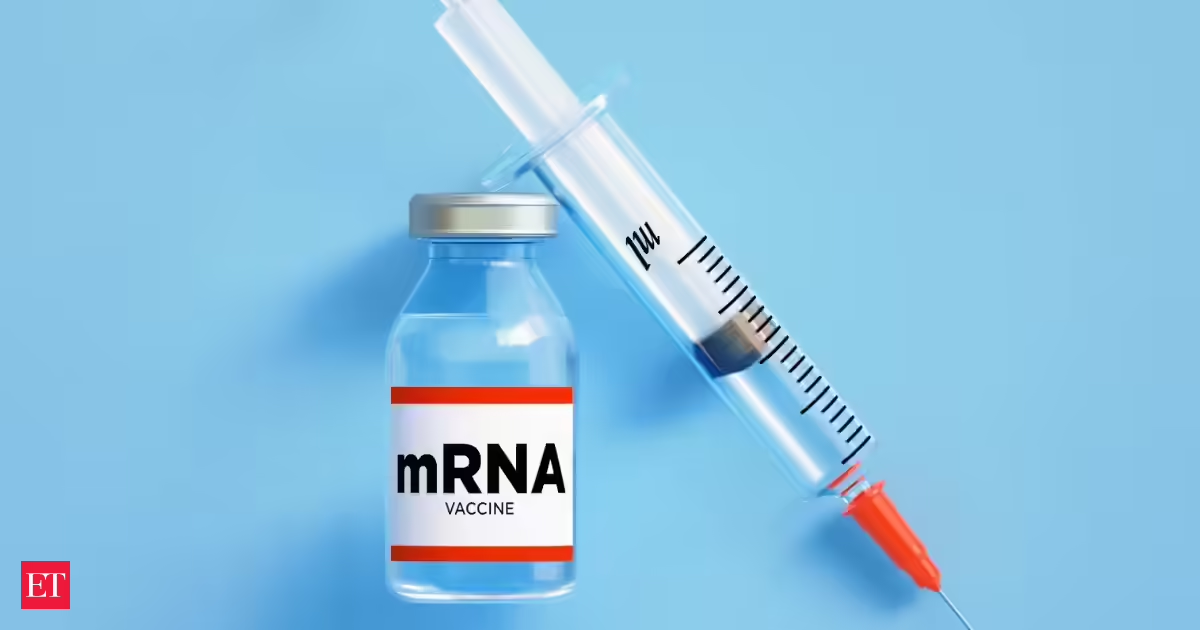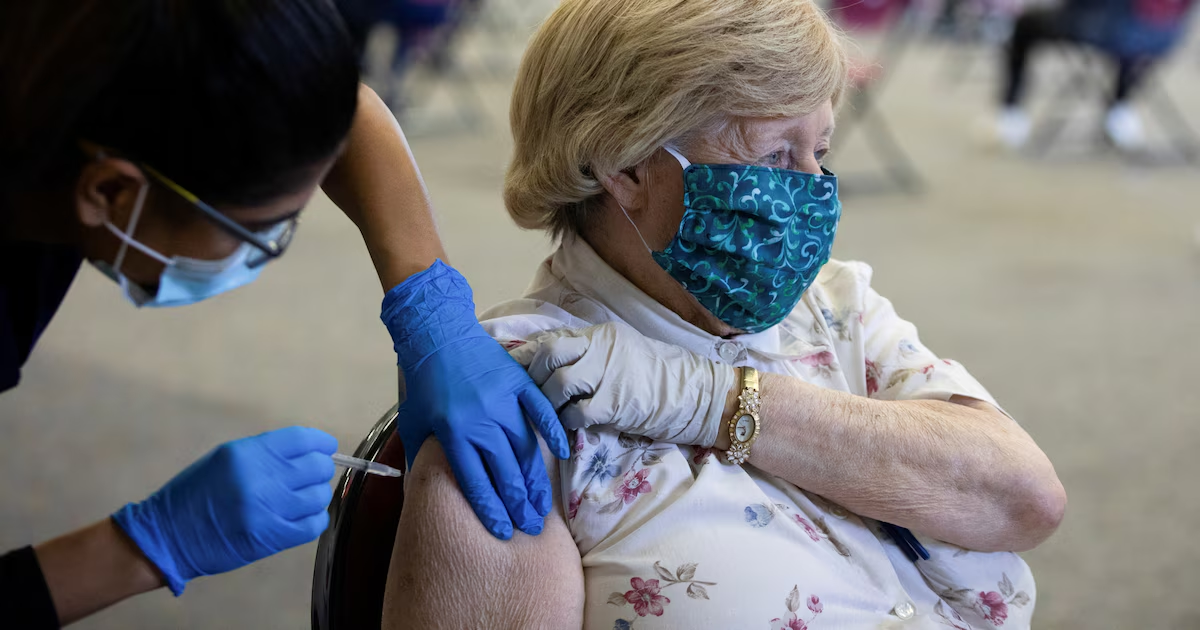
A review published in The Lancet on Tuesday reads the safety and efficacy record across billions of mRNA Covid vaccine doses. The headline finding is unsurprising: the platform is safe and offers life-saving protection, with the rare adverse events now characterised and substantially outweighed by what the vaccines prevent. "Throughout the Covid-19 pandemic, mRNA vaccines demonstrated what rapid, science-driven collaboration can achieve," said Anna Blakney, the University of British Columbia immunologist who led the review, citing not just the speed at which these doses became available but also “the importance of sharing safety data, conducting ongoing rigorous real-world surveillance, and providing clear information about how new types of vaccines work.”The finding that matters for the risk–benefit calculation is that the risk of heart inflammation from the vaccine is significantly lower than the risk from a Covid infection itself, and most vaccine-associated cases have been clinically mild. (Unsplash)But the value of the review is not that it declares the matter settled. It is that it reads the record carefully — what was safe, what side effects emerged, the biological mechanisms at play in either case — at a moment when mRNA platforms are moving fast beyond Covid into vaccines against flu and RSV, personalised cancer treatments, and therapies for genetic diseases like sickle cell.What an mRNA vaccine does in the bodyThe mechanism is worth understanding precisely, because much of the anxiety about mRNA vaccines turns on inaccurate ideas about what they do in the body. An mRNA vaccine delivers a short strand of synthetic genetic instructions, wrapped in a fatty bubble called a lipid nanoparticle, into the cytoplasm of muscle cells at the injection site. The cytoplasm is the cell's outer compartment — not the nucleus, where DNA lives. Cellular machinery reads the instructions, manufactures a copy of the virus's spike protein, and is trained by that protein to recognise and fight the real virus. The spike is detectable for about seven days. The mRNA and lipid components are cleared via the kidneys and liver within three to seven days in animal studies.The review draws the formal regulatory distinction at length: gene therapy involves the deliberate and permanent alteration of a patient's genome. mRNA vaccines do not. The two are different categories, and conflating them has been one of the most durable misinformation around these doses.Another mechanism is a technological advance more directly linked to the safety. The lipids in the two authorised mRNA Covid vaccines are what scientists call ionisable rather than permanently cationic. They are electrically neutral at the body's normal pH, charging up only inside the acidic compartments of cells where the cargo needs releasing. Earlier delivery systems used always-charged lipids that damaged cell membranes and triggered inflammation. The newer ones do not.What billions of doses have establishedThe safety-monitoring record — the system that tracks side effects once a vaccine moves from clinical trials into everyday use — is where most of the open questions have been answered.Severe allergic reactions — anaphylaxis — turn up in roughly two to eight people per million doses, and most of those who do react can be safely revaccinated under supervision. A blood-clotting syndrome that emerged in some cases with adenoviral-vector vaccines like Covishield has not shown up with mRNA vaccines.One highly debated side-effect the platform did produce, and the one most carefully studied, is inflammation of the heart muscle or its outer lining — myocarditis and pericarditis. The risk is elevated in the three weeks after vaccination and peaks within the first week — but mostly in boys and young men aged 12 to 29.The finding that matters for the risk–benefit calculation is that the risk of heart inflammation from the vaccine is significantly lower than the risk from a Covid infection itself, and most vaccine-associated cases have been clinically mild. A subset of patients reports symptoms persisting beyond a year, and the review notes that long-term follow-up is warranted.Two recent studies cited in the review fill in the picture with granular details. A 2025 Danish cohort tracked one million vaccinated adults across 29 possible adverse events and found no significant risk in the four weeks after vaccination. A US analysis of 244,494 adults receiving the XBB.1.5-adapted booster, looking at 15 adverse events, found only anaphylaxis statistically associated. One documented individual received 217 mRNA Covid vaccinations without reported adverse events.What remains openThe authors are equally clear about what remains open. After booster doses, the immune system shifts toward producing a particular type of antibody called IgG4 — from about 0.04% of the antibody response to as much as 19% in some measurements. These antibodies still bind the virus and neutralise it. What they do less well is summon the rest of the immune system's clean-up machinery to destroy infected cells. The clinical meaning is not yet settled. The same shift has been seen in repeat-dose trials of non-mRNA vaccines against HIV, malaria and whooping cough, suggesting it is a feature of giving the body the same antigen many times, not something specific to mRNA. It may even reduce inflammation-driven tissue damage. The honest answer is that scientists are still working it out.The platform also has a built-in limit. An mRNA vaccine injected into the muscle produces strong immunity throughout the body, but weak immunity at the wet linings of the nose and throat — which is where a respiratory virus first lands. This is why mRNA Covid vaccines reduce severe illness and transmission, but do not stop a vaccinated person from getting infected and passing the virus on. The same mismatch explains why protection against infection wanes faster than protection against hospitalisation, and why boosters keep being recommended.The platform is also not a cure-all. As the review puts it, "mRNA vaccines are not a panacea for all diseases". Moderna's RSV vaccine, mRESVIA, received FDA approval in May 2024 for adults aged 60 and over, with expanded approval in 2025 for younger adults at risk. A separate programme for infants was paused after a safety signal in babies aged five to seven months, and Moderna dropped that arm — the kind of course-correction that has been integral to science. Pfizer's mRNA flu vaccine outperformed a standard flu shot in adults aged 18 to 64 in a trial published in the New England Journal of Medicine last November. In a separate cohort of older adults the same trial underperformed.In other words, the technology works but whether each individual vaccine built on it does is a separate question, and one the next decade will keep answering.The platform and its publicA platform that works is one thing. A public that will accept its products is another. The review notes a UNICEF finding that 52 of 55 countries recorded declined vaccine confidence during the Covid pandemic — 94 per cent. A 2023 sentiment analysis of nearly 750,000 social-media posts on mRNA technology found widespread negative perception of the platform's safety, effectiveness and trustworthiness, alongside what the review's authors describe as frequent discussions of severe side-effects, rumours and misinformation. The WHO had vaccine hesitancy on its list of top ten global health threats in 2019, before the pandemic. The pandemic accelerated it. The review's authors note that the misuse of passive reporting systems — voluntary databases like the US VAERS, which collect unverified reports of any event following vaccination — to suggest causality where none is established has been a particular driver of disinformation that "erodes public trust and vaccine uptake."Drew Weissman, the University of Pennsylvania immunologist whose foundational work on modified mRNA earned him and his former colleague Katalin Karikó the 2023 Nobel Prize in medicine, has been describing the collapse publicly. "If you look back 250 years 40 per cent of our children worldwide didn't make it to adulthood. Nowadays it is 4 per cent, and the main reason for that is vaccines," he told Hindustan Times in an interview last year. "The world is now starting to move away from vaccines, which means infectious diseases are going to be a bigger problem. Children will start dying of measles and of polio and of other diseases that we thought were gone." Measles requires 95 per cent population coverage to prevent outbreaks. "There's 30 per cent of the people just refuse to take vaccines now," Weissman said."In the old days, there were always anti-vaccine people but they weren't leading our governments. They weren't in power. And now [they] are making anti-vaccine rules a norm."The review's authors land at the same place. "The widespread dissemination of misinformation and the politicisation of vaccine discourse," they write, "threaten to erode trust in science-based medicine."About 11 per cent of current mRNA clinical trials target cancer, including personalised vaccines that train the immune system against the specific mutations in an individual patient's tumour. Around 30 per cent target therapeutic applications — what Weissman described to HT as gene therapy programmes that "deliver enzymes that can correct incorrect DNA sequences and fix genetic deficiencies like sickle cell or cystic fibrosis," and therapeutic proteins for acute interventions: "If somebody is having a stroke, we can deliver an anti-inflammatory protein to turn down the inflammation in the brain."The next mRNA products are coming. Some will work and some, like the cytomegalovirus candidate, will not. Some will reach readers as flu shots and some as cancer treatments. The clinical, manufacturing and regulatory questions are tractable. The question of whether the science is permitted to land is not. As Manish Sadarangani, the review's senior author at the BC Children's Hospital Research Institute, put it: "mRNA vaccines have already transformed how we respond to emerging diseases, and with ongoing innovation and rigorous safety monitoring, they can drive progress in preventive medicine and cancer treatment for years to come."
Billions of doses later, a Lancet review confirms mRNA vaccine safety
The review draws the formal regulatory distinction: gene therapy involves the deliberate and permanent alteration of a patient's genome. mRNA vaccines do not
1,611 words~7 min read