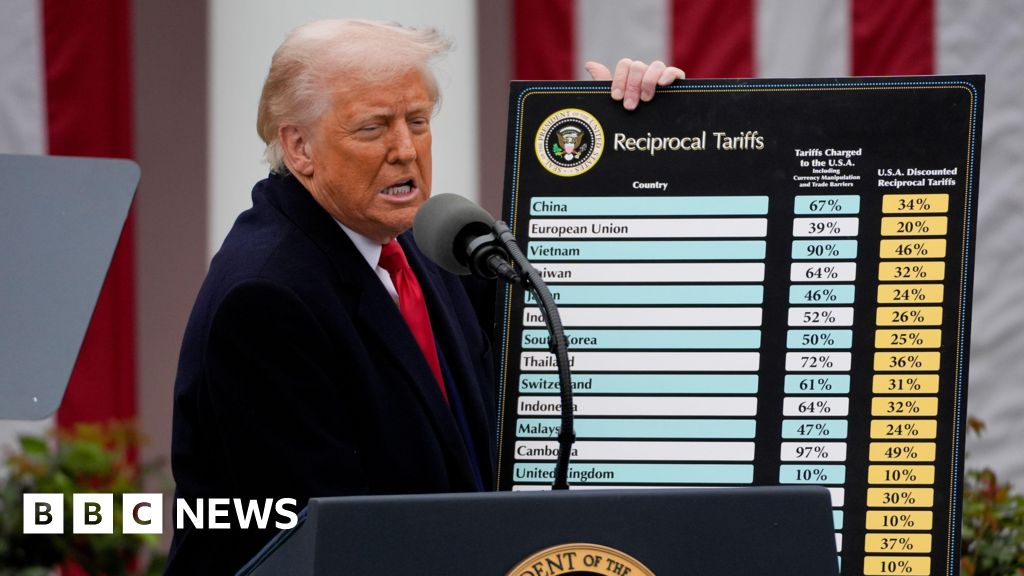
"Tariff" is famously Donald Trump's favorite word, and the U.S. president's continued use of it unleashed fear across markets last year as his administration unilaterally imposed the most protectionist set of trade policies since the 1930s. But the bark was far worse than the bite. It's been just over a year since Trump's "Liberation Day," and the average U.S. tariff rate is lower than many feared in April 2025. But at just under 10%, the daily effective pre-substitution rate is still four times its level at the end of 2024 and, excluding last year, the highest since the early 1940s. Yet tariffs barely register in financial markets today.Also read: Trump's tariffs aren't saving jobs at Whirlpool's Iowa refrigerator plantThat's partly because real wars have replaced trade wars on investors' worry list. But the economic impact of Trump's tariffs has also been nowhere near as severe as many feared, potentially because the trade war coincided with an unprecedented technological boom. But perhaps that's too simplistic? The full economic impact of redrawing the world's trade map and geopolitical alliances remains unknown and may not become clear for years. Negative shocks and surprises could still be in store. STATISTICALLY INSIGNIFICANTTariffs' muted economic impact over the past year can partly be explained by one simple fact: actual levies applied have been lower than statutory rates. That's a key argument in an April Brookings Institution paper by Pablo D. Fajgelbaum of the University of California and Amit Khandelwal of Yale University. The authors find that by December last year, around 57% of U.S. imports were still entering duty-free. That includes most goods from Canada and Mexico under the United States-Mexico-Canada Agreement, or USMCA. The Trump administration is expected to officially declare on Wednesday that it will not extend the 32-year-old North American free trade zone, but that just starts the clock on another review process, with the pact not set to expire until July 1, 2036. Tariffs applied at the border are usually lower than the stated headline rates for other reasons, such as legal loopholes and special agreements. Meanwhile, retaliation against Trump's tariffs has mostly been modest or short-lived, with China the only major trading partner to offer a sustained firm response. The AI boom has also helped, as hyperscalers have invested hundreds of billions of dollars to secure chips and other infrastructure, boosting global trade. As a result, the net impact of tariffs on economic activity has only been between 0.1% and minus 0.1% of GDP up to December, according to the Brookings paper. These findings chime with analysis produced by The Budget Lab at Yale. It estimates that the U.S. economy will be 0.1% smaller in the long run because of tariffs, the equivalent of about $30 billion annually in 2025 dollars. In other words, statistically insignificant, at least in the near term.Also read: One battle after another: How India fared in the year of Trump tariffsMARKETS VS REAL ECONOMY But try telling that to U.S. consumers, who have been forced to pay around 90% of Trump's tariffs. A Federal Reserve paper in April found that excess inflation in core goods since January 2025 is entirely due to tariffs. But the same paper also suggested that the pass-through to goods prices is essentially over. In other words, it was a one-time price move, as the Trump administration had argued. If correct, that would be welcome news for Americans, whose average personal savings rate has eroded to below 3%, the lowest in four years, partly on the back of higher prices. There's also another side to the story. Tariffs are a tax on whoever pays them, usually the consumer. But they are also an immediate source of government revenue, which reached $264 billion last year. That's more than triple 2024 revenue and represents 0.83% of GDP, the highest in over a century. In theory, that revenue should eventually flow back into the economy through tax cuts or higher spending, offsetting some of the hit to consumers.SLOW BURN? Investors shouldn't get complacent, though. While trade uncertainty has subsided, it remains very high. U.S. tariff policy has changed more than 50 times since the beginning of Trump's second term, according to the Tax Foundation. And there's little reason to believe that's the end of it, given the Trump administration's eagerness to use tariffs as a threat in foreign policy negotiations. Investors have mostly shrugged off these worries. "Markets have actually become quite detached from what's happening in the real economy," says Rebecca Harding, a trade economist and author whose most recent book, "The World at Economic War," was published late last year. But heightened trade uncertainty will likely keep raising the cost of international business and the difficulty of establishing new trade routes. Big companies may be able to cope, but small and medium-sized enterprises (SMEs) may struggle. Looking back, it's fair to say that many economists' prophecies of doom regarding tariffs were wide of the mark, but this could just be a matter of timeframe. Brexit offers a cautionary parallel. After Britain voted to leave the European Union in 2016, the UK economy did not immediately tank. But 10 years on, there is broad agreement that the economic damage has been profound. Whether the economic hit to the U.S. from tariffs will have a similar slow burn remains an open question, but one worth asking. (The opinions expressed here are those of the author, a columnist for Reuters)
Why Trump's tariffs had plenty of bark, but limited bite
Donald Trump's tariffs, once feared to cripple markets, have had a surprisingly muted impact, with actual levies lower than headline rates. While consumers bore the brunt, leading to inflation, the economic hit appears statistically insignificant in the short term. However, ongoing trade uncertainty and the potential for a 'slow burn' economic damage, akin to Brexit, remain significant concerns for the future.
904 words~4 min read