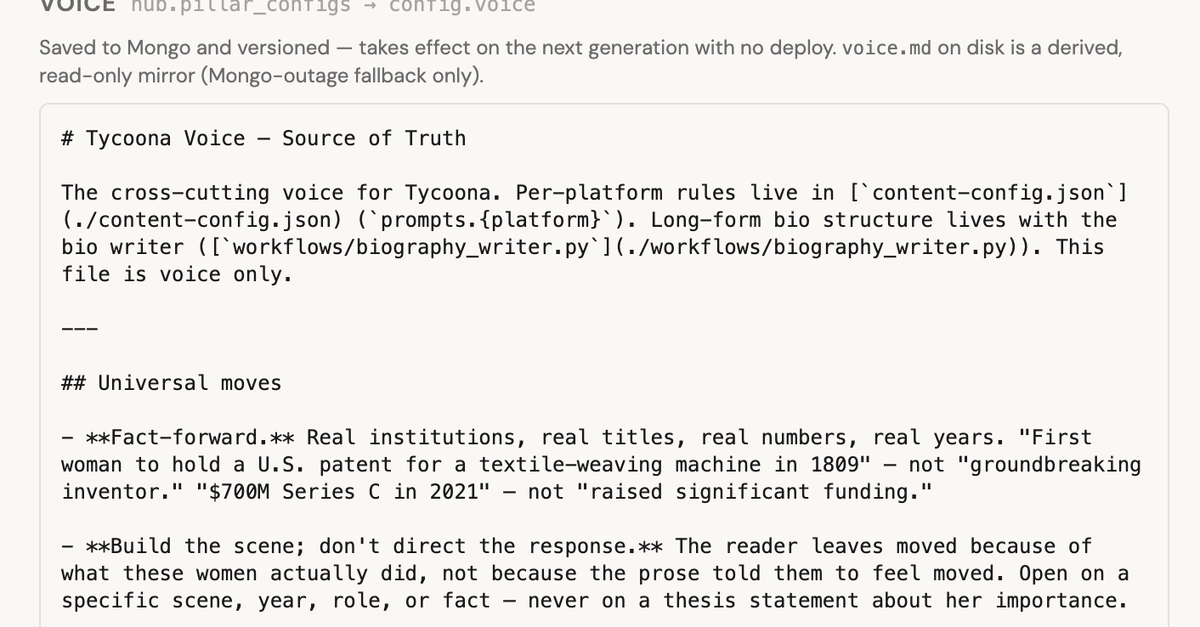
Of all the things involved in turning a woman's life into a 60-second reel, I assumed that the writing would be the easy part. Surely telling a good story in 150 words is exactly what a large language model should be good at; yet it proved surprisingly difficult. Draft after draft suffered from common AI weaknesses: a tendency to use hyperbole and inspirational language, to generalize, follow generic founder arcs ("built in a basement"), and focus on morbid details. (For this effort, I was using Sonnet 4.6, which I found to be better — more grounded, more true to facts, less inventive — than Opus 4.7 at creating longer bios.) Getting to something publishable took a significant amount of work. That said, the human in this story also found writing good short story arcs surprisingly challenging, so the effort spent on getting the system to do it decently was well worth it. Here's some context, then what I did.
I've been publishing short biographies of notable women for a while now, on a website called Tycoona. Why notable women? Because in each field there are so many women who contributed so much and are little known. I've never understood why Corita Kent, the pop-artist nun, isn't as famous as Andy Warhol, why Hetty Green, the Gilded Age value investor called both the "Witch of Wall Street" and the "Queen of Wall Street," disappears into history behind Benjamin Graham and his protege Warren Buffett. The problem I faced is that no one was seeing my bios, so I decided to make short videos or reels in hopes of increasing my reach.