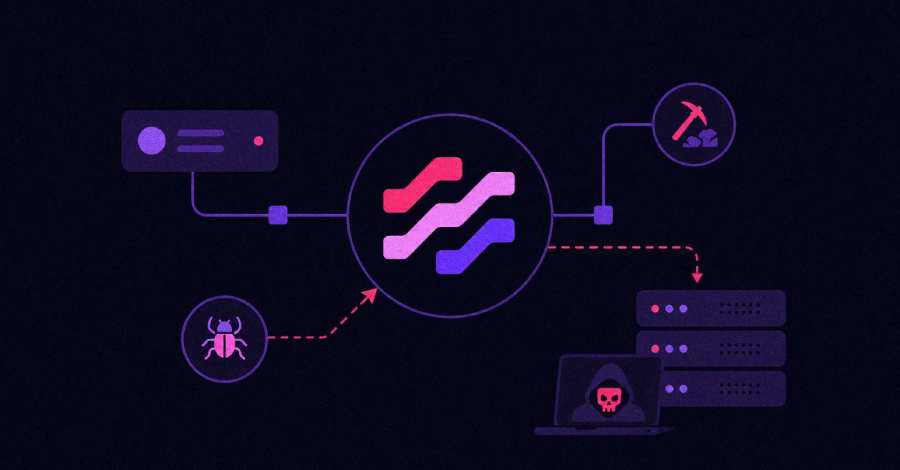
Threat actors are continuing to exploit a critical Langflow vulnerability as part of fresh attacks designed to deliver a Monero cryptocurrency miner.
The activity has been found to weaponize CVE-2026-33017 (CVSS score: 9.3), an unauthenticated remote code execution (RCE) vulnerability in Langflow, indicating threat actors are scanning and targeting exposed artificial intelligence (AI) application endpoints for obtaining initial access to enterprise networks. The attack was observed over a 19-day window between March 27 and April 15, 2026.
"In this campaign, a single line of Python code evaluated inside an unauthenticated Langflow API endpoint pulls down a shell script, fetches a miner binary, and launches it detached," Trend Micro researchers Simon Dulude and John Zhang said in a technical report published last week.
At a high level, the malware is designed to terminate competing cryptocurrency miner processes associated with Kinsing, WatchDog, Rocke, and Outlaw, delete rival wallet and key material, disable host-level security controls, establish cron-based persistence, beacon to an external server ("83.142.209[.]214:80), and deploy a custom miner. It can also propagate to other systems through reused SSH keys, effectively turning an exposed Langflow instance into a pathway for broader compromise.