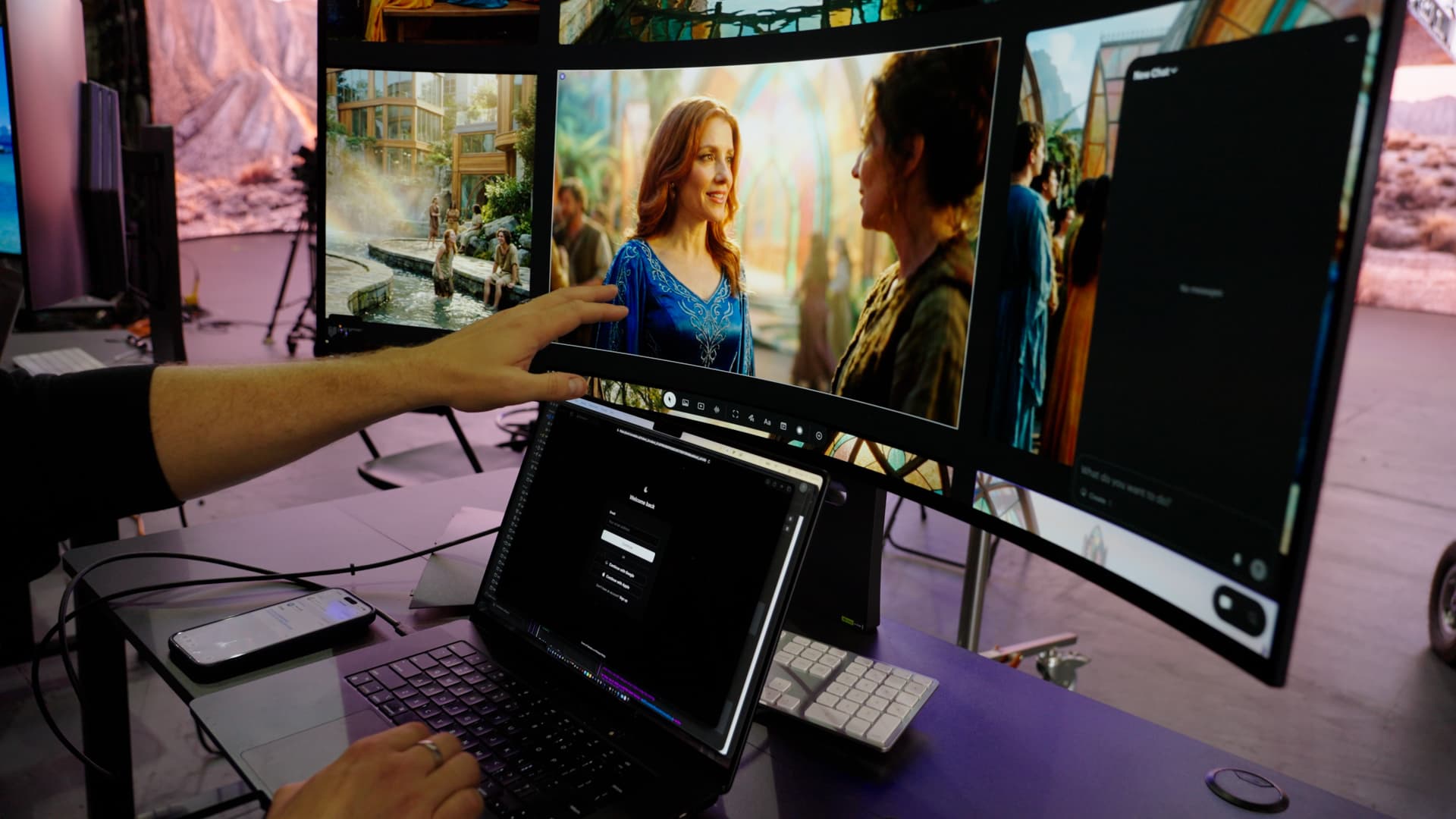
A new video for WEC x Le Mans has all the hallmarks of prestige filmmaking. Through its two minute runtime, the film is a homage to the adrenaline rush of late night racing, viewed through a dazzling array of shifting angles and perspectives. But what truly sets it apart is under the hood. Created by Obsidian and director Wes Walker, WEC x Le Mans signals a new hybrid approach to filmmaking with humans, CGI, and AI working in lockstep. Together, they can make films that would otherwise have been deemed too expensive, impractical, or unsafe, and perhaps abandoned at the ideation stage. The film’s transition from high concept idea to reality has been helped along by rapid advances in video AI. Popular discourse earlier this decade tended to be dismissive, wondering whether AI could match the output of even a mid-tier commercial production house. Today, video has improved rapidly. The most important question is how production houses, brands, and agencies will make optimal use of the AI tools at hand. The Le Mans film from Obsidian moves the utility of AI up the value chain, beyond speed and cost efficiency. It demonstrates how AI can also elevate craft by helping to finesse and polish an idea beyond what was previously possible, imaginable, or affordable. Director Wes Walker said, “This exploration of Le Mans and the Hypercar pushed us to do things in CG and AI that we could never achieve in live action. The film is full of unconventional shots built from a deep passion for automotive racing, shots a camera could never reach. That is the function of hybrid filmmaking: to be limited by nothing but our imagination and knowing what a film needs to say, to hit home, and resonate.” Achieving that required a production architecture that most commercial shoots have never attempted. The film was built on a hybrid pipeline combining live action reference, CGI, and AI generation with Higgsfield acting as the orchestration layer, managing the handoffs between tools and ensuring consistency of identity, physics, and detail across shots. Character consistency across the film was achieved through Higgsfield's proprietary Soul model. The video generation was done on Kling 3.0, selected specifically for its ability to handle high-speed motion, photorealistic faces and figures, and frame-to-frame stability — qualities that matter enormously in a racing film where a single inconsistent frame breaks the illusion of speed. The result was a workflow where no single tool made the creative call, but every tool was used precisely.The road to Le MansThe film began with clarity of purpose: to express the team’s love of Le Mans and Hypercars. The team wished to represent these vehicles as faithfully as possible but had to contend with many logistical hurdles. Discussing the challenges, Walker said, “Cars like these do not get filmed: they are too precise, expensive, and hard to access. Some moments can be watched wide from a helicopter, or fixed camera positions, but you are never on board. Not with the driver and inside the action, not cinematically present and immersed. We wanted what we see in our minds and yearn for as audiences.” Rather than content themselves with an AI sizzle reel, Walker chose to put the audience at the centre of action with sequential narrative storytelling. Higgsfield co-founder and chief strategy officer Mahi de Silva observed,”Our research found that the vast majority believe human creative judgment will always be essential — not as a safety net, but as the thing that makes the work worth making. What Wes built here proves that out. AI generated the variations. Every shot that made the cut was a choice."Obsidian tapped into its heritage, particularly its partnership with Imagine Entertainment, collaborating with filmmaker Ron Howard on previsualisation, hybrid AI, and animation. Howard’s 2013 F1 racing saga Rush was among the references studied for ways to create an immersive experience for the audience, making them feel the sensation of speed rather than be mere passive observers. With the narrative in place, the next step was creating visuals to match. Danilo Steher art directed and led the CG which was the anchor for the project. His team built the automotive base of the cars, incorporating branding and proportion. The diligence extended to aspects that most ordinary viewers would never notice. For instance, how a tyre deforms under load, or how a few hundredths of pressure shift a car’s stance through a corner. This gave the AI teams a solid foundation to build on, helping them incorporate details that would have been time consuming and prohibitively expensive to render using pureplay CG. AI helped generate faces, the crowd, the pit crew, the drivers and the cockpit, human and animal details that located the film in a living, breathing universe. As the orchestration layer, Higgsfield enabled the team to combine multiple models, determining the most appropriate for each shot. The AI elements ran on Kling 3.0 for its accurate physics, photoreal faces and figures, and a faithful read of the source image through an image-to-video pipeline with consistency across sequences. Describing the experience of working on the Le Mans film, Yushen Zeng, head of operations at Kling AI said, “Kling is designed to be production-ready for professional film and advertising work, where the real challenge is balancing quality, control, and consistency at the same time. A racing film like Le Mans, with that level of complexity and craftsmanship, is exactly the kind of production-grade use case Kling is built for. In high-speed racing sequences, what matters is whether identity and detail stay stable frame to frame, and our industry-first native 4K helps to build that beautifully." There was human involvement every step of the way across vital areas such as direction, CG, AI, compositing, colour, sound, and of course editing. When a single shot can be generated a thousand ways, with infinite customisation possibilities, the edit becomes a central act of authorship. The process involved numerous iterations and discarding material that did not meet the mark. This deep engagement ensured that the film was shaped by thousands of small decisions, with critical judgment and the irreplaceable experience of the director, editor, and the production team. While AI has been accused, not entirely without reason, of making visuals appear generic, the Le Mans film demonstrated that in the right hands, it could create something unique. Lenn Anton, Creative Director, Obsidian said, “There were shots the tools handed us that we could never have staged in live action. And there were shots where the AI could not hold on to our standard; and so, Danilo and the CG team built them the traditional way. The craft is knowing which is which and never letting the tool make the creative call.How AI video is moving from cost and time efficiencies to creative excellenceAs AI improves, even brands that were once wary of using it in their videos are increasingly making the shift. Over 80% of the work on the Higgsfield platform now comes from commercial creative, much of it advertising according to de Silva. The main draw goes beyond obvious choices such as cost of production. Higgsfield’s State of AI Video survey which draws on responses from over 4,200 creators across 125 countries, revealed that 50% of creators want these tools to produce work they have always pictured but never had the means to bring to life. AI was viewed not as a tool but as a co-creator by 41% of creators. “Great ideas stagnate because they are judged too expensive, too complicated, too far ahead of their time. That equation is changing,” said de Silva. To make the most of AI-based production, studios need to build workflows and critically retain the talent who can help them make the correct judgment calls. Rather than replace experienced editors and creators, the tools have expanded the reach of these specialists allowing them to do more than ever before with their time and talent. The next era is one in which seamlessly integrated traditional filmmaking, modern techniques including CG and VFX, but the heavy lifting done by AI. The best work will rely on unusual combinations of and collaborations between these various elements. Creating such work requires time and patience, debunking yet another myth about AI. While AI can accelerate certain processes, speed is not an end in itself. Anton observed, “The point was never speed but reach. Same team, same standard. Not fewer of us in the room, but more of what we can make.” Citing the example of the Le Mans film Zeng concluded, “AI video is no longer a separate experimental layer. It can now sit inside the core production workflow, speeding up iteration, expanding creative range, and delivering campaign-ready results.”
What Obsidian’s Le Mans film can teach brands about the AI-powered future of filmmaking
Rather than simply being a tool for faster and less expensive production, AI is enabling filmmakers to expand creative possibilities through hybrid filmmaking, say Higgsfield, Kling AI, and Obsidian during a presentation at Cannes Lions 2026.
1,450 words~7 min read