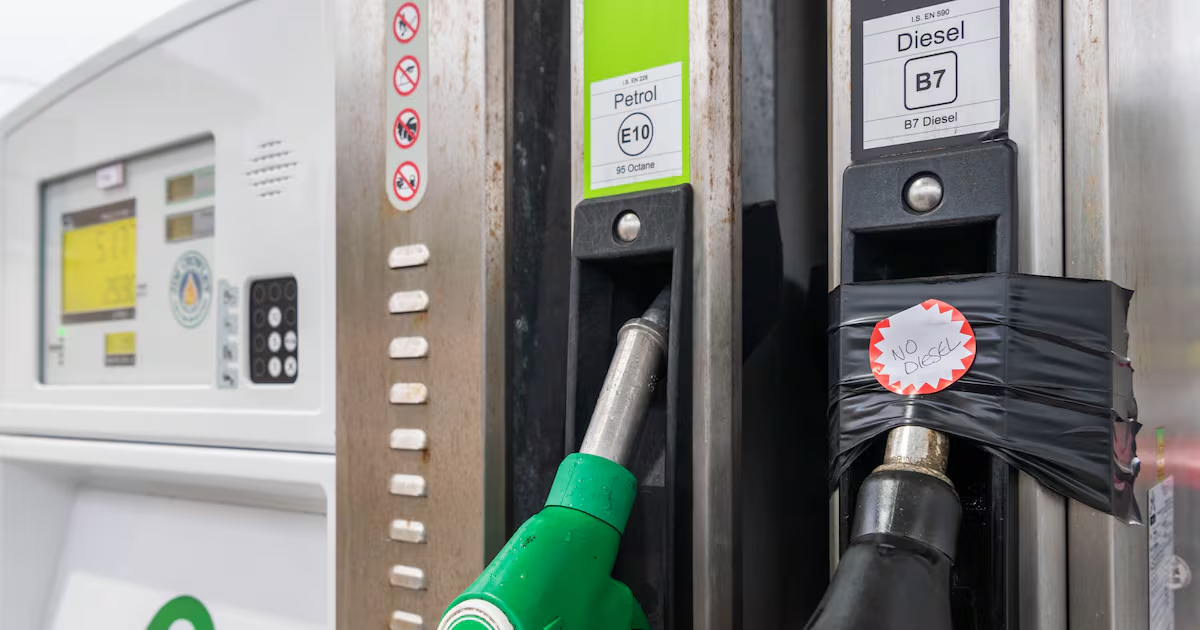
And so the unwinding begins. But there will be no cliff edge for the petrol and diesel levies. And the unfurling is not going to happen immediately. Instead, the leaders of the three Coalition partners agreed last night that the full reversal will not be completed until well after the budget. In other words, a slow bicycle race. The cuts were due to expire at the end of July. But as Jack Horgan-Jones reports, the reduced excise duties on petrol and diesel will remain at the same level until September 1st.When the cuts to fuel taxes were introduced by the Government earlier this year, the effect was to bring the price per litre of diesel and petrol to below €2. Since the ceasefire agreement was announced between the US and Iran, petrol pump prices have fallen. This week, even by removing the per-litre supports of 27c for petrol and 32c for diesel, the price would hover just below the €2 mark in most (but not all) forecourts. However, given the tit-for-tat attacks by Iran and US, and uncertainty over the long-time stability of the ceasefire agreement, prices are expected to fluctuate again. Taoiseach Micheál Martin, Tánaiste Simon Harris and the leader of the group of Independent TDs in Government, Seán Canney, met last night in Government Buildings to agree on a memo to bring to this morning’s meeting of Cabinet. It has been known for some time that the Government would take a tapered approach, and gradually reduce the supports. But it had been expected that the first of the reversals would take place during the summer and not in early autumn. “With the presidency of the council of the European Union due to rotate to Dublin on Wednesday, the potential for protesters to disrupt some of the hundreds of high-powered meetings is also on the Coalition’s radar.“A change in the planned expiry of the cuts will require legislation to be passed through the Oireachtas before the summer recess, which is due to begin on July 16th,” the report on the meeting stated. New guidelines will make once-off housing easier in rural IrelandRibbon development was a thing in the last century in rural Ireland. Then it was effectively stymied by strict new guidelines, the latest of which was published 20 years ago. But in a dramatic reversal of that policy, the Government is set to reintroduce it. Minister for Housing James Browne will bring new guidelines to Cabinet this morning that have been developed by him and the Minister of State in his department, John Cummins. The guidelines will allow more flexible rules for one-off rural housing and will redefine local need less stringently than before. Overall, the policy approach of Browne is to allow new rural housing for people who, he will argue, genuinely need to live in rural areas, while also preventing the uncontrolled spread of housing from nearby towns and cities into the countryside. It also aims to support the renewal of rural towns and villages and address population decline in rural areas.The rules will be stricter closer to cities and towns to prevent urban sprawl, and also in locations considered to be highly-sensitive scenic and amenity areas. However, in other high-amenity areas – including coastlines, river valleys and lakesides – that are scenic but don’t have a conservation designation, new houses may be allowed but they will be carefully managed and priority will be given to people with a local rural housing need.In Gaeltacht areas, the person must live within 3km of the site and have lived there for 10 years. However, this can be relaxed to five years for people who speak Irish and can show a local need. This is to help protect and support the Irish language in these areas.The existing guidelines have long been the subject of complaints in the country’s Gaeltachts, where native Irish-speaking families have found themselves unable to build a house near their home place because of the existing guidelines. People applying to build a house in a Gaeltacht area can show an adult in the household has a good standard of fluency in spoken Irish (a minimum B2 level on the Common European Framework of Reference for Languages). Applicants must also show they have a local need (either social or economic) to live in that Gaeltacht area. If they can prove they speak Irish to the required level, the planning authority may be more flexible when assessing how long they have lived in the area.The policy also recognises that Gaeltacht communities share a specific culture, language and identity. It introduces the idea of “inter-Gaeltacht recognition”, meaning Irish speakers who live and work in one Gaeltacht can use that to show they meet local need requirements in another Gaeltacht.For housing developments with two or more homes, developers must include a “linguistic integration statement”. This sets out how many of the homes will be lived in by Irish speakers. The number should reflect the percentage of daily Irish speakers in that area, and this will be implemented by condition of planning permission.On ribbon development, the new rules will set out that local authorities should not set prescriptive requirements such as requiring a minimum road frontage or limiting developments to a set number of houses in a row. That is a big change. Best ReadsConor Gallagher reports that Aughinish Alumina will have to pay the full €31 million cost of closure and remediation works at its Co Limerick plant up front.Fintan O’Toole, reflecting on the current heat dome over Europe, says “we now live in the future we were warned of”. In his column, Eamon Ryan sets out an eight-point plan to make electricity cheap. Regular contributor Eoin Drea, a researcher at a Fine Gael-linked European People’s Party think tank, pointedly remarks that the Coalition is dreaming of income tax cuts in the budget while most economists are predicting “various shades of financial Armageddon”.PlaybookThe Cabinet meets this morning with fuel levies and the rural housing guidelines at the top of the agenda. It will also discuss a number of other items including a report that shows child poverty has fallen and a new directive that will instruct departments and agencies to communicate the benefits of big infrastructure projects to local communities. This is seen as key to reducing the number of judicial review cases. And of course, Wednesday is the big day for the State as Ireland assumes the presidency of the European Union at a ceremony in Dublin Castle. It will be quickly followed by two days of meetings for EU commissioners, hosted by the Taoiseach in Cork on Thursday and Friday. Dáil Éireann2pm: Leaders’ Questions 3.05pm: Taoiseach’s Questions3.50pm: Development (Strategic Gas Reserve) Bill 2026 – Committee and remaining stages5.50pm: Dublin Airport (Passenger Capacity) Bill 2026 – Committee and remaining stages7.50pm: Regulation of Artificial Intelligence Bill 2026 – Committee and remaining stages9.50pm: Private Members’ Business (Sinn Féin). Motion on Childcare11.50pm: Dáil adjournsSeanad Éireann12.30pm: Commencement Matters2.45pm: Government Business: Criminal Justice (Terrorist Offences) (Amendment) Bill 2025 – Order for committee, committee and remaining stages4pm: Private Members’ Business: Motion on electricity supply6pm: Criminal Justice (Terrorist Offences) (Amendment) Bill 2025 – Committee and remaining stages (resumed)6pm: Guardianship of Infants and Child Care (Amendment) Bill 2026 – Committee and remaining stagesCommittees11.15am: Joint Committee on the Implementation of the Good Friday Agreement engagement with Relatives for Justice/Bridge of Hope Ashton Community Trust11am: Joint Committee on Fisheries and Maritime Affairs | Joint Committee on Climate, Environment and Energy – Impacts of water quality and pollution on sea and inland fisheries11.30am: Comhchoiste na Gaeilge, na Gaeltachta agus Phobal Labhartha na Gaeilge 3pm: Joint Committee on Housing, Local Government and Heritage – Social housing estate regeneration3.40pm: Committee on Budgetary Oversight – Measures to address the cost of financing business in Ireland in advance of Budget 2027 with a focus on taxation and spending measures4pm: Joint Committee on Agriculture and Food – Launch of report on anaerobic digestion4.15pm: Joint Committee on Justice, Home Affairs and MigrationE – Engagement on “criminal legal aid”
Yes, the fuel tax cuts will come to an end ... slowly
Inside Politics: Building once-off housing in rural area is about to get easier, especially for Irish speakers
1,332 words~6 min read