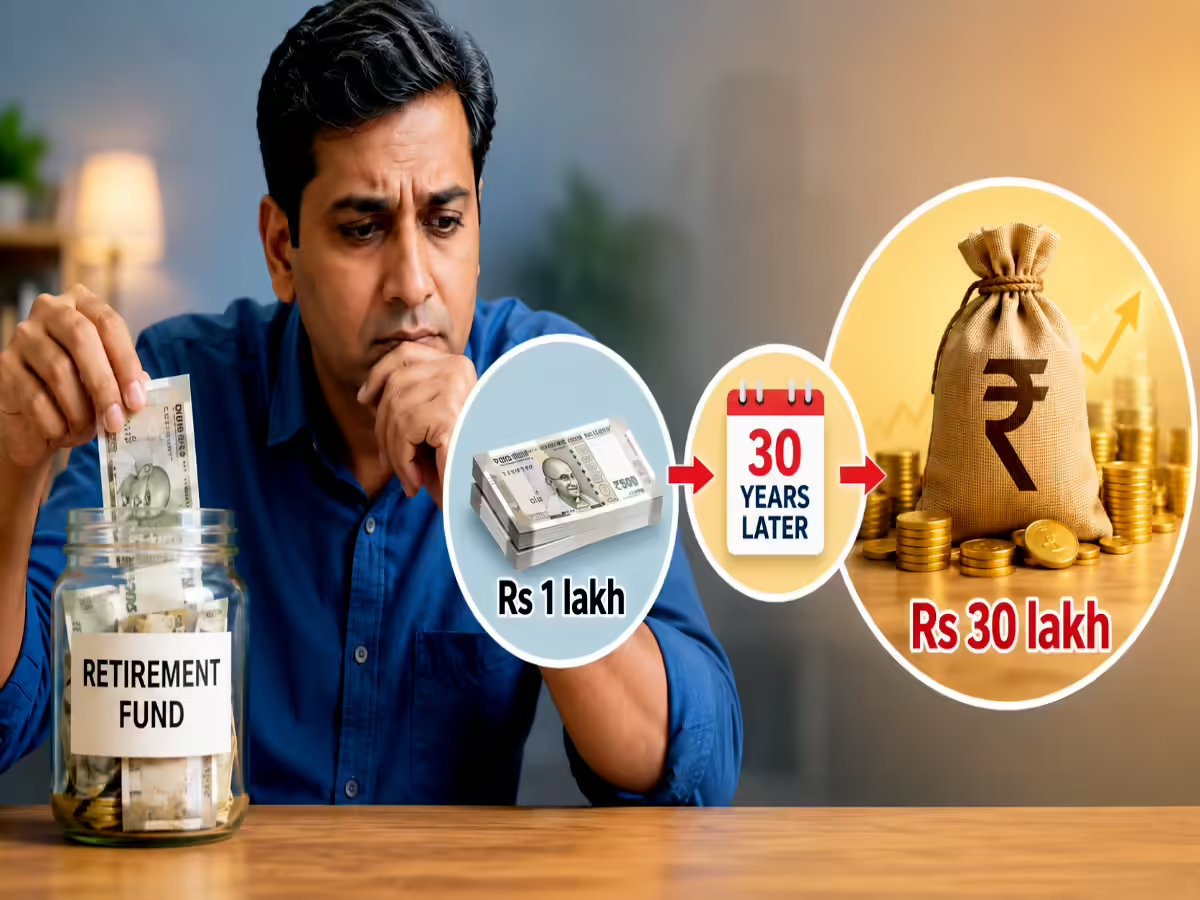
Do you need Rs 1 lakh urgently and your retirement corpus is the only option with you? Withdrawing Rs 1 lakh from your retirement corpus may seem easy at 30 years of age. But that single withdrawal may reduce your corpus by Rs 30 lakh by the time you turn 60. While the power of compounding may help your small investment for your retirement corpus grow into a large amount in the long term, a small withdrawal may deplete its value severely. This is where you need an emergency fund for your immediate needs. First look, how a Rs 1 lakh withdrawal at 30 may cost you around Rs 30 lakh at 60 years of age.Age: 30 yearsRetirement age: 60 years Withdrawal= Rs 1 lakh Expected annualised return= 12% Value of Rs 1 lakh in 30 years= Rs 30 lakh (at 12% growth) You can see that if you withdraw just Rs 1 lakh, it may cost you the principal and Rs 29 lakh of growth on that. But life is uncertain. An emergency situation may hit you even in the best of days. While, dipping in your retirement corpus may not be a good idea, what alternate route can you choose to address your monetary emergency needs.Future value of withdrawn amount (Rs 1-10 lakh) in 30 years at 12% annualised return Current value Value after 30 years at 12% growth Rs 1 lakh Rs 30 lakh Rs 2 lakh Rs 60 lakh Rs 3 lakh Rs 90 lakh Rs 4 lakh Rs 1.2 crore Rs 5 lakh Rs 1.5 crore Rs 6 lakh Rs 1.8 crore Rs 7 lakh Rs 2.1 crore Rs 8 lakh Rs 2.4 crore Rs 9 lakh Rs 2.7 crore Rs 10 lakh Rs 3 crore What qualifies as an emergency? Raj Khosla, founder & managing director, MyMoneyMantra.com, told ET Wealth Online an emergency is an unplanned situation that may arrive anytime unexpectedly and can threaten your health, livelihood, career, and security. Some of the examples Kholsla cites are job loss, medical emergency, urgent car repair, unavoidable home repairs, emergency, etc. Is it justified to withdraw from retirement savings for emergencies? Gurmeet Singh Chawla, managing director, Master Portfolio Services Limited, told ET Wealth Online that only a few emergencies may justify a partial withdrawal from the retirement corpus, but one should be prepared with separatee savings and investments “A life-threatening medical emergency may justify a partial withdrawal, as may long-term unemployment after exhausting all other resources. But planned expenses such as home loan down payment, wedding, car purchase, vacation are generally not justification for a partial withdrawal. These goals should be funded through separate savings and investment,” says Chawla. Citing an example, Chawla says If an investor withdraw Rs 1 lakh at age 30 from a retirement corpus, it can be down by nearly Rs 30 lakh by the time they turn 60. “The Rs 1 lakh withdrawn is not the loss, it is wealth that could have been created by that amount over the next three decades,” says Chawla. Khosla says if the expense can’t wait and you have quick access to your retirement fund, you can consider using it. However, Khosla suggests a user to always compare the net gain of investment against the cost of loan. “A low-cost loan might be a better alternative to breaking long-term savings,” suggest Khosla. But then what, if you suddenly need Rs 1 lakh and you don’t have any friend or family member to take help from, what could be the alternative way? Experts recommend emergency funds for immediate needs Chawla says one needs to have an emergency fund and for short-term needs, they can keep their money in savings accounts, liquid funds, FDs, etc. “In emergencies, the first source of fund should be an emergency fund, as it is meant for unforeseen expenses. If that is not sufficient, the next best option is extra money in a savings account or investments in liquid funds, which provide quick access to cash with minimal impact on long-term financial objectives,” says Chawla. Chawla suggests that one can also look at short-term debt investments or fixed deposits depending on the costs or penalties on withdrawal. Khosla opines that during emergencies, one can first withdraw from their savings account, then from their emergency fund (sweep-in FD) and finally liquid funds. Many experts suggest keeping at least six months of monthly expenses in the form of an emergency fund. Having such a cushion of six months to two years can help one avoid withdrawing from their retirement fund during emergencies. A savings account offers instant accessibility to funds through automated teller machine (ATM), Unified Payments of India (UPI) or net banking. A sweep-in FD can also be redeemed almost immediately. Liquid funds take 1 to 2 business days for redemption (some platforms may offer instant redemption for a smaller amount), and using this fund is ideal if you some amount immediately, says Khosla. Liquid mutual funds generally offer a higher pre-tax return compared to saving accounts. However, one also needs to check exit loads for the specific fund. Thus, you can see that one should make their best efforts to keep the retirement fund untouched for emergency needs. They should create an emergency of six months to two years in low-risk instruments which provide an easy access to their emergency fund.
Need Rs 1 lakh urgently? Think again before withdrawing it from your retirement fund as it could cost you Rs 30 lakh later - The Economic Times
Retirement planning: Dipping into your retirement corpus for urgent needs can be a costly mistake, potentially costing you lakhs by retirement. Experts emphasize building a robust emergency fund, ideally covering six months to two years of expenses. This fund, held in low-risk, easily accessible instruments like savings accounts or liquid funds, acts as a crucial buffer against unforeseen events, safeguarding your long-term financial future.
890 words~4 min read