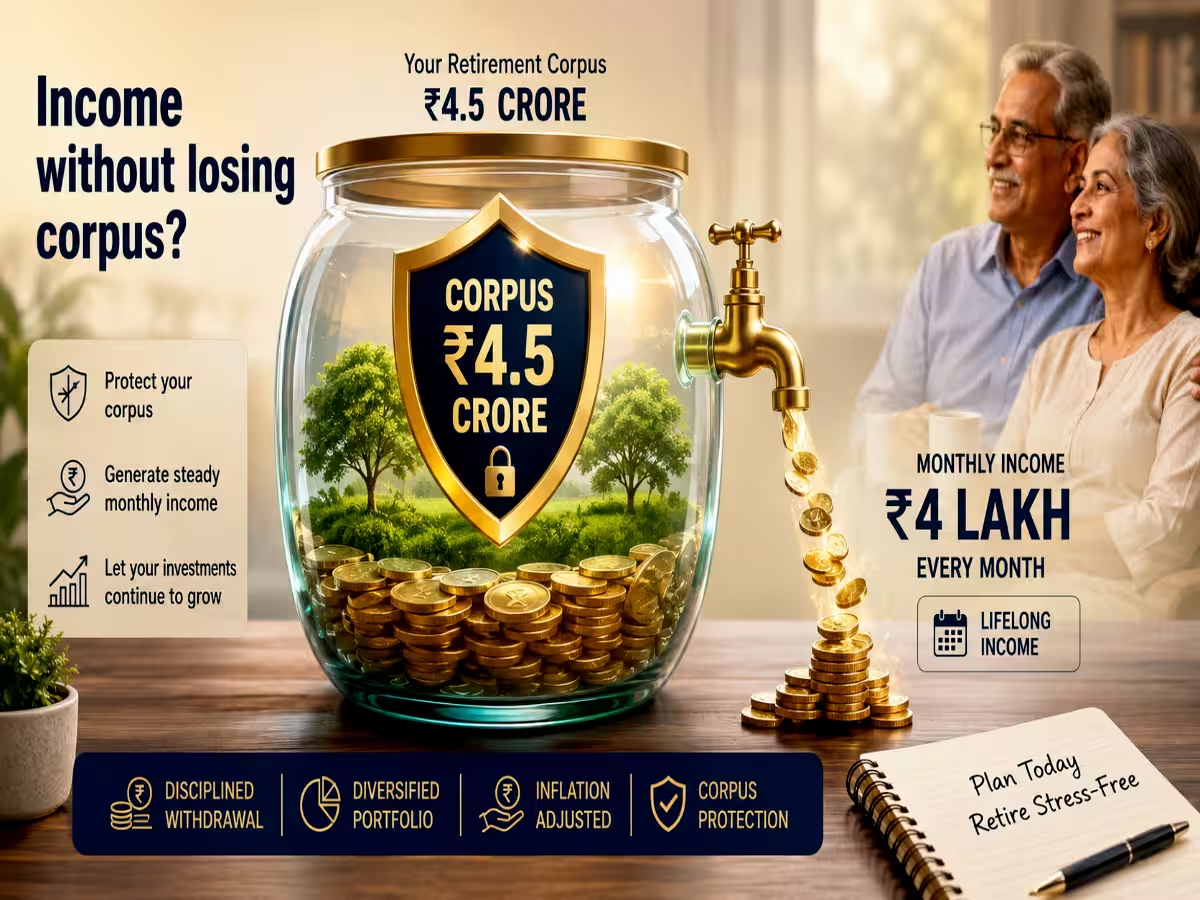
If you decide to retire today with a retirement corpus of Rs 1.5 crore, can it really you a monthly income of Rs 1.5 lakh for 20 years? The amount you can withdraw will depend on the returns you earn. Based on your risk appetite, you can choose a low or high withdrawal rate. For those with high-risk tolerance, an equity-heavy portfolio might yield significant returns in the long term. However, during a market downturn, this kind of equity-heavy portfolio could be risky as it might diminish the value of your retirement corpus. In contrast, a debt-heavy portfolio might offer some stability, but it might not be enough to outpace inflation and last for the long haul. So, what can you realistically expect from a Rs 1.5-crore retirement corpus, if you identify as a conservative, moderate or an aggressive investor? Do you have a fair chance of withdrawing Rs 1.5 lakh each month for 20 years from a Rs 1.5-crore retirement corpus? Experts provide insight on how to effectively plan your retirement with a Rs 1.5 crore corpus. Vishwajeet Goel, head, Pensionbazaar.com, told ET Wealth Online that depemding on your risk appetite, a Rs 1.5 crore retirement corpus could offer a monthly income ranging from Rs 70,000 to Rs 1.2 lakh/month. Rs 1.5 crore corpus for retirees, with asset allocation and monthly withdrawal amounts as suggested by Vishwajeet Goel Risk Profile Asset allocation Suitable products Estimated monthly income* Conservative 0-20% equity, 80-100% debt NPS RIS, immediate annuities, SCSS, RBI Bonds, Rs 70,000 – Rs 85,000 Moderate 30-40% equity, 60-70% debt Annuities, balanced advantage funds, debt funds, SCSS, NPS RIS Rs 85,000 – Rs 1.00 lakh Aggressive 50-60% equity, 40-50% debt Equity mutual funds, NPS RIS, debt funds, partial annuity Rs 1.00 – Rs 1.20 lakh Assumptions Retirement corpus: Rs 1.5 crore retirement corpus Duration: 20-year retirement horizon Objective: Generating regular income while managing longevity and inflation risks Puneet Singhania, director, Master Capital Services Limited, recommends keeping the withdrawal rate up to 6.50% even if someone follows the aggressive strategy with an equity allocation of 65%. For a conservative investor, Singhania expects a return of 7.5% per annum. However, with that return, he suggests the retiree should withdraw 4.50% from the corpus annually. According to Singhania, the advantage of keeping the withdrawal rate lower in either case will be that the retiree may be left with at least Rs 2.1 crore corpus even after withdrawing a monthly amount for 20 years. Rs 1.5 crore corpus for retirees, with asset allocation and monthly withdrawal amounts as suggested by Puneet Singhania Parameter Conservative Plan Balanced Plan Growth Plan Asset allocation (Debt / Hybrid / Equity) 65% / 20% / 15% 40% / 25% / 35% 20% / 15% / 65% Monthly income (starting) ₹ 56,250 ₹ 68,750 ₹ 81,250 Annual withdrawal rate 4.50% 5.50% 6.50% Expected portfolio return 7.5% p.a. 9.5% p.a. 11.5% p.a. Corpus at Year 20 (nominal) ~₹2.1 crore ~₹2.8 crore ~₹3.9 crore* Risk level Low Moderate High Recommended products SCSS, RBI floating rate bond, senior citizen FD, hybridMF, debt fund, large cap MF SCSS, RBI floating rate bond, debt MF (short/medium duration, balances advantage fund, large cap, multi cap, flexi cap funds SCSS, liquid, balanced advantage fund, large cap, flexi cap, multi cap mutual funds Mohit Bagdi, head of investment research & founding member of MIRA Money, expects 7%, 7.75% and 8.25% annualised return for conservative, moderate and aggressive investors, respectively. Instead of a flat withdrawal amount for 20 years, Badgi suggests starting with a low monthly withdrawal and stepping it up by 5% every year to keep pace with rising expenses. Rs 1.5 crore corpus for retirees, with asset allocation and monthly withdrawal amounts as suggested by Mohit Bagdi, MIRA Money) Particulars Conservative Moderate Aggressive Investment (Rs) 1,50,00,000 1,50,00,000 1,50,00,000 Annual Cash Outflow % 6% 6.50% 6.80% Annual Outflow (Rs) 9,00,000 9,75,000 10,12,500 Monthly Income (Rs) 75,000 81,250 84,375 Annual Step-Up 5% 5% 5% Assets FD, debt funds, conservative hybrid funds, equity savings funds Debt / conservative hybrid funds, equity savings and aggressive hybrid funds Aggressive hybrid / equity savings funds, equity-only funds Bucket strategy For retirement planning, a lot of financial experts suggest following the bucket strategy to meet immediate money needs and corpus growth. In a bucket strategy, investors make three buckets of investments. In Bucket 1, they invest the money they require in 0-3 years. They make this investment in schemes providing high liquidity such as savings account or debt liquid funds. In Bucket 2, they invest the amount required in the next 3-10 years. They make investment in conservative and moderate-yield instruments (such as conservative hybrid funds) that balance modest growth and stability. The bucket is used to fill Bucket 1 when it is depleted. In Bucket 3, they invest the amount required after 10 years or later. Such investments are made in equity and aggressive hybrid funds to generate growth that can beat inflation in the long term. Bucket 3 refills Bucket 2 when it empty. In becomes a cycle, providing stability and growth to a retiree’s retirement corpus. Vishwajeet Goelillustrates a monthly withdrawal in the range of Rs 85,000 to Rs 1 lakh/month using the Bucket strategy. According to Goel, the example assumes a Rs 1.5 crore retirement corpus, a 20-year retirement period, annual withdrawal rates of approximately 6-8%, periodic portfolio rebalancing, and long-term annual returns of 4-5% for liquid assets, 7-8% for income-oriented investments (including annuities and NPS RIS), and 10-11% for growth-oriented assets such as equity mutual funds and NPS. Actual returns and income may vary based on market conditions, inflation, taxation, annuity rates, and individual withdrawal patterns. Bucket Allocation Suggested Investments Purpose Bucket 1: Immediate Income ₹15 lakh (10%) Savings Account, Liquid Funds, Money Market Funds Provides 1–2 years of living expenses and emergency liquidity Bucket 2: Stable Income ₹60 lakh (40%) Senior Citizens' Savings Scheme (SCSS), Immediate Annuities, Corporate Bond Funds, RBI Bonds, NPS Retirement Income Scheme (RIS) Generates regular income and protects against market volatility Bucket 3: Long-Term Growth ₹75 lakh (50%) NPS (Active Choice/Auto Choice), Flexi-cap Funds, Index Funds, Balanced Advantage Funds Generates long-term growth and helps counter inflation Things to keep in mind during retirement planning Prefer capital preservation to aggressive growth Singhania says since retirement planning is a long-term goal. One should focus on capital preservation rather than blindly chasing aggressive returns. For asset allocation and withdrawal planning, Singhania says, “Allocate across debt instruments, dividend-yielding equities, hybrid mutual funds and equity mutual funds. Factor in inflation at 6–7% annually as a Rs 1.5 crore corpus today won't have the same purchasing power in 15 years. Avoid over-concentration in a single asset class, chasing high-yield small-caps, or withdrawing beyond 3–4% annually. Keep 6–12 months of expenses liquid at all times.” Goel advises planning for healthcare and emergency expenses separately, as medical costs tend to rise significantly once you retire. Goel also recommends that investors should avoid investing the entire corpus in fixed deposits or traditional debt products, as inflation can erode real returns over time. “They shouldn’t depend on a single product or asset class for retirement income or chase high-return products without understanding the risks involved,” says Goel. Retirement is a long-term planning process. Retirees should diversify their investment portfolio. Rather than chasing high returns, they should focus on the sustainability of the corpus. For that, they should invest in instruments providing liquidity in the short term and growth in the long term. Having a medical emergency fund can come in handy as you don’t need to withdraw a large amount from your retirement corpus. The withdrawal rate should be less than the growth rate to ensure sustainability of the corpus throughout retirement.
Rs 1.50 lakh/month income from Rs 1.5 crore corpus? Easy retirement strategies for conservative, moderate and aggressive investors explained - The Economic Times
Retiring with Rs 1.5 crore can provide a monthly income, but the amount depends on risk appetite and investment returns. Experts suggest withdrawal rates between 4.5% and 6.5% annually, with potential monthly incomes ranging from Rs 70,000 to Rs 1.2 lakh. A bucket strategy is recommended for managing immediate needs and long-term growth.
1,278 words~6 min read