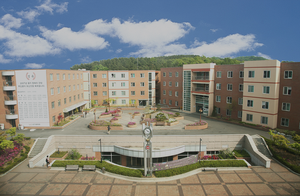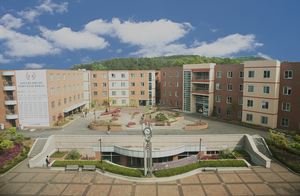
College says repayment scheduled for August after selling disputed property, ministry says planned asset sale unlikely within a year Woongji Accounting and Tax College's Korean Language Education Center in Paju, Gyeonggi Province. (Woongji Accounting Tax College) A private college in South Korea used about half of the tuition paid by foreign students for operating expenses before their visas were approved, leaving over 170 students waiting months for refunds after their applications were denied.“We sent approximately $4,350 each in January from a bank in India,” three Indian students who were set to enroll in a language program at Woongji Accounting and Tax College in Paju, Gyeonggi Province, told The Korea Herald. “But the school said they would not proceed with the visa process.”The Korea Herald confirmed the cases of the three Indian students among those awaiting refunds.When the students asked for a refund, the college initially agreed to reimburse them. But for the students, that was the start of a monthslong wait.In May, Woongji told students in an email that all 170 students admitted to its language program had been denied D-4 visas by the Justice Ministry. D-4 visas are issued to foreign students enrolled in Korean language training programs.The total tuition paid by 170 students would amount to roughly 1 billion won ($646,000), based on the college’s estimate, raising questions over whether the college had sufficient funds to return the payments.In the email, the college said refunds had been delayed due to “temporary fund liquidity” problems. The college promised that students would receive their refunds by June 30.But Woongji told The Korea Herald on Monday that some students will have to wait until late August to receive their refunds. About half of the refunds had already been made, and approximately 500 million won remained unpaid, it added.“We are in a somewhat difficult financial situation,” Song Young-rok, vice president of the college, told The Korea Herald. “We had already used about 50 percent of the tuition received as operating expenses.”Song said the visa denials were unexpected, adding that the college had expected at least half of the students’ visa applications to be approved, based on the previous year’s admissions.“We had unpaid wages and were on the brink of power cuts,” he said, explaining why the college used part of the tuition funds.As of Monday evening, the Justice Ministry had not responded to The Korea Herald’s inquiry asking why the students were denied visas.Woongji pins refund plan on asset sale, but ministry casts doubtSong said the college had a concrete reimbursement plan and that all remaining students would receive refunds by late August. He said the college foundation owns a building in Mapo-gu, Seoul, valued at 30 billion won, and is seeking to sell it to secure funds.“We are waiting for the Education Ministry’s approval to sell the building,” Song said. “The ministry is reviewing it positively because we have submitted clear explanations of how we will use the funds, including paying unpaid refunds.”The college said the ministry’s approval was only a “procedural issue” and that it had already secured a buyer for the building. Song added that the college expects the building to be sold between late July and August, allowing students to receive refunds once the asset is sold.However, the Education Ministry cast doubt on whether the sale could proceed within that timeline, saying the property is tied up in a legal dispute.“They are trying to sell the building, but the facility is currently subject to an eviction lawsuit,” an Education Ministry official said.The ministry said another entity has claimed ownership of the building and taken Woongji to court. Woongji reportedly won in a lower court, but the appellate trial is still underway.The ministry added that the college had unpaid wages and other outstanding payments that would also have to be addressed if the building is sold.Woongji also blamed delays in ministry approval for worsening its financial difficulties.“We initially tried issuing bonds with the building as collateral,” Song said. “The previous ministry official in charge excessively delayed the approval process, causing our institution to fall into financial difficulties.”Under Article 28 of the Private School Act, private school operators seeking to sell or change the status of income-generating assets, including buildings, must receive approval from the relevant supervisory authority — in this case, the Education Ministry.Ministry says legal tools are limitedThe three Indian students filed complaints with the Education Ministry.Another ministry official confirmed to The Korea Herald that it had received multiple complaints about Woongji from students since April.“It is not just one or two cases. We have continued to receive complaints,” the official said. “So we are continuing to tell the college that it needs to refund the tuition.”The ministry also confirmed that part of the total amount had been refunded. However, it said there are limits to how far it can intervene.“There is no legal basis for us to take administrative action over the mismanagement of international students,” the official said, adding that there was currently also no legal basis for the ministry to force the college to make the payments.The official said the ministry currently operates the International Education Quality Assurance System, or IEQAS, under which a panel reviews the internationalization capacity of universities.“We are monitoring what steps the university is taking to address the situation,” the official said. “Depending on its response, we may take this into account during the IEQAS review.”Although IEQAS does not have a specific index assessing a college’s ability to retain international students or its financial stability, the ministry said such issues could still be considered during the review process.Meanwhile, the ministry’s division overseeing junior colleges said colleges that lack financial stability, like Woongji, could face more drastic measures.A ministry official noted that the Private University Structural Improvement Act will take effect on Aug. 15, allowing the ministry to evaluate private colleges’ financial status and require them to submit structural reform plans.“Failure to follow the structural reform plan could ultimately lead to college closures,” an education official said.The case also raises concerns over whether Woongji has sufficient safeguards in place as it continues to expand programs for foreign students, including a second foreigner-exclusive department opened this semester.
[Exclusive] Korean college delays W1b in refunds to foreign students after visa denials
A private college in South Korea used about half of the tuition paid by foreign students for operating expenses before their visas were approved, leaving over 1
1,025 words~5 min read