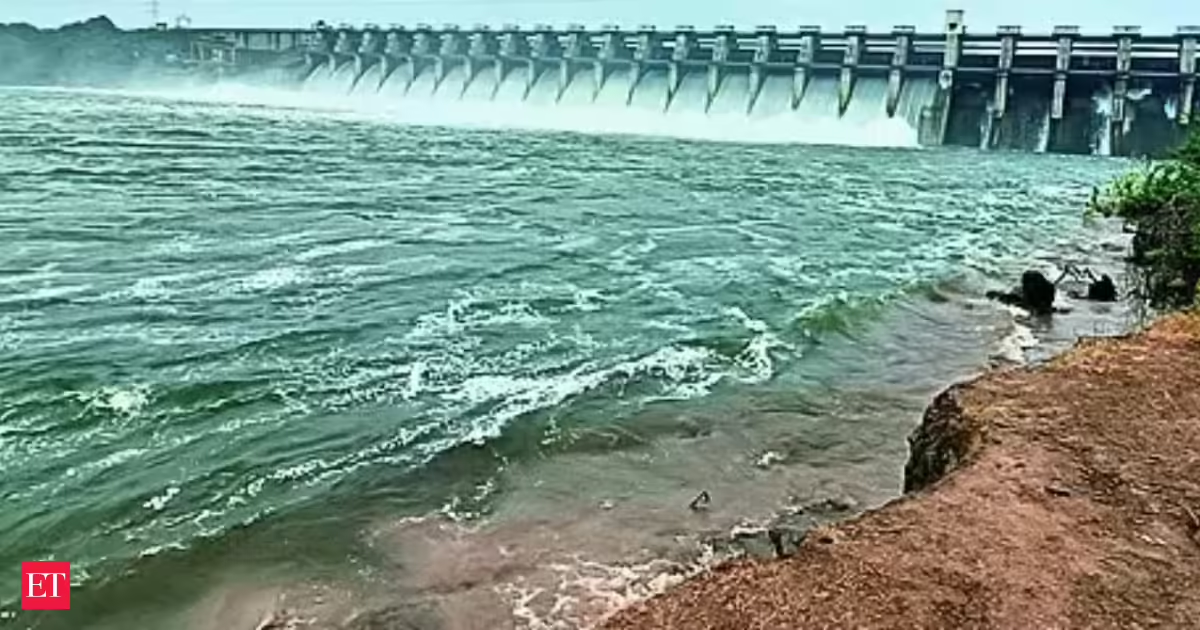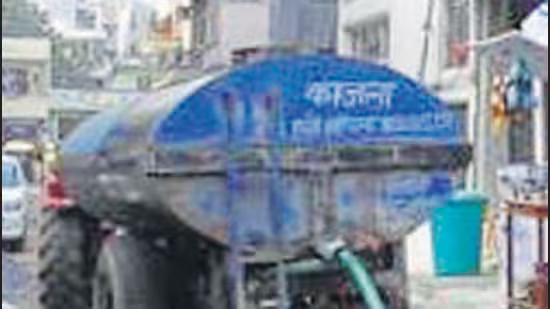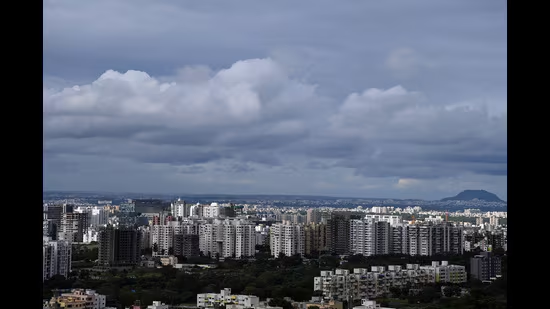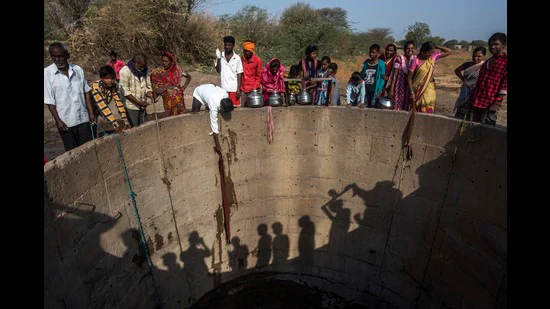
Even as the southwest monsoon has been delayed this year, the state’s latest groundwater assessment presents a mixed picture. While more than half of Maharashtra’s talukas recorded an improvement in groundwater levels compared with the five-year average for May, nearly 47% continued to witness a decline, highlighting persistent water stress in several parts of the state.According to the Groundwater Surveys and Development Agency (GSDA), groundwater levels fell in 165 of the state’s 353 talukas, while 188 talukas recorded an increase. (REPRESENTATIVE PHOTO)According to the Groundwater Surveys and Development Agency (GSDA), groundwater levels fell in 165 of the state’s 353 talukas, while 188 talukas recorded an increase. The assessment, based on data from 3,920 observation wells and released in June for May 2026, found that despite an overall improvement in more talukas, groundwater stress remains uneven and regionally concentrated, particularly across parts of western Maharashtra.In the Pune region, groundwater conditions continue to show clear signs of stress. The region recorded 32 talukas affected, reflecting one of the highest concentrations of groundwater decline in the state. Within Pune district specifically, of the 13 talukas, 11 recorded a decline in groundwater levels compared to the five-year May average, while only 2 showed improvement.This indicates that most parts of the district are experiencing downward pressure on groundwater reserves, particularly in rapidly urbanising and peri-urban areas. Earlier assessments had already flagged Mulshi and Velhe talukas under mild stress, suggesting that certain pockets of the district remain consistently vulnerable. The situation is also reflected in increasing dependence on private water tankers in some fringe areas, pointing to growing demand-supply pressure on local groundwater sources.In the Nashik region, groundwater decline appears more widespread and uniform. The region recorded 37 talukas showing a fall in groundwater levels, the highest among all regions in the state. Unlike areas with mixed trends, Nashik reflects a consistent pattern of depletion across talukas, indicating broader regional stress rather than isolated pockets. This makes the region one of the most significantly affected zones in Maharashtra’s latest groundwater assessment.Statewide surveyStatewide, Maharashtra shows a mixed groundwater situation with both recovery and decline recorded across talukas, indicating uneven recharge patterns ahead of the delayed monsoon season. According to the GSDA assessment for May 2026 (released in June), groundwater levels declined in 165 out of 353 talukas, while a higher number of 188 talukas recorded an increase compared to the five-year May average.Among the 165 talukas showing decline, most cases were relatively moderate, with 149 talukas recording a fall of up to 1 metre. A further 14 talukas saw a decline between 1 and 2 metres, while 2 talukas recorded a sharper drop of 2 to 3 metres, including Khandala in Satara district and Kalamb in Dharashiv district. This indicates that while widespread, the intensity of decline is concentrated in a limited number of pockets.On the other hand, among the 188 talukas that showed improvement, 139 talukas recorded a rise of up to 1 metre, while 38 talukas saw an increase between 1 and 2 metres. Additionally, 7 talukas recorded a rise of 2 to 3 metres, and 3 talukas registered an improvement of more than 3 metres, suggesting that certain regions benefited from better local recharge conditions.Overall, the statewide data reflect a balanced yet uneven groundwater scenario, where improvements slightly outnumber declines, but significant stress pockets persist across several regions, particularly in urbanising and water-intensive belts.
Pune, Nashik among most affected as Maharashtra records mixed groundwater trend
In the Pune region, groundwater conditions continue to show clear signs of stress. The region recorded 32 talukas affected, reflecting one of the highest concentrations of groundwater decline in the state
560 words~3 min read