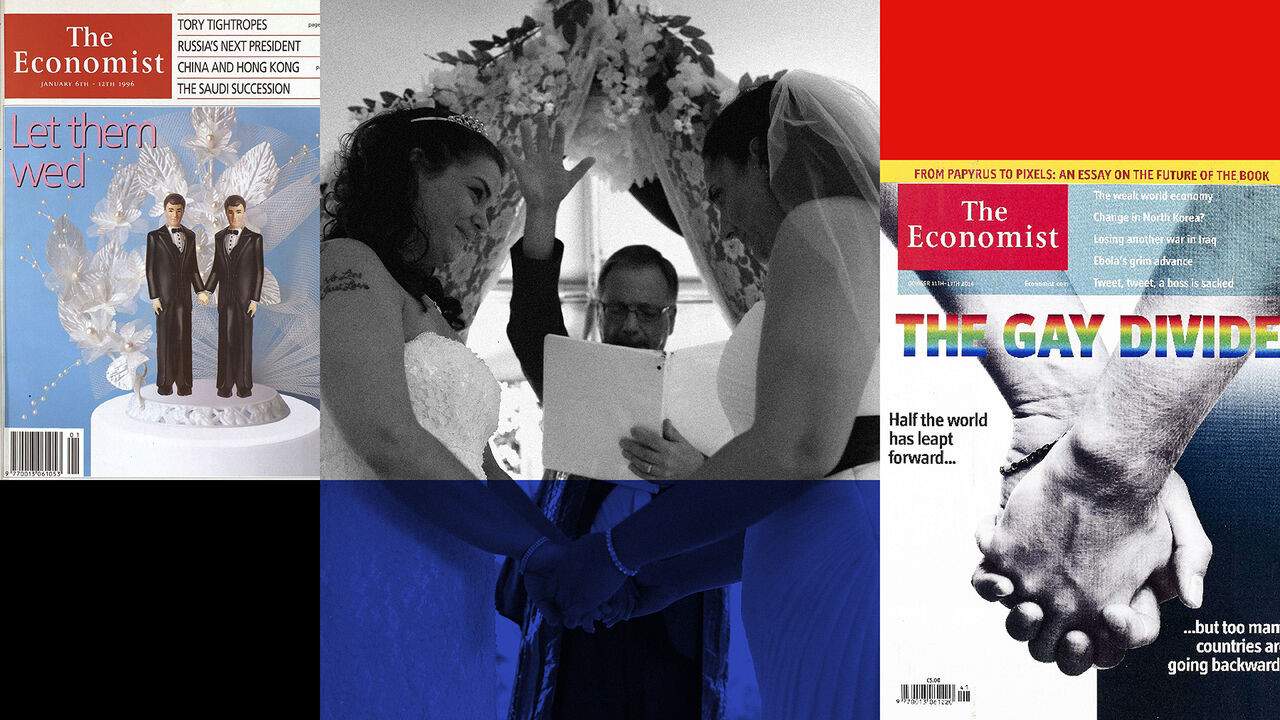
Jun 29th 2026 “Let them wed”, we declared in 1996, next to an image of two tuxedoed men holding hands on a wedding cake. The cover drew more hostile correspondence than any in The Economist’s history to that point. In an accompanying leader we urged governments around the world to legalise same-sex marriage, which at the time seemed like a far-fetched idea. Eight years later Massachusetts pioneered the recognition of gay marriage in America, but even then the cause seemed to be going nowhere. The move sparked a national backlash, with state after state rushing to enact legal bans. The marriage-equality movement was on “one of the most impressive losing streaks in American political history”, we wrote in a 2014 retrospective. “Marriage traditionalists crowed that the people would never accept a hare-brained idea foisted upon them by homosexual activists and their elitist friends. Rare and brave was the politician who supported gay marriage. Barack Obama opposed it in his 2008 presidential campaign, despite what he promised would be his ‘fierce advocacy’ of gay and lesbian equality.” But our report in 2014 was not an examination of America’s lack of progress on gay marriage. Rather, it was an account of how America came to embrace it. By then gay marriage enjoyed solid majority support—a change in popular opinion that no one on either side of the debate had foreseen. “In a country where public opinion on controversial social issues usually changes slowly (not until the mid-1990s did more than half of Americans approve of interracial marriage, according to Gallup, a pollster), one is hard pressed to think of any precedent,” we wrote. Public policy had also swung sharply. In 2012 Mr Obama renounced his opposition to gay marriage. After that it was approved by plebiscite in three states, and the one attempt to ban it failed. In 2013 the Supreme Court ordered the federal government to recognise these marriages, and a series of lower-court decisions brought gay marriage to state after state “like a string of firecrackers”. “No one doubts that, in due course, the entire country will join them. Opponents, feeling what had seemed like the most stable ground fall away beneath them, are scrambling for ways to change the subject. For homosexual Americans, it is not just a new era. It is a new country.” Our report was prompted by a Supreme Court decision not to hear a number of appeals against lower-court rulings that had upheld the right of gay couples to marry. The court thus cleared the way for marriage rights to spread across the country. We called it “a great victory” for supporters of gay marriage. But we also wanted to explain why the public’s view of gay marriage had evolved. “Social change so marked and rapid can come only from a confluence of causes, but the most important was probably a change in moral judgment,” we wrote. By 2013 nearly 60% of Americans had no moral problem with same-sex relations. As moral disapproval waned, support for same-sex marriage waxed. “Given that America, like most places, has viewed homosexuality as wicked since more or less the beginning of time, approval by a wide majority represents a watershed not just in contemporary politics but also in cultural history.” Why, then, the change in public morality? One reason, we argued, was a generational shift: the deaths of anti-gay traditionalists and the coming of age of people who saw homosexuality as a normal human variation. Another was the emergence of sexual minorities from the shadows into full public view. “In 1985, fewer than 25% of Americans told Gallup they had any friends, relatives or colleagues who were gay (see chart). The proportion rose steadily, to nearly 60%, through most of the 2000s—then it leapt in 2013 to 75%. The world of 1985 had been turned upside down. Today, it is odd not to have a gay person in your life; and what you know, you are unlikely to hate or fear. Given this, who would not want her friends and family members to enjoy the comfort and security of matrimony?” Gay America, too, had undergone a transformation. After we ran our cover in 1996, some gay activists were sceptical. They wanted the right to marry, but not to be rushed to embrace the institution. Their movement was about liberation from stifling sexual and social norms, they said. Why would gay people want to emulate straights for whom marriage is so often a failure or disappointment? By 2014, however, that view had faded: “Younger gay and lesbian people, if they are lucky enough to have grown up in contentedly married households, want the same for themselves and their children. Older gay men remember lacking the social and legal protections of marriage while caring for sick and dying partners during the AIDS plague, when it was common for caregivers to be excluded from the hospital rooms of those they had tended lovingly through years of suffering and decline. Gay people, ironically, have done exactly what religious conservatives long begged them to do: they have embraced ‘family values’.” At the end of that report in 2014 we did something unusual: we let the author share his own story. Growing up in Arizona in the 1960s and 70s, he fought desperately for years to deny that he was gay. He did not admit the obvious truth to himself until he was 25. As an Economist writer in 1996 he pitched the “Let them wed” cover, believing it to be a fanciful idea. Yet by the time he wrote our story in 2014 he was married to the man he loves. ■