Growing tissues can crack, break, and dissociate to form structures that can later withstand immense forces.
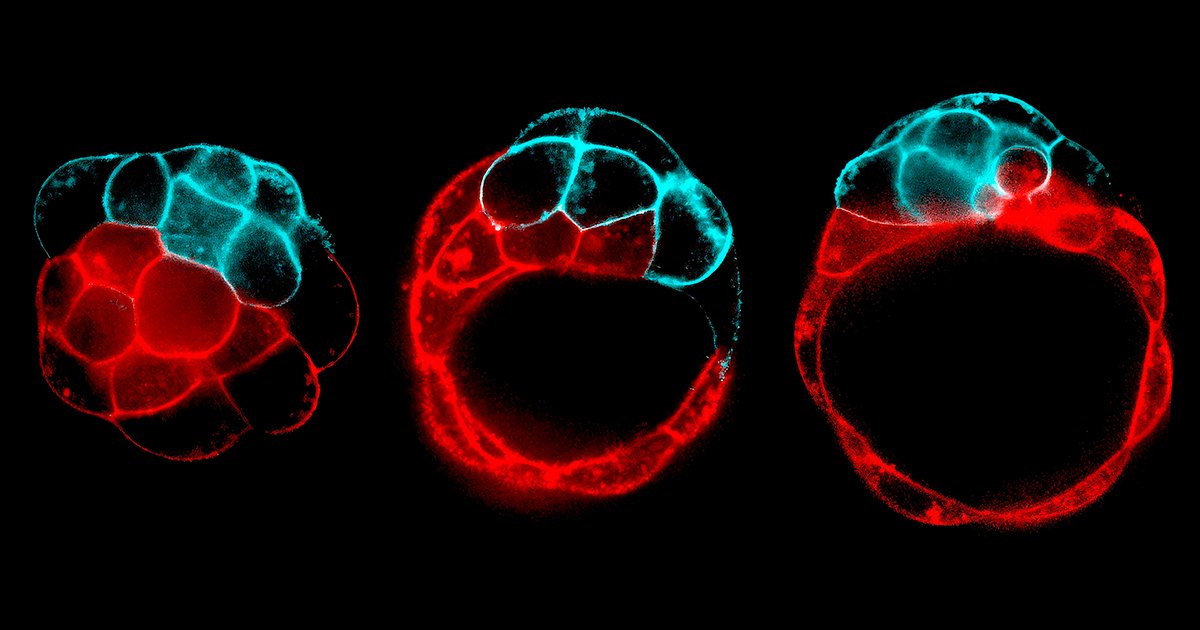
A fracturing process, shown here in stages, creates the cavity of a blastocyst, inside which an embryonic mouse will grow. The fluid inside follows the path of least resistance, preferentially breaking contacts between weaker (red) over tenser (blue) cells.
Jean-Léon Maître
There’s a moment, just before the tight mass of cells that is a developing mouse embryo implants itself in the womb, that it all comes apart.
Hundreds of tiny fluid-filled bubbles expand between each of the orb’s few dozen cells. The bubbles grow and press outward on cell membranes — and then, in a moment of fracture, pry them apart. Thin protein strands tether the cells together as the dissociated embryo floats. Over the course of a few hours, the smaller bubbles empty into larger ones, until the fluid coalesces into a single cavity. With this defining feature, the zygote becomes a blastocyst, ready to embed itself in the lining of the uterus. And inside this hollow ball of cells, reshaped by fracture, a fetus will grow.