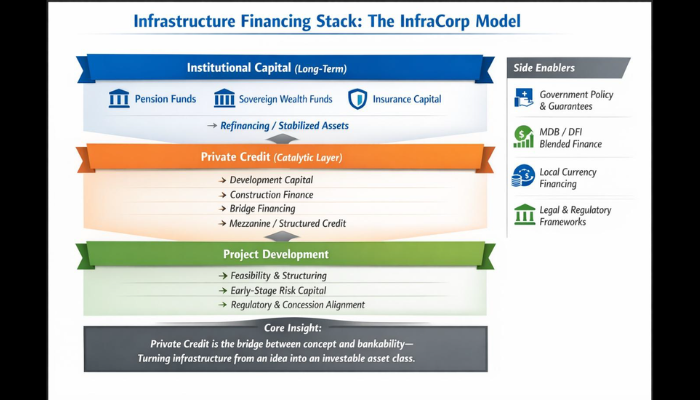
At this year’s Berlin Global Infrastructure Summit, one theme dominated both formal panels and private conversations: private credit is no longer a niche allocation—it is becoming a core pillar of infrastructure finance.
In mature markets, this shift has been both rapid and consequential. Over the past decade, private credit has grown into a multi-trillion-dollar asset class, driven by three structural forces. First, post-2008 banking regulation constrained traditional lenders’ ability to hold long-dated and higher-risk assets on their balance sheets. Second, a prolonged low-interest-rate environment pushed institutional investors, pension funds, insurers, and sovereign wealth funds, to seek higher-yielding alternatives. Third, borrowers increasingly turned to private markets for speed, flexibility, and certainty of execution, particularly in volatile public markets.
The result is a profound reconfiguration of credit intermediation. Private credit now sits at the intersection of opportunity and concern. It is praised for filling financing gaps and enabling complex transactions. Yet regulators increasingly question its opacity, interconnectedness with the banking system, and resilience under stress.