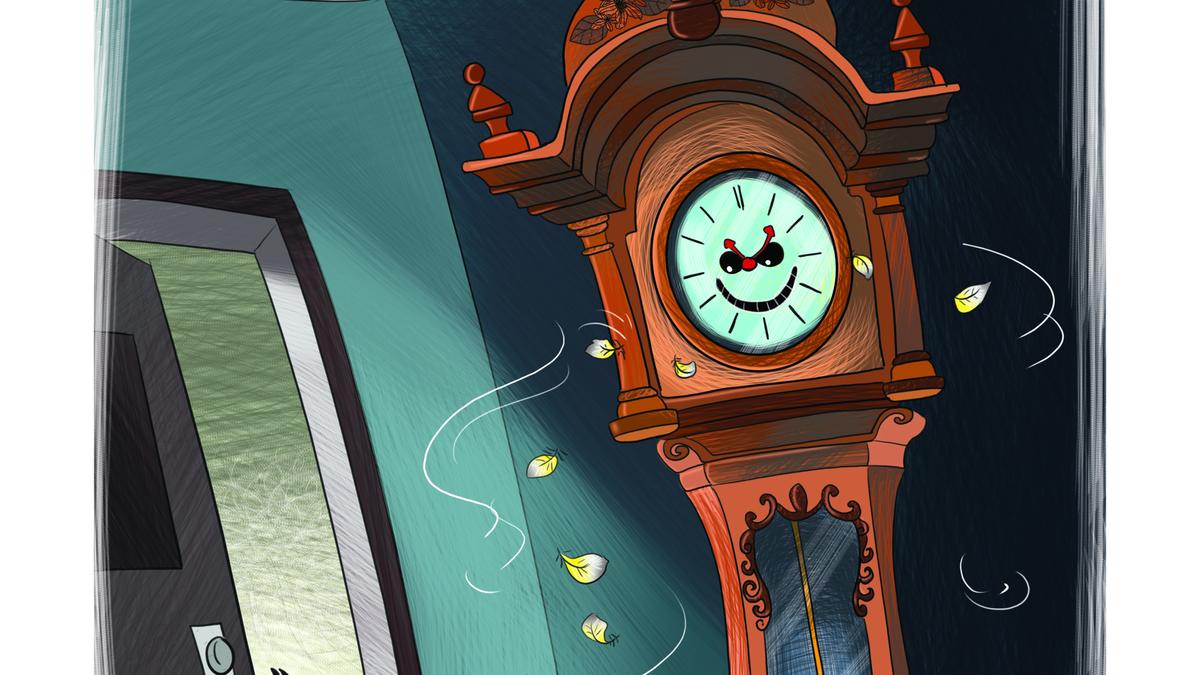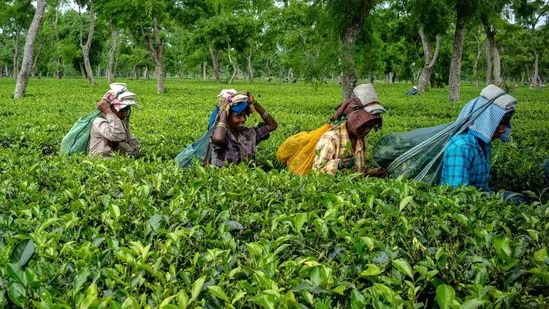
Let me take you back to the 1990s. To a tea garden in Jorhat, Assam. It is early morning. The mist is still lingering over the bushes. And the workers are already heading to the fields. Not because they woke up unusually early. But because in this tea garden — it is already one hour later than the rest of India.Assam Tea Garden (Bloomberg/ Representative Image)Here is something most people outside Assam do not know. India has one time zone. But Assam's tea gardens had two. One was Indian Standard Time (IST). The other was called Bagan Time. Garden Time. A clock set one hour ahead of India by the British colonisers — to squeeze more daylight out of the workers — and simply left behind after Independence. Think about that for a moment. In 1947, we got freedom. We tore down the empire. We wrote a new Constitution. We became a Republic. But in the tea gardens of Assam, the British clock kept ticking. Nobody thought to reset it.The workers in these gardens are not strangers to being forgotten. Their ancestors were brought from Jharkhand, Odisha, and Chhattisgarh by the British — walked across states, settled in a land that was not their homeland, told to pluck leaves that would be shipped to London and poured into teacups in England every morning. After Independence, they stayed. They became Indian citizens. They voted in every election. They paid taxes. They sent their children to school when they could afford to. But there is something else from those years that I cannot forget. The women who worked in the gardens — many of them had young children. Babies. One year old. Two years old. There was no childcare. There was no creche. There was no government scheme that had found its way into the rows between the tea bushes. So, they would do something that has stayed with me for the rest of my life. They would take a piece of cloth. Tie it to the branch of a tree. Place their baby inside — gently — like a small hammock. Hanging there. Under the Assam sky. And go back to work.Their baby would hang there while they earned wages that ranked among the lowest in the country. While the tea they plucked would travel thousands of miles and sit on shelves in some of the most expensive shops in the world. I was a child when I saw this. I did not have the words for it then. But I understood one thing. These people were not on the edges of India. They were at the centre of a global industry. Their labour built something the whole world consumed every morning. And yet — in every important conversation about India — they were simply not there.India loves to talk about its diversity. We celebrate it. We put it in tourism brochures and school textbooks and political speeches. But diversity is not the same as inclusion. Knowing that 126 communities exist is not the same as actually listening to what 126 communities have to say. We have become very good at acknowledging the existence of India's invisible people. We are far less good at hearing them. The tea garden workers of Assam are a perfect example of this contradiction. They are counted in census data. They appear in election statistics. Political parties court their votes every five years with promises that arrive punctually and disappear just as punctually after results day. But their daily reality — the wages, the health care, the children, the schools, the roads, the sense of whether their life is actually getting better — this rarely entered the mainstream conversation. For decades, it didn't.Something shifted after 2014. Not dramatically. Not overnight. Not in ways that make for easy headlines. But if you visit the tea garden areas of Assam today and talk to people — really talk to them, not as voters but as people — you notice things that were not there before. Roads that now reach further than they used to. Gas cylinders in homes that previously cooked on firewood. Bank accounts that exist where there were none. Mobile phones with data connections in the hands of women who would once have had no way to access any government service without travelling hours to a town.Schemes like Jan Dhan, Ujjwala, and Ayushman Bharat were not designed specifically for tea garden workers. But they reached them. Imperfectly, unevenly, with the usual gaps that come with implementation at scale — but they reached. The baby hammock tied to the tree branch is harder to find today. That does not mean it has disappeared everywhere. But it is harder to find. Something has moved. It would be too much to call it transformation. The wages are still a subject of long-running disputes. The healthcare infrastructure is still uneven. The political representation is still far from what the numbers deserve. But the direction has changed. And for communities that spent decades watching their situation stay exactly where it was — direction matters. It matters enormously.There is a particular kind of silence that comes from being ignored for long enough.It is not the silence of someone who has nothing to say. It is the silence of someone who has learnt that saying it makes no difference. I grew up seeing that silence. In the tea gardens. In the river islands of Assam where flooding came every year and the response from the outside world arrived sometime after the water receded. In villages where people lived lives of extraordinary complexity that mainland India had neither the patience nor the curiosity to understand.The Northeast of India is many things. But in the national imagination, it was mostly a place that got mentioned around election time and forgotten in between. That too is changing. Slowly. The connectivity — roads, rail, air — that is coming to Northeast India in the last decade is not just infrastructure. It is acknowledgement. It is the State saying: you are part of this. You are not an afterthought. Again — it is not enough. And saying things are better than they were is not the same as saying they are where they should be. But there is a difference between a government that forgets you exist and one that at least keeps trying to find you. Even imperfectly. Even incompletely. That difference is felt on the ground in ways that do not always make it into the national conversation.Here is what I keep coming back to. The tea garden workers of Assam lived for decades on a clock the British set. Long after the empire ended, their time was still being kept by a system built for someone else's convenience. A system that was never designed with their comfort or dignity in mind. A system that simply continued because changing it required someone to decide it mattered enough to change. This is, if you think about it, a near-perfect metaphor for the larger situation. Independent India inherited many clocks from the British. Some of them we reset immediately. Some we are still working on. And some — like the clock in the tea garden — we forgot to look at for a very long time. The workers did not forget. They lived by it every day. We just did not notice.The women who tied their babies to tree branches in the 1990s were not doing it because they did not love their children. They were doing it because they had no choice — and because nobody in a position to give them a choice was paying close enough attention. That is not a failure of the heart. It is a failure of systems. Systems that were built for a certain kind of Indian — urban, educated, connected, loud enough to be heard — and that quietly left everyone else to manage on their own. Progress is not the same as arrival. And for many of these communities, arrival still feels like something coming rather than something here. But at least now someone seems to know the address.I do not have a neat solution to offer. What I have is a memory. Of mist over tea bushes. Of a baby in a cloth hammock tied to a branch. Of workers living on a time that was never theirs to begin with. And a question that I think deserves to be asked more often than it is. How many clocks are we still not resetting? Some of them, it seems, we have finally started to look at. That is not nothing. That is, in fact, everything — if you are the one who has been waiting.(The views expressed are personal)This article is authored by Nitesh Pandey, founder, genius30.org and an entrepreneur.
The clock nobody reset
This article is authored by Nitesh Pandey, founder, genius30.org and an entrepreneur.
1,462 words~7 min read