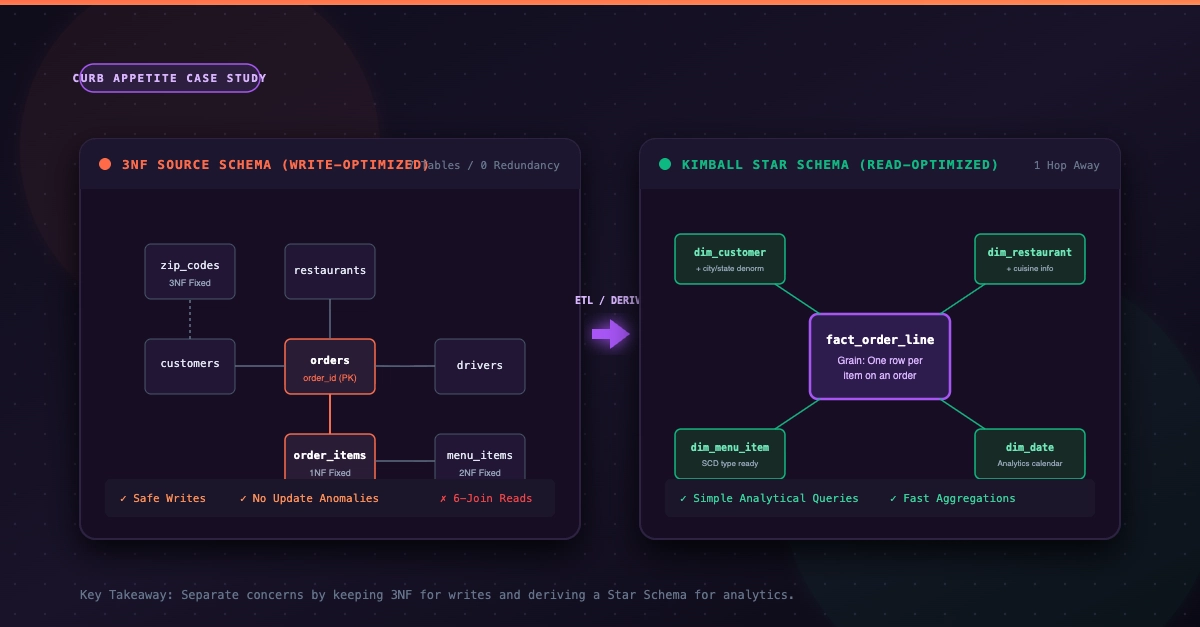
Denormalization has been the standard approach to analytical data modeling for good reason. Moving joins, lookups, and business rules out of query time and into ingestion gives you the fastest possible reads for a known access pattern. For most of the past decade, it was often the practical default for latency-sensitive analytics. Earlier columnar engines and distributed query processors could execute joins, but many workloads paid for them through higher latency, higher compute cost, spill-to-disk, or distributed coordination overhead.
That constraint has loosened. Modern columnar databases with advanced join algorithms have reduced the cost of runtime joins enough that normalization is now a genuinely viable option for many analytical workloads. Denormalization still delivers faster reads, but normalization can bring operational benefits: simpler pipelines, flexible schemas, and cleaner governance. Engineers can now make the decision based on their actual workload characteristics, rather than being forced into one approach by engine limitations.
This guide is a decision framework for making that choice in ClickHouse. It starts with why denormalization became the default, explains what has changed in join performance, then compares the tradeoffs on both sides so you can decide where to denormalize, where to join, and where to use ClickHouse primitives that bridge the gap.