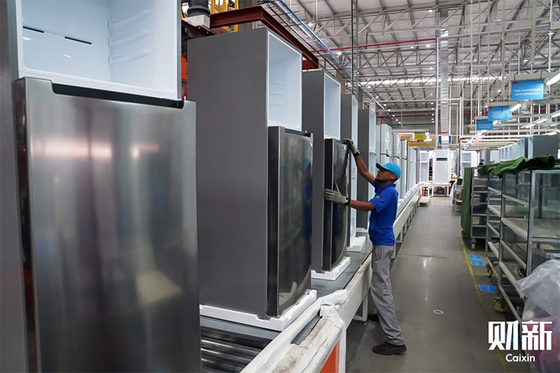
Brazil’s home appliance market is experiencing heightened competition as both new and established players – particularly Chinese brands – increase investment and expand operations in the country. The influx of entrants is creating new dynamics in a market traditionally dominated by a limited number of companies. Felipe Costa, CEO of Midea Carrier Argentina, Brazil and Chile, notes that Chinese and local brands are building factories, contributing to the intensifying competition [para. 1][para. 2]. Major Chinese manufacturers like Gree, TCL, and Haier have a strong presence, with localized production and sales networks. They compete with longstanding global leaders like Samsung and LG, especially in the air conditioner segment, which has become a particularly contested category. Costa highlights that competition with over 20 players has driven improvements and innovations within the industry [para. 3][para. 4][para. 5].The growth of e-commerce has further fueled rivalry, especially during the pandemic when online sales of air conditioners surged from about 40% penetration pre-pandemic to 60% at the peak [para. 6]. Midea ranks third overall among home appliance makers in Brazil, leveraging its presence since 2007 to build manufacturing, brand experience, and consumer understanding. Despite its strong position, opportunities remain for growth across specific categories due to Brazil’s large and diverse consumer base [para. 7]. Residential air conditioners, refrigerators, and washing machines present the highest growth potential. Air conditioner penetration lags behind other Latin American markets, while washing machine adoption is lower than that of refrigerators, which are seeing high demand due to a replacement cycle [para. 8][para. 9].Brazil is the Americas’ second-largest home appliance market by volume, behind only the U.S., and consistently ranks among the world’s top five to ten for major categories [para. 10]. Success in Brazil, Costa asserts, is essential for global appliance companies [para. 11]. However, replicating global strategies without local adaptation often leads to failure. Product localization and a deep understanding of Brazilian consumer habits are crucial. Design and user-friendliness matter, as does responding to regional needs—for example, Midea launched an air conditioner and humidifier combo in 2025 for drier regions where standard ACs are unpopular [para. 12][para. 13][para. 14].Chinese brands have shifted their reputation in Brazil from “cheap” products to being seen as technological and innovative [para. 15]. Midea initially focused on building a comprehensive product portfolio before scaling up brand marketing efforts around 2019-2020 [para. 16]. Targeting the high-end market first, such as washer-dryer combos, helped establish credibility before moving into mass-market segments [para. 17]. The company has increased visibility through sports sponsorships including the CBF, CONMEBOL tournaments, and FC Barcelona partnership, activities that have doubled brand awareness [para. 18][para. 19][para. 20][para. 21][para. 22][para. 23].Local manufacturing is almost essential given Brazil’s high tariffs and mature supply chain [para. 24]. Midea produces most mainstream products domestically, and in December 2024 opened a new $99 million factory in Pouso Alegre with a capacity of over 1 million units annually—the largest sector investment in a decade. Additional investments have expanded logistics and production capabilities in Minas Gerais and complemented existing factories in Manaus and Canoas [para. 25][para. 26][para. 27]. The company’s hybrid operating model combines wholly owned factories with joint ventures to access local knowledge while integrating global expertise [para. 28][para. 29]. Midea is leveraging these strengths to expand elsewhere in Latin America, capitalizing on its experience and product line in the region [para. 30].AI generated, for reference only
Midea Steps Up Brazil Push With Local Factories, Football Sponsorships
As competition intensifies, companies like Midea are betting on local manufacturing, design and branding to win over consumers in Latin America’s biggest market
557 words~3 min read